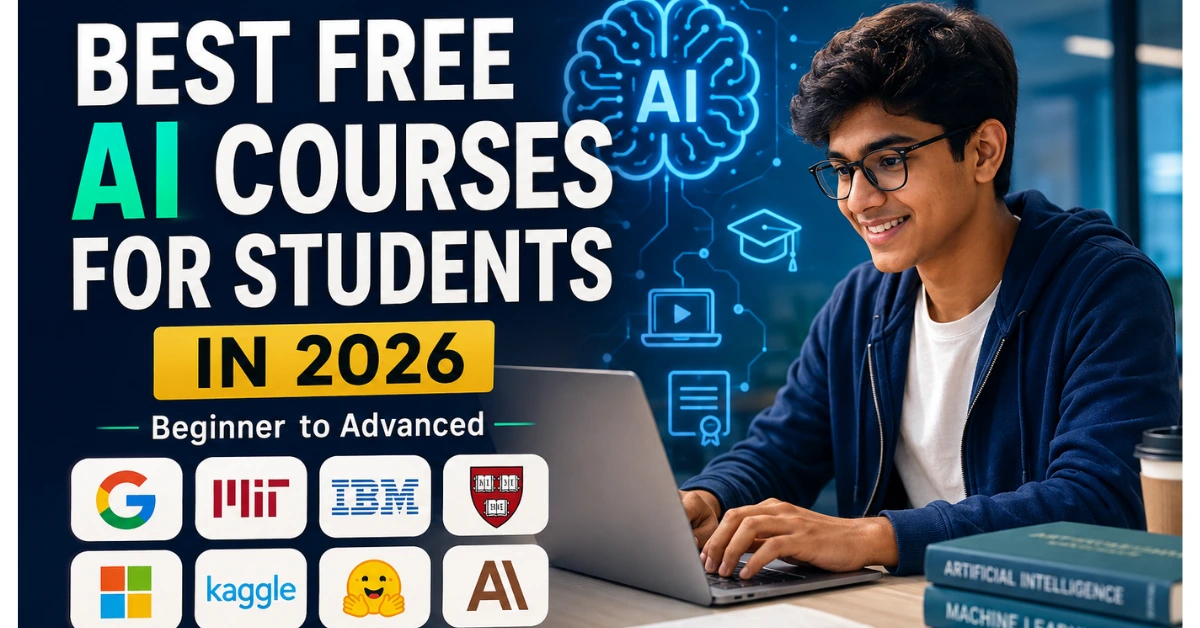
Best Free AI Courses for Students in 2026 (Beginner to Advanced)

Best AI courses for students in 2026

A few years ago, learning AI properly meant either paying for an expensive bootcamp or hoping your college had a professor who kept up with the field. Neither of those was ever guaranteed for a student outside a metro city. That’s changed faster than almost anyone expected. Google, Microsoft, Harvard, MIT, IBM, Anthropic, and a handful of nonprofits have all put out genuinely good, free AI courses, and most of them don’t need a coaching centre, a laptop with a GPU, or a bank account with room in it. This guide walks through ten of the best free AI courses available right now, sorted from complete-beginner to fairly advanced. Every course here was checked for what it actually teaches, how long it really takes, and whether the certificate is free or has a catch — because “free course” and “free certificate” are two different promises, and a lot of roundups blur that line. Also read: The Complete Guide to Studying With AI: 25 Practical Ways for Students (2026) Why Every Student Should Learn AI in 2026 The honest answer is that AI has stopped being a specialised skill and started being a baseline one, the way spreadsheets or basic English typing became baseline skills a generation ago. Job postings across fields that have nothing to do with computer science now casually mention “comfort with AI tools.” Boards like CBSE have been steadily working AI and data literacy into the curriculum, and most competitive exam aspirants — JEE, UPSC, CA, whatever the target — are already using AI tools for revision even if nobody formally taught them how.What makes this moment genuinely different for students in Tier 2 and Tier 3 cities is that the gap that used to separate a Delhi or Bangalore student from everyone else is shrinking. A CBSE student in a small town with a decent internet connection can now sit through the same Harvard AI lectures, learn from the same fast.ai instructors that alumni credit with landing jobs at Google Brain and Tesla, and go through the same Google training that a student in a metro coaching hub gets — for the same zero rupees. That access simply didn’t exist five years ago, and it’s the reason this list is worth taking seriously. Also Read: Best AI Tutors for CBSE Students (2026): 7 Smart Tools for Smarter Learning How We Selected These AI Courses Every course on this list had to clear four filters. First, it had to be genuinely free to learn from — not a “free trial” that locks you out after a week. Second, wherever a certificate exists, we checked whether it’s actually free or whether “free course” secretly means “pay for the piece of paper,” and we’ve said so honestly in each entry. Third, the content had to be current enough for 2026 — AI moves fast, and a course still teaching 2019-era chatbots isn’t doing anyone favours. Fourth, we leaned toward providers with a real track record: universities, the companies building the AI tools themselves, and platforms with millions of completed enrolments, rather than random creator-made courses that vanish in a year. 10 Best Free AI Courses for Students These are ordered roughly from “no experience needed” to “bring your coding shoes.” You don’t need to do them in sequence — pick the one that matches where you are right now. 1. YUVA AI for ALL (Government of India) If you are an Indian student starting from zero, this is an absolute hidden gem. Launched by MeitY, this course explains AI using relatable, everyday Indian examples. It’s perfect for school students or anyone who feels overwhelmed by heavy tech jargon. Best for: Absolute beginners and school students. Difficulty: Very Easy Duration: ~4.5 hours Certificate: Yes, a completely free, official government certificate. 2. Google AI Essentials This is the most sensible starting point if you’ve never touched an AI tool with intention before. It’s built by Google’s own AI trainers and focuses entirely on practical use: writing prompts, using generative AI for real tasks, and knowing when to trust (or not trust) an AI’s output. Aspect Details Best for Absolute beginners, non-technical students Difficulty Beginner Duration ~5–10 hours, self-paced Certificate Learning is free; the Google certificate usually requires Coursera’s paid tier, though Google.org occasionally sponsors free-certificate access through partner programs What you’ll learn Prompt writing, using Gemini and similar tools responsibly, picking the right AI tool for a task Pros: No coding, no jargon, genuinely practical exercises, backed directly by Google. Cons: The free certificate isn’t guaranteed unless you catch a sponsored access window; content stays surface-level by design. 3. Elements of AI (University of Helsinki) Built by the University of Helsinki and MinnaLearn, this is the closest thing the internet has to a proper “AI 101” taught the way a good university would teach it — except every part of it, including the certificate, is free. No hidden Coursera-style paywall anywhere. Aspect Details Best for Beginners who want real conceptual grounding, not just tool tips Difficulty Beginner Duration ~25–30 hours across the core course, self-paced Certificate Completely free (LinkedIn-shareable); Finnish learners can also earn university credit What you’ll learn What AI actually is, machine learning basics, neural networks, the societal impact of AI It’s one of two courses on this list — Google AI Essentials is the other — that comes up again and again when non-technical beginners ask Reddit’s ML communities where to actually start, specifically because there’s no fine print about the certificate later. The trade-off is format: it’s almost entirely reading-based with very little video, which suits some students and bores others. 4. AI For Everyone (DeepLearning.AI) Taught by Andrew Ng — the person who arguably did more than anyone to make online AI education mainstream — this course skips the math entirely and focuses on how AI actually gets used in organisations and where its limits are. Aspect Details Best for Students who want to understand AI strategy and limitations, not just tool usage Difficulty Beginner … Read more

How to Use AI to Remember Social Science Dates and Historical Events Easily (CBSE Guide)

How to Use AI to Remember Social Science Dates

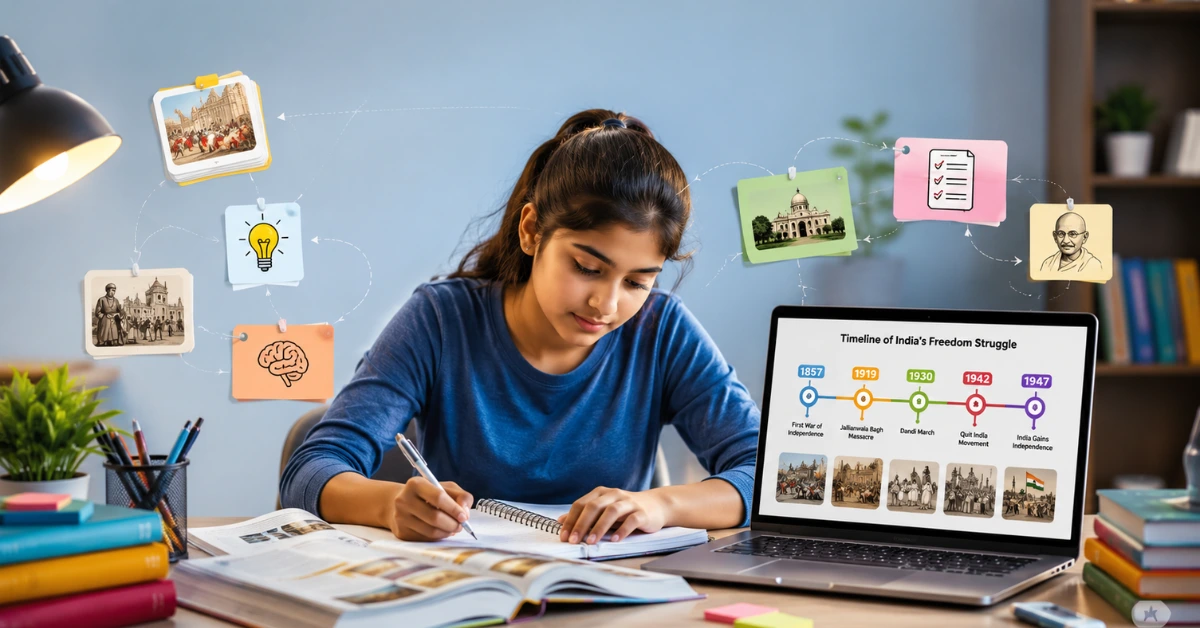
If you are wondering how to remember History dates with AI, you are not alone. It’s a familiar moment during every Social Science exam. You understand the chapter perfectly and can explain the event in your own words — but the moment you write the year, your mind goes blank. Was Jallianwala Bagh in 1919 or 1920? One forgotten date can cost marks, even when your understanding is spot on. The problem isn’t that History is hard. It’s how most of us try to learn it — reading the same dates again and again, underlining them in different colours, hoping repetition will make them stick. It rarely does. The brain remembers stories, patterns and connections far better than isolated numbers. This is where AI can become more than just an answer machine. Most students use tools like ChatGPT or Gemini only to get summaries — but used the right way, AI can turn confusing timelines into simple stories, build personalised memory tricks, and generate flashcards and quizzes that make dates genuinely easy to remember. This guide isn’t about shortcuts. It’s about using AI as a memory coach — one that helps you understand an event first, so the date sticks naturally. If you’re preparing for CBSE Class 9 or 10 boards, these methods can make your Social Science revision far more organised, and a lot less stressful. These strategies aren’t just for History; they are cross-disciplinary tools you can apply to Geography facts, Political Science amendments, or Economic milestones. Also Read: Best AI Tutors for CBSE Students (2026): 7 Smart Tools for Smarter Learning See the Method in Action: From Jallianwala Bagh (1919) to the Revolt of 1857 Instead of just telling you to “ask AI for a story,” here’s what that actually looks like. The story version: On Baisakhi day, a crowd gathers peacefully in a walled garden in Amritsar to protest new British laws. General Dyer blocks the only exit and orders his soldiers to fire, without warning, into the unarmed crowd. Hundreds die. The massacre turns Indian public opinion firmly against British rule and pushes leaders like Gandhi toward mass movements. The memory trick: Baisakhi (spring, new beginnings) turning into bloodshed is the twist that makes 1919 memorable — a peaceful festival gathering meeting the harshest British response yet. The flashcard: Front — “Jallianwala Bagh.” Back — “1919, Amritsar, Dyer, turning point against British rule.” The quiz question: “What festival was being marked when the Jallianwala Bagh massacre happened?” This one detail anchors the date in your memory far better than the number alone. Once you see how one event breaks down this way, you can run any other event — the Revolt of 1857, the Quit India Movement of 1942, the Non-Cooperation Movement — through the exact same four steps: story, trick, flashcard, quiz. One More Example: The Revolt of 1857 The same approach works for every major event in your syllabus. Take the Revolt of 1857, for example. The story version: Indian soldiers, known as sepoys, were already unhappy with low salaries, poor treatment and growing British control. The introduction of the new Enfield rifle cartridges, believed to be greased with cow and pig fat, sparked widespread anger. What began as a military uprising soon spread across different parts of northern India and became one of the biggest challenges to British rule. The memory trick: Think of 1857 as the year when scattered anger finally turned into open rebellion. Instead of remembering only the number, connect it with the beginning of India’s first large-scale revolt against British rule. The flashcard: Front — Revolt of 1857Back — 1857 | Sepoy uprising | Beginning of the First War of Independence | Major challenge to British rule. The quiz question: What issue related to the Enfield rifle cartridges triggered the Revolt of 1857? Once you practise a few events this way, you will realise that remembering dates becomes much easier because every year is attached to a story, a reason and an important outcome—not just a number in your textbook. Also Read: Fear of Mathematics? How Indian Students Can Use AI to Understand Difficult Math Concepts Build the Timeline Before You Memorise the Dates One of the biggest mistakes students make is trying to memorise dates one by one. They begin highlighting years in the textbook without first understanding how those events are connected. A few days later, everything starts to feel mixed up because the brain is trying to remember isolated numbers instead of a sequence of events. Before you focus on individual dates, spend a few minutes understanding the timeline of the entire chapter. Once you know what happened first, what happened next, and why one event led to another, remembering the years becomes much easier. Instead of memorising ten separate facts, your brain remembers one continuous story. This is where AI can save a lot of time. Rather than reading the chapter repeatedly and creating your own timeline, you can ask ChatGPT or Gemini to organise the entire chapter into a simple year-wise sequence. Make sure the timeline is easy to read and includes only the most important events so that you are not overwhelmed with unnecessary details. Try this prompt: Create a simple year-wise timeline of the CBSE Class 10 History chapter “Nationalism in India”. Include only the most important events in chronological order. Explain each event in one simple sentence that a Class 10 student can easily understand. Once the timeline is ready, read it from top to bottom two or three times. You will notice that the dates no longer feel random. They become milestones in a journey, making them much easier to recall during revision and in the examination hall. Also Read: The End of the Guess Paper: How AI is Predicting Board Exams in 2026 Let AI Create Memory Tricks That Actually Work Some dates refuse to stay in your memory no matter how many times you read them. If that happens, the problem is not your memory—it is … Read more

Help Your Child Write Better English: Simple Educational Tools That Actually Work (Teacher’s Guide for Indian Parents)

Parent supporting a young child while practicing English writing at home using simple learning tools.

“Sir, padhna toh theek ho gaya hai, par likhne mein bahut problem hoti hai.”

I hear this from parents very often. And honestly, it makes sense.

Reading is recognising words. Writing is creating them. Writing needs spelling, sentence order, and confidence — all at the same time. That’s why many children who read reasonably well still avoid writing.

AI Literacy 101: How to Teach AI to Students (A Practical Classroom Guide for 2026)

AI Literacy 101: How to Teach AI to Students (A Practical Classroom Guide for 2025)

AI literacy is the ability to understand what Artificial Intelligence is, how it works, how to use it responsibly, and how to think critically about its outputs. In 2026, it is as foundational as reading comprehension or mathematical reasoning — students who lack it are navigating a world they can’t fully see or evaluate. This guide gives every teacher a practical, grade-by-grade roadmap to build that literacy in their classroom — no technical background required.

Read more

From Chalkboards to Chatbots: The Evolution of Teaching with AI

AI chatbot

From chalkboards to chatbots, education has changed dramatically. A few decades ago, a classroom meant chalkboards, textbooks, and teachers writing notes while students copied everything into their notebooks. Today, that same classroom might include AI tutors, smartboards, chatbots, and students getting instant explanations with just a question.

The journey from chalkboards to chatbots isn’t just about new technology—it’s about how teaching itself has evolved. Every stage, from traditional classrooms to digital learning and now AI-powered education, has changed the way teachers teach and students learn.

Artificial Intelligence is no longer a futuristic idea. In 2026, many teachers use AI to create lesson plans, prepare quizzes, simplify complex topics, and reduce repetitive work. Students use AI tools to revise faster, practice difficult concepts, and receive personalized learning support whenever they need it.

In this article, we’ll explore how education has evolved over the years, what role AI is playing today, and why the future of teaching will likely combine the strengths of both technology and human educators.

Read more

From chalkboards to chatbots, education has changed dramatically. A few decades ago, a classroom meant chalkboards, textbooks, and teachers writing notes while students copied everything into their notebooks. Today, that same classroom might include AI tutors, smartboards, chatbots, and students getting instant explanations with just a question.

The journey from chalkboards to chatbots isn’t just about new technology—it’s about how teaching itself has evolved. Every stage, from traditional classrooms to digital learning and now AI-powered education, has changed the way teachers teach and students learn.

Artificial Intelligence is no longer a futuristic idea. In 2026, many teachers use AI to create lesson plans, prepare quizzes, simplify complex topics, and reduce repetitive work. Students use AI tools to revise faster, practice difficult concepts, and receive personalized learning support whenever they need it.

In this article, we’ll explore how education has evolved over the years, what role AI is playing today, and why the future of teaching will likely combine the strengths of both technology and human educators.

Read more

AI vs Human Grading: Which Is Fairer for Student Assessment?

AI vs Human Grading

In today’s classrooms, Artificial Intelligence is rapidly making its way into areas once considered purely human-driven. One major shift is in how students are graded. But as AI tools become more common, a big question arises: Can AI really grade students more fairly than human teachers? Or are there key elements of human judgment that machines still can’t replace?

Read more

AI-Powered Mental Wellness: Student Support in 2025

AI powered mental wellness

Introduction

“In 2025, AI-powered mental wellness tools are making a difference.

Imagine a high school girl in Ohio, sitting in class, her eyes glued to her desk. Moreover, she’s been super quiet lately, skipping lunch with her friends, and no one’s really noticed. Then, out of the blue, her counselor’s phone buzzes—an AI-powered mental wellness tool says she’s been fading away. Therefore, that little ping starts a talk with someone who can help, maybe even pulls her back from the edge. This isn’t some movie—it’s AI-powered mental wellness in action in schools across the USA. Meanwhile, on X, people in India are asking, ‘Can AI fix our mental health crisis?’ Well, we’re asking the same question here, and I think AI-powered mental wellness might just be the answer our kids need

Read more

AI Rewrites Neurodiverse Learning: What Schools Overlook

AI and neurodiversity

Introduction: The Quiet Revolution in Neurodiverse Classrooms

For years, students with neurodiverse conditions—such as autism, ADHD, dyslexia, and other learning differences—have struggled in traditional education systems that prioritize standardized methods of teaching. However, artificial intelligence (AI) is now revolutionizing how neurodiverse students learn, offering personalized, adaptive, and accessible education like never before. Despite these advancements, many schools are still lagging behind in implementing AI-powered solutions, leaving neurodiverse students underserved. So, how exactly is AI transforming neurodiverse learning, and what crucial aspects are schools missing?

Read more

AI in Early Childhood Education: Screen Time or Smart Time?

AI-in-Early-Childhood-Education-Screen-Time-or-Smart-Time

How Parents and Teachers Are Using AI to Turn Play into Learning

Introduction

AI in Early Childhood Education is no longer a futuristic concept—it’s happening now. In fact, from interactive learning apps to AI-powered storytelling tools, technology is reshaping how young children engage with education. However, does this innovation truly enhance learning, or is it just another form of screen time?”

Read more

Teachers Using AI Save 5 Hours a Week — Here’s How They’re Doing It

AI-Teachers-The-Future-of-Education

The surprising truth about AI in education: it’s making teachers more human, not less

The Tuesday Night That Almost Ended a Career

At 11 PM on a Tuesday, Maria Gonzalez — fifteen years into teaching English — stared at a stack of 120 ungraded essays and a cold mug of coffee. The house was quiet. For the third time that week, she was choosing between sleep and feedback. “I wrote my resignation letter that night,” Maria told me. “I loved my students, but I was drowning.” Six months later, Maria is still in the classroom — and thriving. An AI assistant now gives those essays a first pass in half an hour. The time she used to spend on repetitive work has shifted to one-on-one conferences, creative project design, and, for the first time in years, leaving by 4 PM. This is the quiet revolution spreading through schools. AI isn’t replacing teachers. It’s freeing them to do the work that matters.

Read more

Oh hi there 👋
It’s nice to meet you.

Subscribe & get your free AI Study Guide now — packed with tools, tips, and strategies to boost learning worldwide

We don’t spam! Read our privacy policy for more info.