The Complete Guide to Studying With AI: 25 Practical Ways for Students (2026)

The Complete Guide to Studying With AI

You’ve probably already done this: opened ChatGPT or Gemini at 11 PM, pasted in a question you didn’t understand in class, and gotten an answer in four seconds. It felt like magic. And then, a week later, the same topic showed up in a test — and you blanked. That gap between “AI gave me the answer” and “I actually know this” is where almost every student gets stuck. It’s also the one thing most AI-for-students articles never talk about. They’ll hand you a list of ten apps and call it a day. That’s exactly what this guide aims to fix. It’s built from three things: what students are actually saying on Reddit and YouTube, what’s genuinely new in AI tools as of 2026, andwhat I’ve observed while working with students every day at Akshaya Digital Library, where many of them already use ChatGPT, Gemini, and other AI tools for studying. Some of what follows will contradict the “just use AI for everything” advice you’ve read elsewhere. That’s intentional. The numbers show this isn’t just a trend. A national study of Indian households found that among students already using edtech, 69% who’ve adopted generative AI are using it daily — mostly to clear doubts (73%) and practice lessons. The demand is real. The question is whether it’s working for you or just making you feel productive. Also Read: Best AI Tutors for CBSE Students (2026): 7 Smart Tools for Smarter Learning Here are 25 ways to ensure AI actually builds your brain, rather than replacing it. Build Real Understanding, Not Just Get Answers Every AI tool will explain a concept to you. Almost none of them will check whether you actually got it — unless you set it up right. 1. Explain the topic back to AI, in your own words Don’t just read the AI’s explanation and move on. After it explains something, try explaining it back — as if you’re teaching a younger student. If you get stuck explaining any part, that’s exactly the part you don’t understand yet. This one habit teaches you more than reading the same page five times. Example Prompt: “I’m going to explain the human digestive system to you like you’re a curious 12-year-old. Stop me and ask ‘why’ whenever I use a term I haven’t defined or my logic skips a step. Don’t summarize for me — just question me until I can explain it cleanly.” Also Read: Fear of Mathematics? How Indian Students Can Use AI to Understand Difficult Math Concepts 2. Before starting a new chapter, ask what mistakes students usually make in it. Before diving into a new chapter, ask: “What are the 5 mistakes students usually make when they first learn [topic]?” This single question does more than a full re-read, because it tells you exactly where the traps are before you fall into them — a trick almost nobody outside a handful of Reddit study threads is talking about yet. 3. Turn on Guided Learning — don’t just chat normally. ChatGPT’s Study Mode, Gemini’s Guided Learning, and Claude’s Learning Mode are recent additions (all free, on the free tier) that most students still don’t know exist. Instead of handing you the answer, they ask guiding questions first — closer to a real tutor than a search engine. Turn this on specifically for topics you’re learning for the first time, and switch it off for quick fact-checks where you genuinely just need a definition. 4. Ask for the same concept explained three different ways. One explanation doesn’t work for everyone. Ask AI to explain a concept once with a real-life example, once step by step, and once as something you could draw as a picture or diagram. Whichever one makes it click for you — that’s how you learn best. 5. Ask for an Indian, everyday example — not a foreign one. AI often gives examples from American life that don’t make sense to us. Just add: “Give me an example from Indian daily life, not from abroad.” A topic like probability or economics becomes far easier with an example from a train ticket line or a local market instead of Wall Street. Also Read: Google NotebookLM + Notion AI: A Complete AI Study System for Students (Build Your Second Brain) Get Doubts Cleared Without Waiting for Class This is the single biggest reason students reach for AI, according to national survey data — not cheating, doubt-clearing. Here’s how to do it properly. 6. Voice-note your doubt instead of typing it. If your doubt is messy — half in Hindi, half in English, and you’re not sure how to phrase it — just talk. Use the voice input on ChatGPT, Gemini, or Meta AI and explain your confusion exactly as it sounds in your head. You’ll get a much more useful answer than a stiff, over-typed query, and it removes the friction that stops most students from asking at all. 7. When you photograph a question, always ask “why,” not just “what. Snapping a photo of a textbook question is old news. The mistake most students make is stopping at the final answer. Add this every time: “Don’t just give me the answer — show me the exact step where a student is most likely to go wrong.” That one line turns a copy-paste habit into an actual learning moment. 8. Practice Competency-Based Questions (CBQs) specifically. For CBSE students in 2026, this is critical. CBQs now make up 50% of the Class 10 and 12 board papers. Most AI tools default to basic Q&A. Try: “Convert this NCERT concept into a CBSE-style competency-based question with a real-world scenario, the way it would appear in a 2026 board paper.” 9. Cross-check every AI answer against your own textbook — always. General-purpose AI models are not trained specifically on NCERT or your state board’s textbook, and they will occasionally give a technically-correct-but-wrong-for-your-syllabus answer, or simply hallucinate a fact with total confidence. Build this habit: ask the AI, “Which NCERT … Read more

How to Use AI to Remember Social Science Dates and Historical Events Easily (CBSE Guide)

How to Use AI to Remember Social Science Dates

If you are wondering how to remember History dates with AI, you are not alone. It’s a familiar moment during every Social Science exam. You understand the chapter perfectly and can explain the event in your own words — but the moment you write the year, your mind goes blank. Was Jallianwala Bagh in 1919 or 1920? One forgotten date can cost marks, even when your understanding is spot on. The problem isn’t that History is hard. It’s how most of us try to learn it — reading the same dates again and again, underlining them in different colours, hoping repetition will make them stick. It rarely does. The brain remembers stories, patterns and connections far better than isolated numbers. This is where AI can become more than just an answer machine. Most students use tools like ChatGPT or Gemini only to get summaries — but used the right way, AI can turn confusing timelines into simple stories, build personalised memory tricks, and generate flashcards and quizzes that make dates genuinely easy to remember. This guide isn’t about shortcuts. It’s about using AI as a memory coach — one that helps you understand an event first, so the date sticks naturally. If you’re preparing for CBSE Class 9 or 10 boards, these methods can make your Social Science revision far more organised, and a lot less stressful. These strategies aren’t just for History; they are cross-disciplinary tools you can apply to Geography facts, Political Science amendments, or Economic milestones. Also Read: Best AI Tutors for CBSE Students (2026): 7 Smart Tools for Smarter Learning See the Method in Action: From Jallianwala Bagh (1919) to the Revolt of 1857 Instead of just telling you to “ask AI for a story,” here’s what that actually looks like. The story version: On Baisakhi day, a crowd gathers peacefully in a walled garden in Amritsar to protest new British laws. General Dyer blocks the only exit and orders his soldiers to fire, without warning, into the unarmed crowd. Hundreds die. The massacre turns Indian public opinion firmly against British rule and pushes leaders like Gandhi toward mass movements. The memory trick: Baisakhi (spring, new beginnings) turning into bloodshed is the twist that makes 1919 memorable — a peaceful festival gathering meeting the harshest British response yet. The flashcard: Front — “Jallianwala Bagh.” Back — “1919, Amritsar, Dyer, turning point against British rule.” The quiz question: “What festival was being marked when the Jallianwala Bagh massacre happened?” This one detail anchors the date in your memory far better than the number alone. Once you see how one event breaks down this way, you can run any other event — the Revolt of 1857, the Quit India Movement of 1942, the Non-Cooperation Movement — through the exact same four steps: story, trick, flashcard, quiz. One More Example: The Revolt of 1857 The same approach works for every major event in your syllabus. Take the Revolt of 1857, for example. The story version: Indian soldiers, known as sepoys, were already unhappy with low salaries, poor treatment and growing British control. The introduction of the new Enfield rifle cartridges, believed to be greased with cow and pig fat, sparked widespread anger. What began as a military uprising soon spread across different parts of northern India and became one of the biggest challenges to British rule. The memory trick: Think of 1857 as the year when scattered anger finally turned into open rebellion. Instead of remembering only the number, connect it with the beginning of India’s first large-scale revolt against British rule. The flashcard: Front — Revolt of 1857Back — 1857 | Sepoy uprising | Beginning of the First War of Independence | Major challenge to British rule. The quiz question: What issue related to the Enfield rifle cartridges triggered the Revolt of 1857? Once you practise a few events this way, you will realise that remembering dates becomes much easier because every year is attached to a story, a reason and an important outcome—not just a number in your textbook. Also Read: Fear of Mathematics? How Indian Students Can Use AI to Understand Difficult Math Concepts Build the Timeline Before You Memorise the Dates One of the biggest mistakes students make is trying to memorise dates one by one. They begin highlighting years in the textbook without first understanding how those events are connected. A few days later, everything starts to feel mixed up because the brain is trying to remember isolated numbers instead of a sequence of events. Before you focus on individual dates, spend a few minutes understanding the timeline of the entire chapter. Once you know what happened first, what happened next, and why one event led to another, remembering the years becomes much easier. Instead of memorising ten separate facts, your brain remembers one continuous story. This is where AI can save a lot of time. Rather than reading the chapter repeatedly and creating your own timeline, you can ask ChatGPT or Gemini to organise the entire chapter into a simple year-wise sequence. Make sure the timeline is easy to read and includes only the most important events so that you are not overwhelmed with unnecessary details. Try this prompt: Create a simple year-wise timeline of the CBSE Class 10 History chapter “Nationalism in India”. Include only the most important events in chronological order. Explain each event in one simple sentence that a Class 10 student can easily understand. Once the timeline is ready, read it from top to bottom two or three times. You will notice that the dates no longer feel random. They become milestones in a journey, making them much easier to recall during revision and in the examination hall. Also Read: The End of the Guess Paper: How AI is Predicting Board Exams in 2026 Let AI Create Memory Tricks That Actually Work Some dates refuse to stay in your memory no matter how many times you read them. If that happens, the problem is not your memory—it is … Read more

The End of the Guess Paper: How AI is Predicting Board Exams in 2026

AI exam predication

There’s a very specific kind of panic that hits sometime in late January or early February. Your board exams are around six weeks away. Your syllabus is technically “done,” but nothing feels ready. So you do what every student in India has done for the last three decades — you ask someone for the guess paper.

Read more

Will AI Exam Prediction Be Banned in India? The Truth Students Need to Know

AI exam Prediction

Every year, as board exams and entrance tests like NEET and JEE approach, student panic is practically guaranteed. But lately, amidst all this pressure, a new question is dominating group chats:

“Which AI tool is the best for predicting this year’s questions?”

Maybe you—or someone you know—are already using an AI tool that analyzes past papers to guess what might appear in the exam. Millions of students are quietly turning to these smart tools to cope with immense academic pressure.

Read more

Karnataka AI Tutor Program Explained: How AI Tutors Could Change Government Schools in India

Karnataka AI Tutor Program Explained: How AI Tutors Could Change Government Schools in India

A state that educates millions of kids in Kannada is now betting that artificial intelligence can do what decades of teacher shortages couldn’t. Here’s what’s actually happening — and why it might matter far beyond one state.

“Picture a child in a government school in Kalaburagi — no private tutor, no internet at home, one teacher handling five subjects — suddenly having something that answers every question, in Kannada, without getting tired.”

Read more

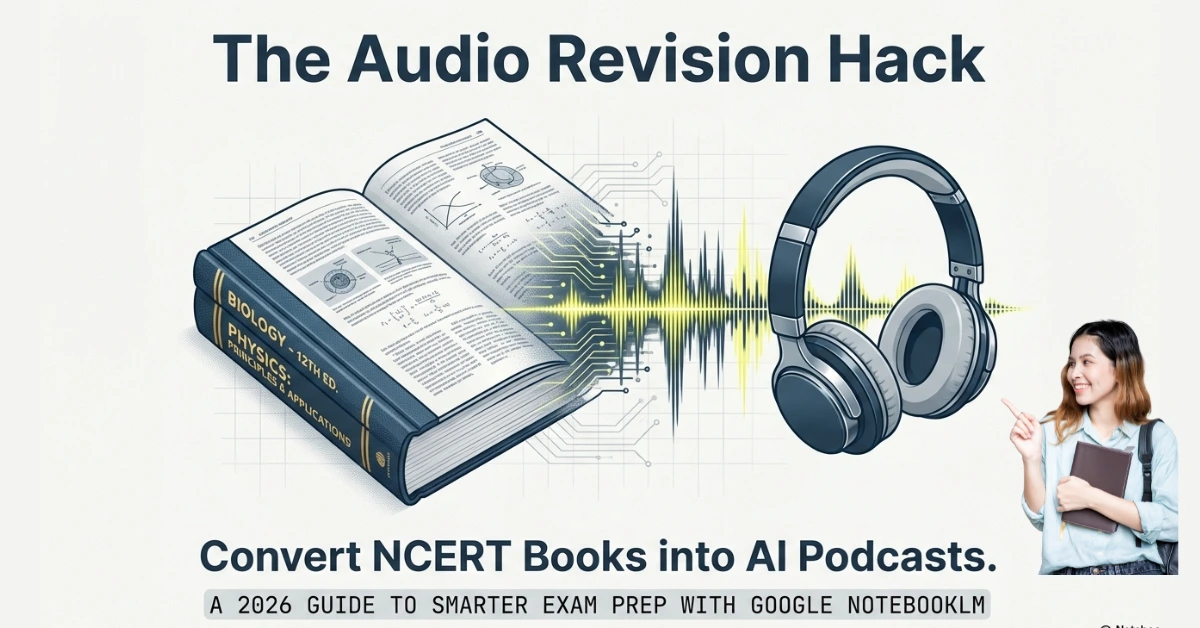
How to Use NotebookLM to Convert NCERT Books into Audio Podcasts for Exam Revision

Notebooklm Audio revision

Long chapters, heavy NCERT books, and zero time — that’s the daily struggle of Indian students.
What if your 50-page Biology chapter could become a 10-minute audio podcast you can listen to while walking, travelling, or relaxing?

That’s exactly what NotebookLM’s Audio Overview feature does.

Read more

AI Tools for CBSE English Students: Grammar, Writing, and Safe Use (A Teacher’s Guide)

AI Tools for CBSE English Students: Grammar, Writing, and Safe Use (A Teacher’s Guide)

Why Choosing the Right AI Tool for CBSE English Is So Confusing

Look, CBSE students are genuinely confused about AI tools… and honestly, who can blame them? There’s zero clear guidance. You open your phone, someone’s pushing a new app. You check YouTube, there’s another website being recommended. One teacher tells you AI is useful. The next one says it’s completely wrong. So where does that leave you? Stuck in the middle, basically trying to guess what’s safe and what’ll land you in trouble.

Read more

How Indian Students Can Use AI to Improve CBSE English Writing Without Cheating

How Indian Students Can Use AI to Improve CBSE English Writing

Why CBSE Students Are Confused About Using AI for English

Let’s be honest. Many of you are scared to even open ChatGPT or other AI tools. You keep thinking, ‘Is this cheating? What if the teacher finds out? What if my Internal Assessment marks go down?

But here’s the thing. The real confusion isn’t whether you should use it. It’s how you’re using it.

Read more

AI for Indian Students: Your Teacher’s Real Talk on Learning Smarter in 2025

AI for indian students

Last Tuesday started like any other.

Coffee in hand. Red pen ready. Thirty essays on “The Impact of Globalization” waiting to be graded.

The first essay? Brilliant. Sharp vocabulary. Tight structure. I was impressed.

Then I picked up the second one. Same structure. Same examples. Same… everything.

But here’s what gave you all away:

Read more

Smart Study: How to Use ChatGPT to Analyze 10 Years of CBSE Question Papers

How to Use ChatGPT to Analyze 10 Years of CBSE Question Papers (with Prompts)

The Problem Every Board Student Faces

Exam season is here, and you know what teachers keep saying: “Solve 10 years of Previous Year Questions!” Sounds great, right? But here’s the reality – sitting with a pile of old question papers and manually counting which chapter appeared how many times? That’s going to take you 2-3 days minimum. By the time you figure out the pattern, half your revision time is gone.

Read more

Oh hi there 👋
It’s nice to meet you.

Subscribe & get your free AI Study Guide now — packed with tools, tips, and strategies to boost learning worldwide

We don’t spam! Read our privacy policy for more info.