
Last Updated on May 7, 2026 by Asheesh Kumar
Every year, as board exams and entrance tests like NEET and JEE approach, student panic is practically guaranteed. But lately, amidst all this pressure, a new question is dominating group chats:
“Which AI tool is the best for predicting this year’s questions?”
Maybe you—or someone you know—are already using an AI tool that analyzes past papers to guess what might appear in the exam. Millions of students are quietly turning to these smart tools to cope with immense academic pressure.
But here’s the elephant in the room no one is asking out loud:
Is AI exam prediction in India actually legal? Could the government ban these AI study tools?
As an educator, I want to give you a straight and honest answer today, because understanding these rules directly impacts your academic future.
The Big Difference: AI Pattern Analysis vs. Real Paper Leaks
Let’s clear up one major misconception first.
Under the umbrella of “AI prediction,” two very different things are happening online. Knowing the difference is what keeps students safe and out of trouble.
The Right Way: AI Pattern Analysis
Legitimate AI study tools deeply analyze 10 to 15 years of past papers to highlight recurring topics and important concepts.
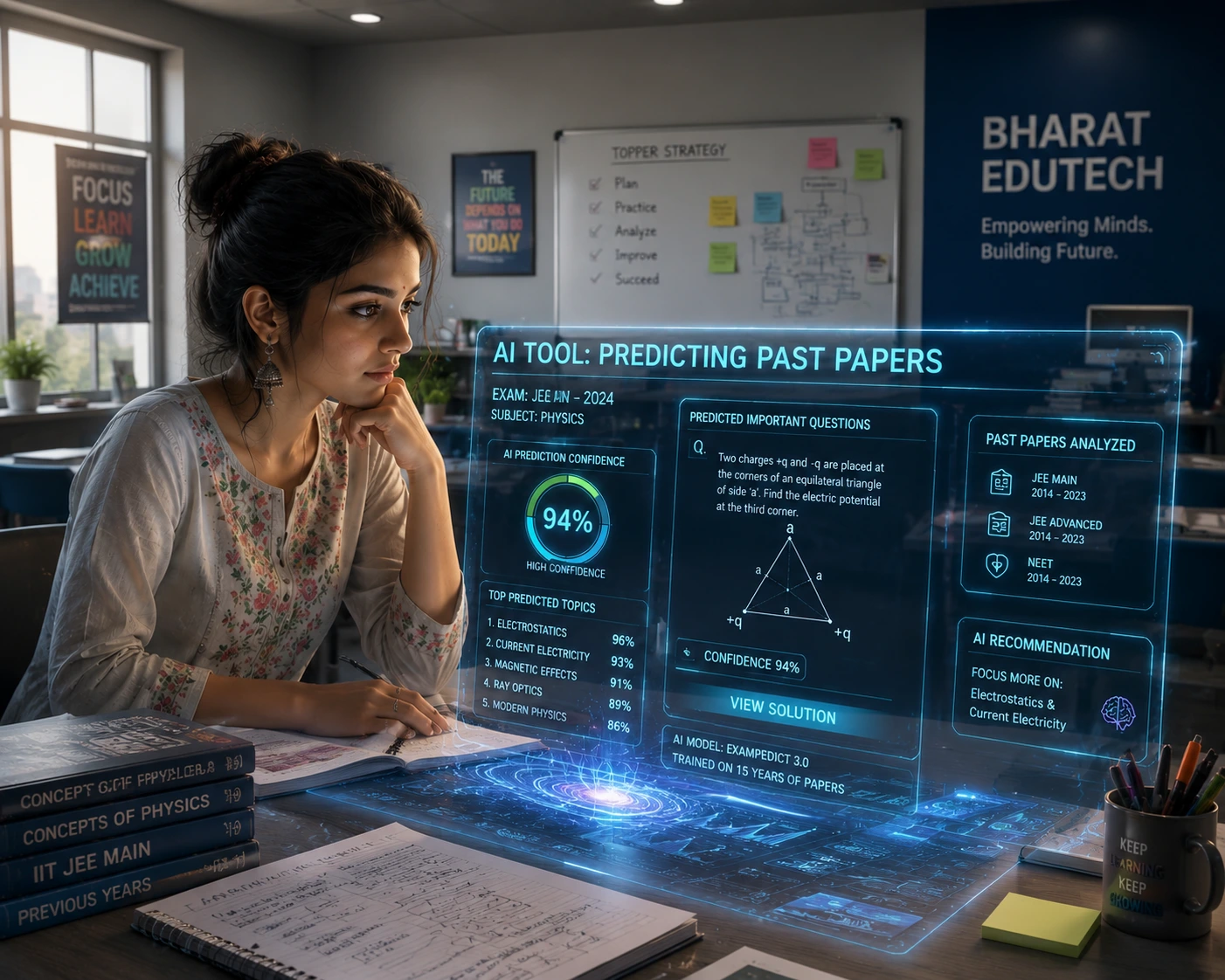
For example, an AI tool might say:
“This physics concept appeared in 4 of the last 5 exams, so make sure you revise it properly.”
This is very similar to what teachers already do when they mark “important questions” in textbooks or suggest likely topics before exams. In simple words, this is just high-tech pattern recognition, and it is completely legal and safe. In fact, responsible AI exam prediction in India is becoming a smarter way for students to revise efficiently without wasting time on low-priority topics.
Also Read: Beyond the Syllabus: 9 Secret AI Prompts to Predict Your Next Exam
The Wrong Way: Fake “AI” Paper Leak Claims
Now let’s talk about the dangerous side. Some shady Telegram groups, apps, and websites claim they can provide the “real paper” using AI technology.
But here’s the truth: They are usually not predicting anything at all. Instead, they illegally obtain leaked papers through insiders or organized cheating networks and simply attach the word “AI” to sound modern and trustworthy.
This is not innovation. It is a serious criminal offense.
The Strict Law Students Must Know: The Public Examinations Act, 2024
After multiple paper leak controversies across India, the government introduced strict rules through the Public Examinations (Prevention of Unfair Means) Act, 2024.
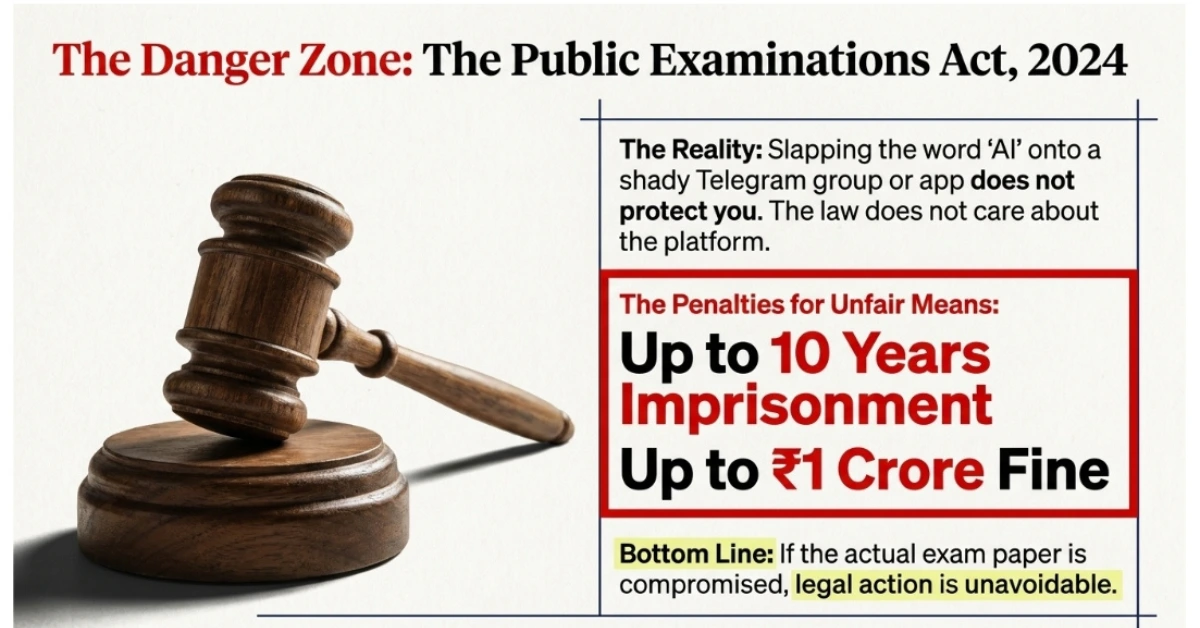
And yes, the law is extremely serious. Under this Act, facilitating unauthorized help, leaking exam material, or participating in organized cheating can lead to:
- Up to 10 years of imprisonment
- Fines of up to ₹1 crore
- Severe action against service providers and organized groups involved
The law does not care whether the leaked paper was shared through WhatsApp, Telegram, or disguised inside an AI app. If the actual exam paper is compromised, legal action is unavoidable.
This is why students must clearly understand the difference between legal AI study tools and illegal paper leak scams.
So, Will AI Exam Prediction Be Banned in India?
Now for the million-dollar question: Will the Indian government completely ban all these AI prediction and study tools?
The short answer is—No.
Instead of stifling new technology, India is embracing it. In fact, starting with the 2026–27 academic session, the government has made Artificial Intelligence and Computational Thinking mandatory subjects from Class 3 onwards in CBSE schools. Banning AI for study purposes would directly contradict the country’s educational goals.
Rather than banning the tools, examination boards like the NTA and CBSE are making their tests “AI-Proof.” They are shifting toward competency-based questions and randomizing sets so much that no AI can simply memorize and predict an exact paper. Basically, as AI gets smarter, our exam setters are getting smarter, too.
Also Read: Karnataka AI Tutor Program Explained: How AI Tutors Could Change Government Schools in India
How Students Should Use AI Responsibly
If you are using AI tools for revision, mock tests, concept explanations, or past-paper analysis, you are not doing anything illegal. There is absolutely no need to panic. Using technology to study smarter is completely different from cheating.
In fact, AI study tools can genuinely help students:
- Save revision time
- Identify weak areas
- Practice smarter
- Understand difficult concepts faster
The key is using them responsibly.
FAQ Section
Is AI exam prediction legal in India?
Yes. AI exam prediction tools that analyze previous years’ papers and study patterns are legal in India. However, leaked-paper services disguised as AI tools are illegal.
Can AI predict exact NEET or JEE questions?
No genuine AI tool can accurately predict the exact exam paper. Most tools only identify important trends and recurring concepts from past exams.
What is the punishment for paper leaks in India?
Under the Public Examinations (Prevention of Unfair Means) Act, 2024, offenders can face up to 10 years in prison and fines of up to ₹1 crore.
Will CBSE ban AI tools for students?
No. CBSE is actually integrating AI and Computational Thinking into education. The focus is on responsible AI usage, not banning educational technology.
My Advice to You as a Student
If you are reading this and using an AI tool for self-study, revision, or past-paper analysis, you are not doing anything illegal. There is absolutely no need to panic. Studying smartly is not a crime!
However, here is where you must draw the line:
- Avoid the “100% Guarantee” Trap: If an app, website, or social media account promises you the “exact paper” for tomorrow’s exam, run the other way. That is not a prediction; it is a crime under the 2024 Act, and you do not want to be associated with those people.
- Use AI to Learn, Not to Cheat: Use AI heavily to clear your concepts and take mock tests.
Remember, there are no shortcuts to true understanding. Trust your hard work, leverage technology responsibly, and focus on your preparation!

My name is Asheesh Kumar i am a dedicated educator and have a deep understanding of artificial intelligence, I aim to transform traditional learning methods by integrating cutting-edge technology and AI-driven tools into education. As a teacher and personal tutor, I have the privilege of working with many students and understanding their individual strengths and weaknesses. With this insight, I know how to help each student overcome their challenges and improve their skills. Understanding each student’s unique learning style and needs allows me to tailor lessons that maximize their potential. This holistic approach not only boosts academic performance but also builds confidence and a lifelong love for learning.
Very well presented. Every quote was awesome and thanks for sharing the content. Keep sharing and keep motivating others.