
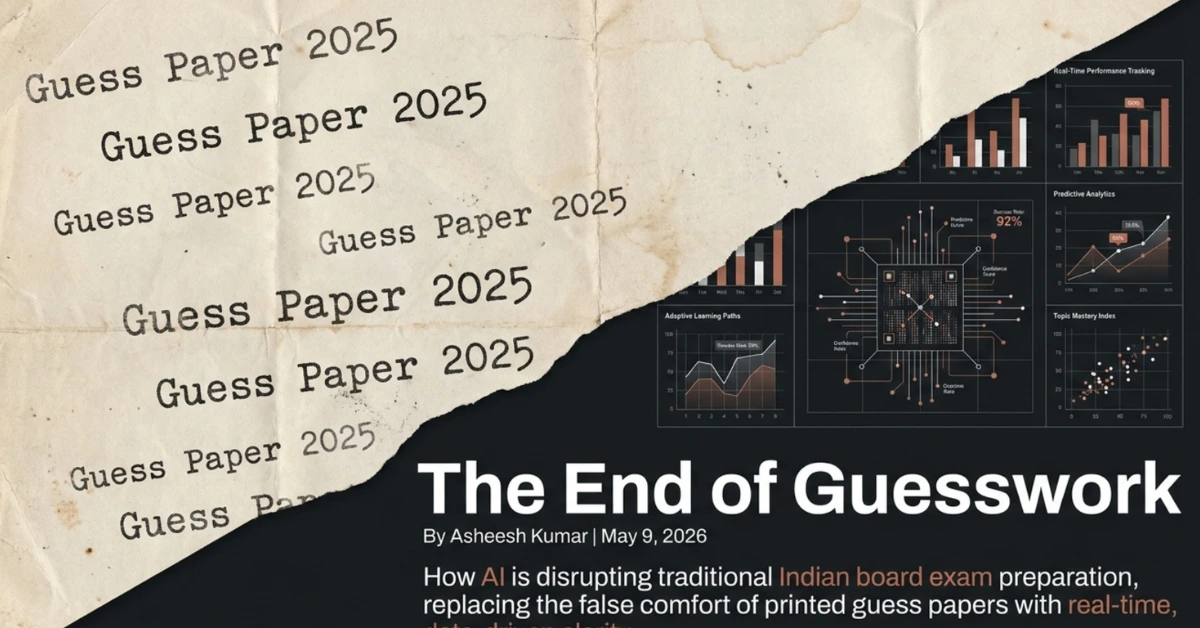
Last Updated on May 9, 2026 by Asheesh Kumar
There’s a very specific kind of panic that hits sometime in late January or early February. Your board exams are around six weeks away. Your syllabus is technically “done,” but nothing feels ready. So you do what every student in India has done for the last three decades — you ask someone for the guess paper.
You’ve seen them. Printed on thin, slightly yellow sheets. Sold outside stationary shops in bundles of five. Passed around WhatsApp groups at midnight with the caption: “Confirmed questions, my uncle is a teacher.” Shared by coaching centres with bold fonts that promise 90% accuracy. The guess paper was never just a piece of paper — it was hope, packaged cheaply.
And for millions of Classes 10 and Class 12 students, it still is.
But something is quietly changing in 2026. That creased sheet of “important questions” is getting some serious competition — not from a new coaching center, not from another YouTube channel, but from artificial intelligence tools that are doing what the guess paper always promised to do, only actually delivering on it.
Also Read: Beyond the Syllabus: 9 Secret AI Prompts to Predict Your Next Exam
What the Old Guess Paper Got Wrong
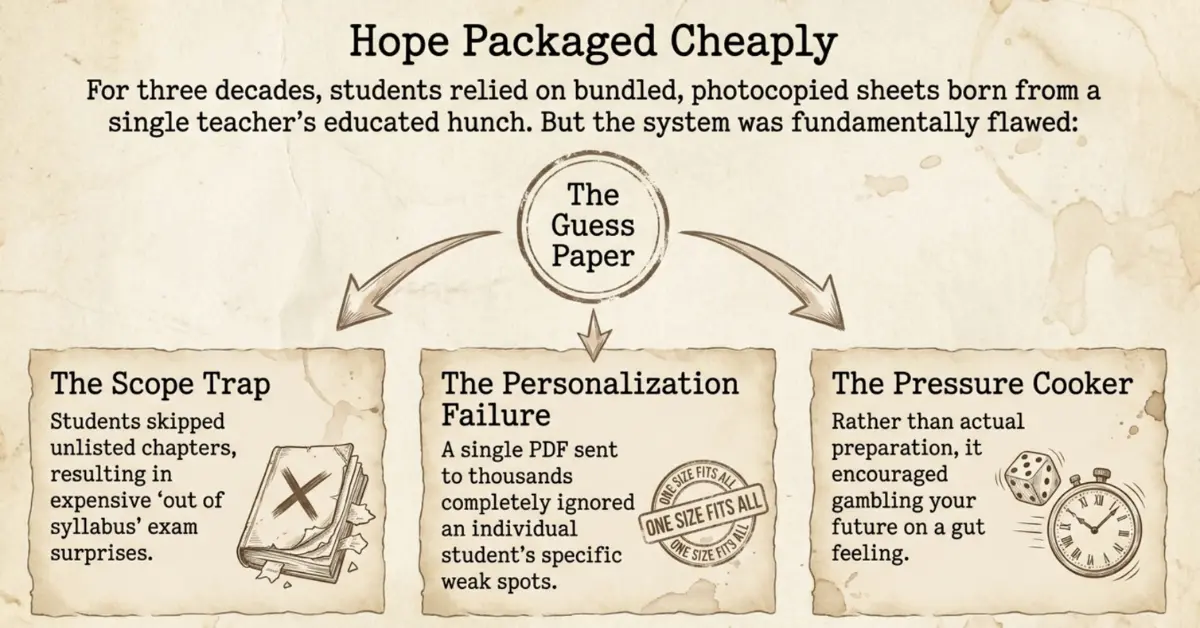
Let’s be honest about the guess paper for a second. It wasn’t totally useless. At its best, it was the result of an experienced teacher sitting down with ten years of past papers, noticing which chapters repeated, and writing down their educated hunch. That’s not nothing. Pattern recognition from experience has real value.
But it had some serious problems.
First, it was often wrong in expensive ways. A student who only studied guess paper chapters and skipped the rest could walk into the exam and find that three out of five long-answer questions were from “out of syllabus” topics — meaning topics they ignored because no guess paper mentioned them.
Second, it was a one-size-fits-all tool. The same guess paper went to thousands of students across different schools, different states, different levels of preparation. It couldn’t tell you whether you specifically needed to revise chemical equations more than genetics, or whether your weak spot was comprehension passages or grammar.
Third, and perhaps most importantly — board exams in India carry far more emotional weight than a simple academic test. They influence college admissions, career pathways, and in many families, define a student’s social standing. The guess paper fed into that pressure rather than relieving it. You’d study only what it told you, cross your fingers, and hope.
That’s not preparation. That’s gambling with your future.
Also Read: Will AI Exam Prediction Be Banned in India? The Truth Students Need to Know
Enter the AI — And It’s Not What You Think
When most students hear “AI for exam prep,“ they imagine something futuristic and complicated. Something their parents definitely can’t afford. Something that requires fast internet and a shiny laptop.
The reality in 2026 is much more practical — and much more interesting.
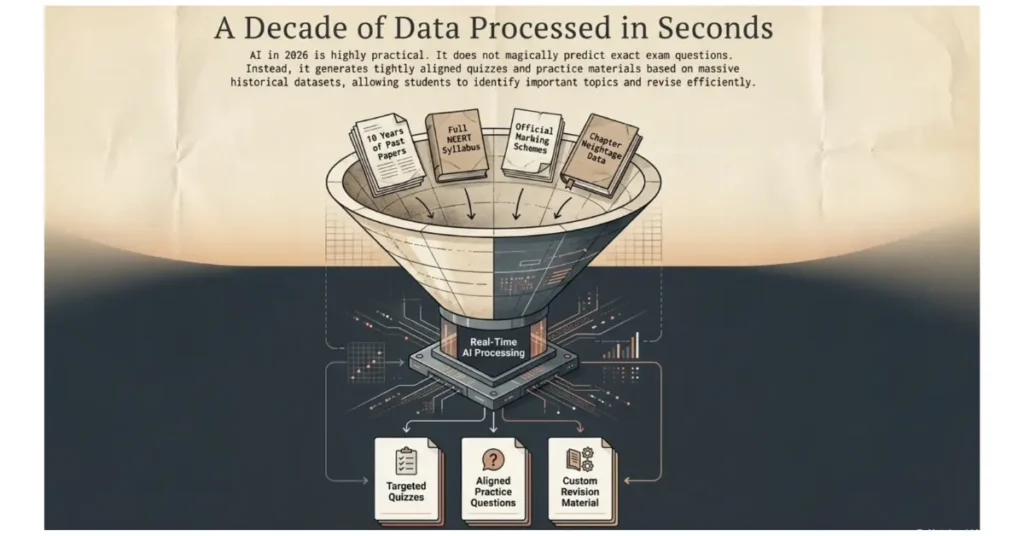
Students and teachers are now using AI tools not to magically predict real exam questions, but to generate high-quality practice questions, quizzes, and revision material that is tightly aligned with syllabi and past exam patterns. These tools analyze textbooks, notes, and previous papers to help learners practice smarter, identify important topics, and revise efficiently.
Think of it like this: the old guess paper was one experienced teacher’s gut feeling. AI-based prediction is ten years of past papers, the full NCERT syllabus, official marking schemes, chapter weightage data, and pattern-shift analysis — all processed in seconds, updated in real time.
And it’s already working at a scale that’s hard to ignore.
The AI Prediction That Made Students Pay Attention
For NEET 2025, one AI prediction platform called PaperPredict matched 72 out of 90 Biology questions. That’s over 80% of the Biology section.
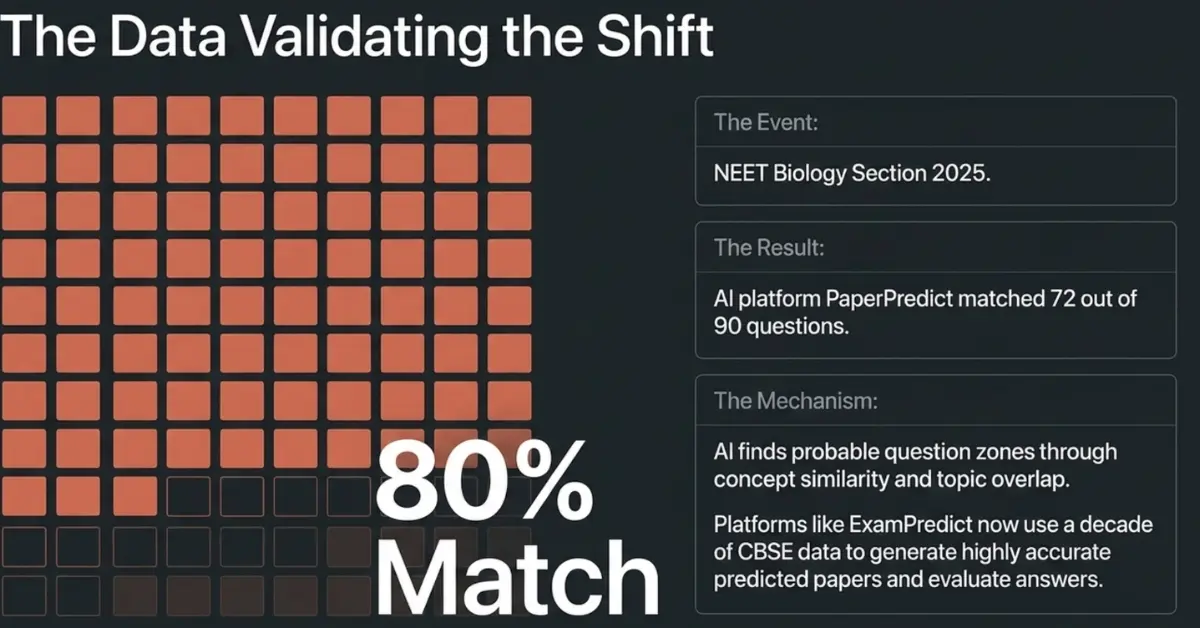
Let that sit for a moment. Eight out of every ten Biology questions that appeared in one of India’s most competitive exams — matched by an AI tool students had been practicing on beforehand.
Now, to be fair, this doesn’t mean students were reading the exact same questions. The matching is about concept similarity and topic overlap. But for a student preparing for NEET, knowing that a particular AI platform has a strong track record of identifying which types of questions, which chapters, and which application patterns are going to appear — that’s enormously valuable.
Platforms like ExamPredict, built specifically for CBSE Class 10 and 12 students, claim to generate predicted papers based on over a decade of board exam data and offer answer evaluation in CBSE style. Whether you believe the 95% accuracy claims or not, the underlying approach — using historical data to identify the most probable question zones — is fundamentally more rigorous than anything the old guess paper ever offered.
How AI Actually Reads a Question Paper
Here’s the part that’s genuinely fascinating, and worth understanding even if you’re not a tech person.
When an AI tool analyzes board exam papers, it’s not just counting how many times “photosynthesis” appeared. It’s doing something far more nuanced.
It looks for conceptual repetition, not just word repetition. If “Climate Change Causes” appeared in 2017, and “Reasons Behind Global Warming” appeared in 2020, AI recognizes the conceptual similarity between the two — even though the exact words are different. A human teacher might catch this after reviewing a few years. An AI catches it across fifteen years of papers, across subjects, instantly.
It notices when patterns shift. Syllabi change. CBSE has been moving steadily toward competency-based and application-focused questions, especially after NEP 2020. AI tools track these shifts year by year and adjust their predictions accordingly. The guess paper from a tuition centre rarely did that — it was often recycled from the previous year with minor changes.
It gives you a probability, not a promise. The good AI platforms don’t say “these ten questions will appear.” They follow something like a 70-25-5 rule — identify the topics most likely to appear, prepare for moderately likely ones too, and never completely ignore the outliers. That’s honest. That’s actually how smart preparation works.
Also Read: Smart Study: How to Use ChatGPT to Analyze 10 Years of CBSE Question Papers
What Smart AI-Based Exam Preparation Looks Like in 2026
If you are staring down exams right now, do not abandon traditional studying just because AI exists. That is the wrong takeaway. Instead, combine the two:
Respect the unexpected: Never ignore the topics the AI doesn’t flag. There is always that one obscure chapter everyone skipped that shows up to ruin your day.
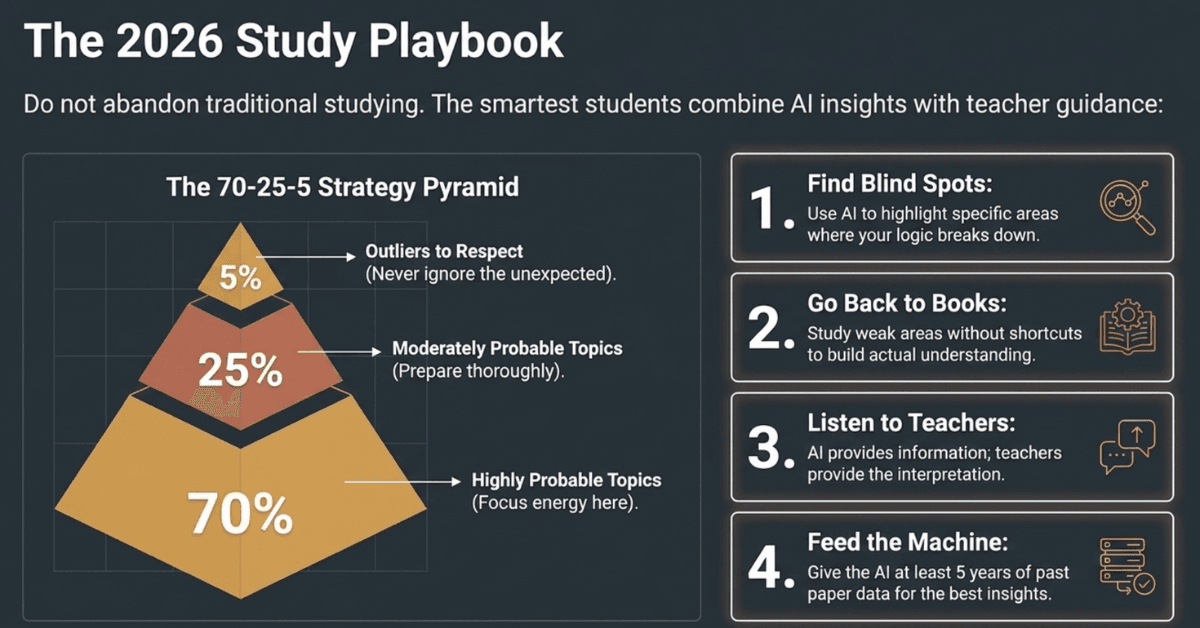
Use AI to find your blind spots: Let it test your conceptual understanding and highlight the specific areas where your logic breaks down.
Go back to the books: Study those weak areas properly. No shortcuts. No memorized answers. Build actual understanding.
Feed the machine: If you use an AI prediction tool, give it enough data. Five years of past papers will always produce better insights than one isolated test.
Listen to your teachers: AI provides information. Teachers provide interpretation. The smartest students in 2026 rely on both.
The Guess Paper Promised Comfort. AI Promises Clarity.
The guess paper was fear flattened onto cheap paper. It told generations of students to study less, hope harder, and trust prediction over preparation. It wasn’t malicious. Most of the time, it was created with good intentions. But it often failed students exactly when students needed certainty most.
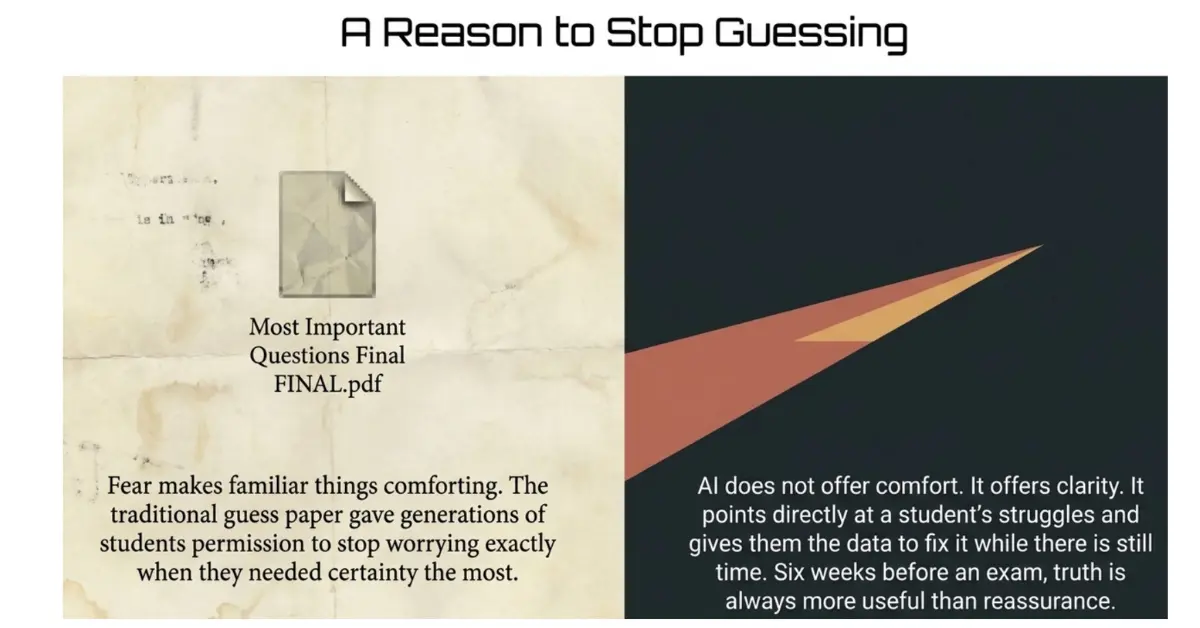
AI is offering something very different. Not comfort. Clarity. It tells students:
“Here is where you are struggling. You still have time. Fix it now.”
One approach feels gentler in the moment. The other is probably kinder in the long run. And despite everything, the guess paper isn’t disappearing overnight. This February, photocopied sheets will still sell outside stationery shops. Parents will still forward PDFs on WhatsApp.
Students will still save files called “Most Important Questions Final FINAL.pdf”. Not because they’re foolish.
Because fear makes familiar things comforting. But the direction is changing. And if you’re a student sitting with your phone six weeks before exams, overwhelmed by everything that currently feels life-defining, the truth is probably more useful than reassurance.
The guess paper gave students permission to stop worrying. AI gives students a reason to stop guessing.
And that difference changes everything.
And if you’re curious about how AI is reshaping education, explore more guides here on FutureReadyStars.com — where we break down new AI tools in simple language for students, parents, and teachers.

My name is Asheesh Kumar i am a dedicated educator and have a deep understanding of artificial intelligence, I aim to transform traditional learning methods by integrating cutting-edge technology and AI-driven tools into education. As a teacher and personal tutor, I have the privilege of working with many students and understanding their individual strengths and weaknesses. With this insight, I know how to help each student overcome their challenges and improve their skills. Understanding each student’s unique learning style and needs allows me to tailor lessons that maximize their potential. This holistic approach not only boosts academic performance but also builds confidence and a lifelong love for learning.
1 thought on “The End of the Guess Paper: How AI is Predicting Board Exams in 2026”