
Last Updated on July 7, 2026 by Asheesh Kumar
The student who asks AI, “What will come in the exam?” is looking for a magic question bank. They almost always get a useless, generic list.
But the student who asks AI to think like an examiner? That student builds a preparation system that tops the class.
Can AI predict exam questions?

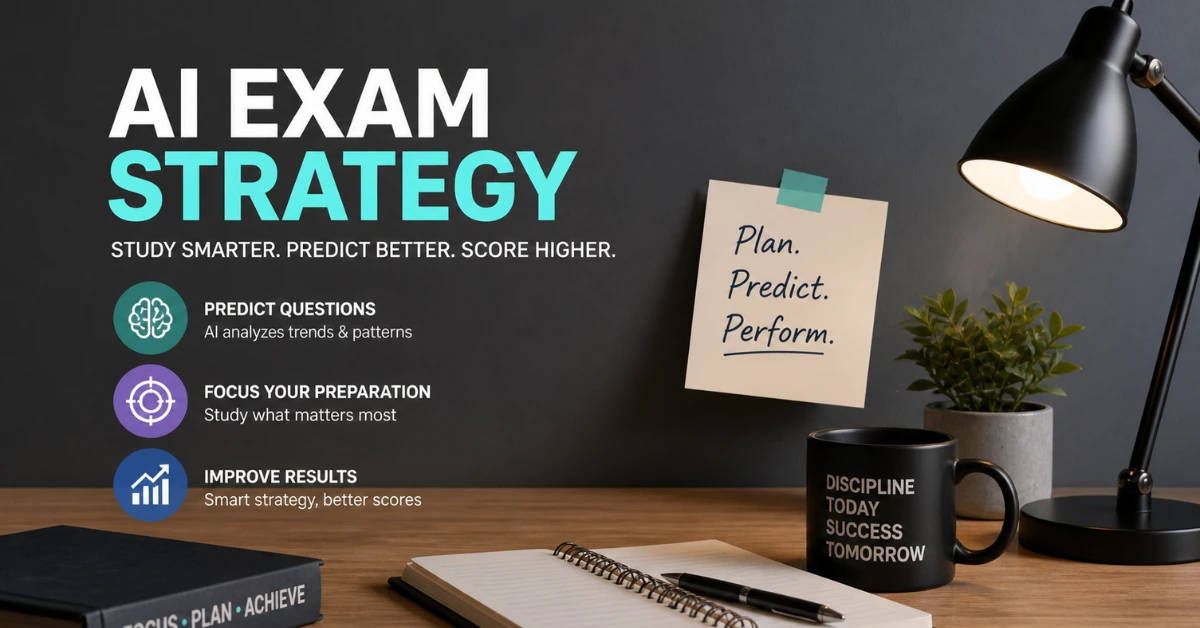
AI cannot predict exact exam questions, but it can analyze syllabus trends, previous year questions, and exam patterns to identify high-probability topics. This is what makes AI exam prediction a powerful study strategy.The honest truth about Generative AI is that it is only as smart as the context you provide. Feed it vague input, and you get a vague answer. Feed it context, a specific role, and clear structure, and you get insights that sound like they came straight from your professor’s desk.
Whether you are preparing for CBSE or UP Board exams, or tackling highly competitive national exams like UPSC, JEE, and NEET, these nine architectural prompts apply universally. They give AI the context it needs to stop acting like a search engine and start acting like a strict, veteran examiner.
Also Read: 50+ Best AI Prompts for Students in 2026 – Study Smarter with ChatGPT & AI Tools
1.The Examiner Mindset Prompt (AI Prompts for Exam Preparation)
This prompt is the most powerful tool in your arsenal. It shifts the AI out of “student helper” mode and places it directly into the chair of a rigorous question-setter.
Copy-Paste Ready:
“Act as a senior university examiner for [Subject Name] at the [Class 12 Board / B.Tech / BA / etc.] level. Your job is to test deep understanding, not rote memorization. Based on these syllabus topics: [paste topics], generate 10 questions most likely to appear in a 3-hour final exam. For each question, explain WHY you selected it—what core concept it truly tests and what a surface-level student would likely miss.”
Why it works: Assigning a role forces the AI to shift its entire reasoning framework. The “explain why” clause gives you the examiner’s underlying logic, training you to anticipate exam patterns rather than just memorize answers.
2. The PYQ Pattern Detector (Predict Exam Questions Using AI)
Exam setters are human beings with habits. Topics that haven’t appeared in two or three years are often systematically rotated back in. AI can spot these cyclical patterns in seconds.
Copy-Paste Ready:
“I am sharing previous year exam questions (PYQs) for [Subject] from [Board / University], covering the years [20XX to 20XX]. After analysing them:
- List recurring themes that appeared in 2 or more years.
- Identify syllabus topics that have never appeared in any paper.
- Predict 8 concepts most overdue to appear this year.
- Rate each prediction (High / Medium / Low probability) and provide your reasoning. Here are the past papers: [paste PYQs]”
03. The Bloom’s Taxonomy Ladder (AI Study Prompts for Deep Learning)
Most students prepare only for recall—defining terms and stating facts. However, high-scoring papers award the majority of marks for application and analysis. This prompt forces you to see a single concept through six distinct lenses.
Copy-Paste Ready:
“Take this concept: [e.g., ‘Article 32 of the Indian Constitution’ or ‘Electromagnetic Induction’]. Generate one exam-quality question at each cognitive level:
- Level 1 (Recall): Basic definition or fact
- Level 2 (Understanding): Explain in your own words
- Level 3 (Application): Real-world scenario-based
- Level 4 (Analysis): Compare, contrast, or cause-effect
- Level 5 (Evaluation): Critically assess or judge
- Level 6 (Creation): Design, propose, or innovate My exam format is: [MCQ / 5-mark short answer / 10-mark long answer]. Make the questions rigorous.”
04. The Trick Question Trap Detector
Professors do not ask tricky questions to be cruel; they ask them because true mastery means knowing how to handle edge cases. This prompt finds those traps in advance.
Copy-Paste Ready:
“You are a professor who wants to identify students who have memorized [topic] without truly understanding it. Generate 5 exam questions designed to:
- Exploit the most common student misconceptions.
- Have answers that feel obvious but are actually wrong.
- Test exceptions to standard rules. For each question, describe the trap, the wrong instinct most students will follow, and the correct reasoning.”
05. The Indian Context Case Study Builder
Modern exams increasingly use localized scenarios to test conceptual understanding. Generic Western textbook examples leave you unprepared for this format.
Copy-Paste Ready:
“Create a realistic Indian case study of approximately 150 words that tests knowledge of [concept]. Set it in: [e.g., a rural village in UP / a Mumbai tech startup / a government district hospital]. The scenario must feel authentic to the Indian socio-economic context. After the case study, write 4 questions scaling from basic identification (2 marks) to policy recommendation (8 marks).”
06. The Objective Study Audit (Smart Exam Preparation with AI)
Every student naturally gravitates toward studying what feels comfortable and skips what feels confusing. This prompt acts as an objective audit to identify the gaps you didn’t even realize you had.
Copy-Paste Ready:
“I have genuinely studied the following topics: [list what you have covered]. My complete syllabus is: [paste full syllabus]. Based on standard exam patterns for [subject + exam name]:
- Which highly-tested topics am I most likely underestimating?
- Which chapters that seem minor actually appear frequently?
- What are my highest-risk gaps given the time I have remaining? Be completely honest and critical. Do not just validate what I have studied; flag what I have missed.”
07. The Feynman Test Prompt
If you can explain a concept simply to someone who knows nothing about it, you understand it. If you cannot, you have merely memorized a string of words.
Copy-Paste Ready:
“I am going to explain a concept to you as if you are a high school student hearing it for the first time. Assume no prior knowledge. After I explain, tell me what I got right, point out gaps or oversimplifications, and ask me 3 follow-up questions a professor would ask to probe deeper. Rate my understanding: Exam-Ready / Needs Work / Memorized but Not Understood. My explanation of [concept]: [Write your explanation here in your own words].”
08. The Answer Evaluator
Writing practice answers without getting feedback is like practicing penalty kicks without a goalkeeper.
Copy-Paste Ready:
“You are a strict but fair examiner evaluating a student’s written answer. Question: [paste the question] | Total marks: [X marks] My answer: [paste your written answer here] Please evaluate: Marks awarded out of [X] with a point-by-point justification, what is missing that would have earned full marks, and provide one model paragraph showing the ideal answer structure.”
09. The Last Night Emergency Prompt
Sometimes reality hits hard: the exam is in twelve hours. This prompt is designed for maximum output in minimum time.
Copy-Paste Ready:
“I have [X hours] before my [subject] exam tomorrow. My full syllabus: [paste full syllabus]. What I have genuinely studied: [be completely honest]. Act as a ruthless strategy coach. Identify the 5 highest-probability topics I must cover tonight. For each, give me the 3 most important points an examiner expects to see, and 2 highly likely questions with concise, 60-word model answers. Flag any ‘easy marks’ topics I might be skipping.”
The One Thing AI Cannot Do For You
The students who use these prompts and still fail are the ones who read the AI’s output and consider themselves “prepared.” They screenshot the predicted questions without ever sitting down to write the actual answers.
Prompting is strategy. Studying is still the work.
Using AI to audit your preparation and deepen your understanding is no different from hiring a brilliant tutor. But using it to bypass the actual mental labor defeats the purpose of your education. Use these prompts to write, check, rewrite, and iterate.
Copy your syllabus, open your AI tool of choice, and do the work it points you toward. Prepare like you mean it.
Also Read: NotebookLM Cinematic Video Overview: Turn Your Notes Into a Mini Documentary (Student Guide)
FAQ
1. Can AI really predict exam questions?
AI cannot predict exact questions, but it can analyze patterns and help identify high-probability topics.
2. Which AI prompts are best for exam preparation?
Prompts like Examiner Mindset, PYQ Pattern Detector, and Feynman Test are highly effective.
3. Is using AI for studying cheating?
No. Using AI as a learning tool is like having a tutor—it depends on how you use it.
4. How often should students use AI prompts?
Ideally daily for revision and weekly for strategy planning.
If you’re serious about scoring higher with less guesswork, start using just 2 of these prompts today — and track the difference in your test performance.
And if you’re curious about how AI is reshaping education, explore more guides here on FutureReadyStars.com — where we break down new AI tools in simple language for students, parents, and teachers.

My name is Asheesh Kumar i am a dedicated educator and have a deep understanding of artificial intelligence, I aim to transform traditional learning methods by integrating cutting-edge technology and AI-driven tools into education. As a teacher and personal tutor, I have the privilege of working with many students and understanding their individual strengths and weaknesses. With this insight, I know how to help each student overcome their challenges and improve their skills. Understanding each student’s unique learning style and needs allows me to tailor lessons that maximize their potential. This holistic approach not only boosts academic performance but also builds confidence and a lifelong love for learning.
3 thoughts on “Beyond the Syllabus: 9 Secret AI Prompts to Predict Your Next Exam”