
Last Updated on August 5, 2026 by Asheesh Kumar
A year ago, if you had asked most parents what an AI Olympiad was, many would probably have smiled politely and changed the subject. Today, the conversation is very different. Artificial Intelligence is no longer limited to tech companies or college students—it has started becoming part of school education.
With CBSE introducing AI and Computational Thinking for Classes 3–8 from the 2026–27 academic session and expanding AI education further in higher classes, parents and teachers across India are beginning to ask an important question:
“How can we help children understand AI in the right way instead of just using AI tools?”
One of the best answers is participating in an AI Olympiad.
Unlike traditional school exams, AI Olympiads encourage children to think logically, solve problems, understand how AI works, and explore technology responsibly. They are less about memorising definitions and more about developing skills that will remain valuable long after school.
Whether you’re a parent, a teacher, or someone running a coaching centre, this guide will help you understand which AI Olympiads matter in 2026, how they differ, and how to prepare children without creating unnecessary pressure..
What Exactly is the AI Olympiad?
What Is an AI Olympiad?
An AI Olympiad is a competitive examination that tests a student’s understanding of Artificial Intelligence, computational thinking, problem-solving, and responsible technology use.
Think of it as the AI version of Mathematics or Science Olympiads.
Instead of asking students to memorise textbook definitions, these competitions evaluate whether they can understand AI concepts, recognise real-world applications, think critically, and—at higher levels—apply basic programming and machine learning concepts.
The syllabus is designed according to age and grade level. A Class 3 student learns about AI in everyday life, while older students gradually explore topics like data, ethics, Python programming, Generative AI, and machine learning.
Also Read: Best Free AI Courses for Students in 2026 (Beginner to Advanced)
Why AI Olympiads Actually Matter
AI is reshaping every industry, and today’s children won’t just use it—they will work alongside it. That’s why an AI Olympiad is much more than just another certificate to add to a file.
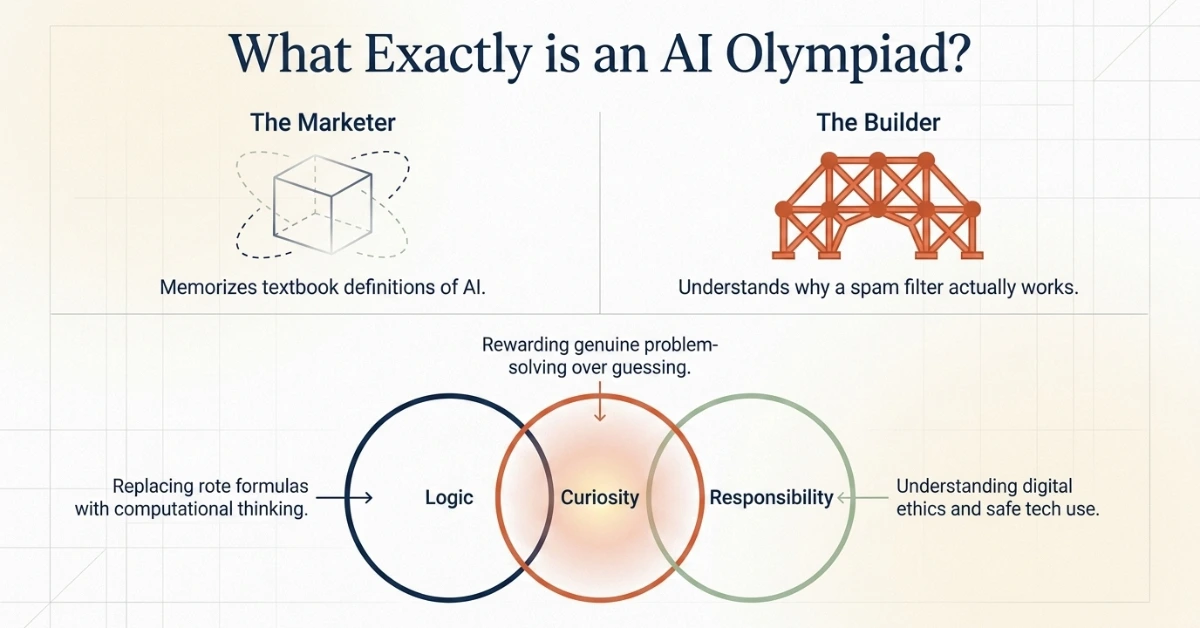
Instead of relying on rote learning, these competitions naturally build logical thinking and real problem-solving skills. They take children beyond basic tools like ChatGPT, teaching them digital ethics and giving them the confidence to handle future tech safely. The best part is that these exams reward pure curiosity. A student who genuinely understands why a spam filter works will always perform better than someone who simply memorized the textbook definition without grasping the concept.
Also Read: Best Free AI Courses for Students in 2026 (Beginner to Advanced)
The Two AI Olympiads Parents Should Know About
Searching online for AI competitions can easily overwhelm parents, given the number of options out there. To cut through the noise, there are two Olympiads in India that genuinely stand out. They are accessible, incredibly well-structured, and perfect whether your child is just starting out or already knows a bit about tech.
1. STEMLearn.AI: The Complete AI Experience
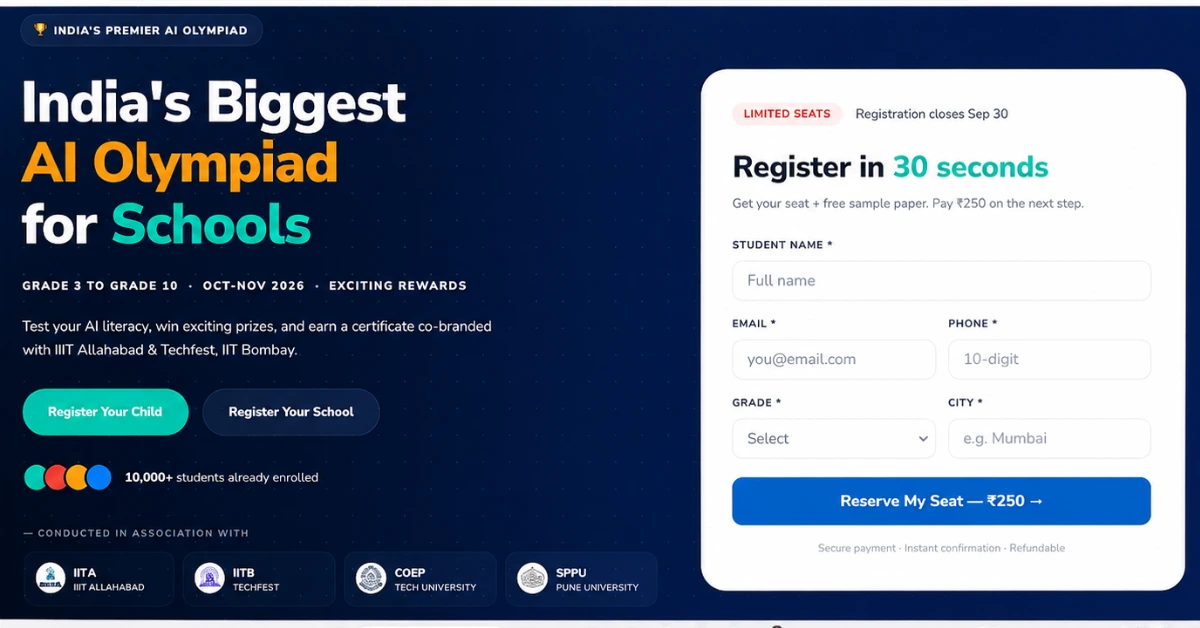
If your main goal is to help your child build a rock-solid foundation strictly in Artificial Intelligence, this is currently your best bet. Backed by top academic names like IIIT Allahabad and IIT Bombay’s Techfest, it’s specifically designed for students from Grades 3 to 10.
The best part about STEMLearn is that it doesn’t expect younger kids to write complex code. The 60-minute, English-medium exam is perfectly tailored to their age. Plus, you aren’t left in the dark to prepare—registration gives you full access to their Learning Management System (LMS), complete with grade-specific study materials, practice quizzes, and sample papers. You can take it via OMR in schools or online individually.
Instead of overwhelming students all at once, the syllabus grows gradually with them:
- Younger Students: Focus on spotting AI in everyday life, understanding smart devices, and basic online safety.
- Middle Schoolers: Move on to understanding how AI makes decisions, dealing with data, fairness, and bias.
- Senior Students: Get hands-on with Python programming, Machine Learning basics, Generative AI, and digital ethics.
While top rankers win cash prizes, medals, and a chance to attend innovation events at IIT Bombay, the real reward for most kids is the detailed performance report that helps them see exactly where they stand nationally.
👉 Register Your Child for AI Olympiad 2026 (Official Website)
Also Read: The Complete Guide to Studying With AI: 25 Practical Ways for Students (2026)
2. AUNO (Amar Ujala National Olympiad): The Flexible Option
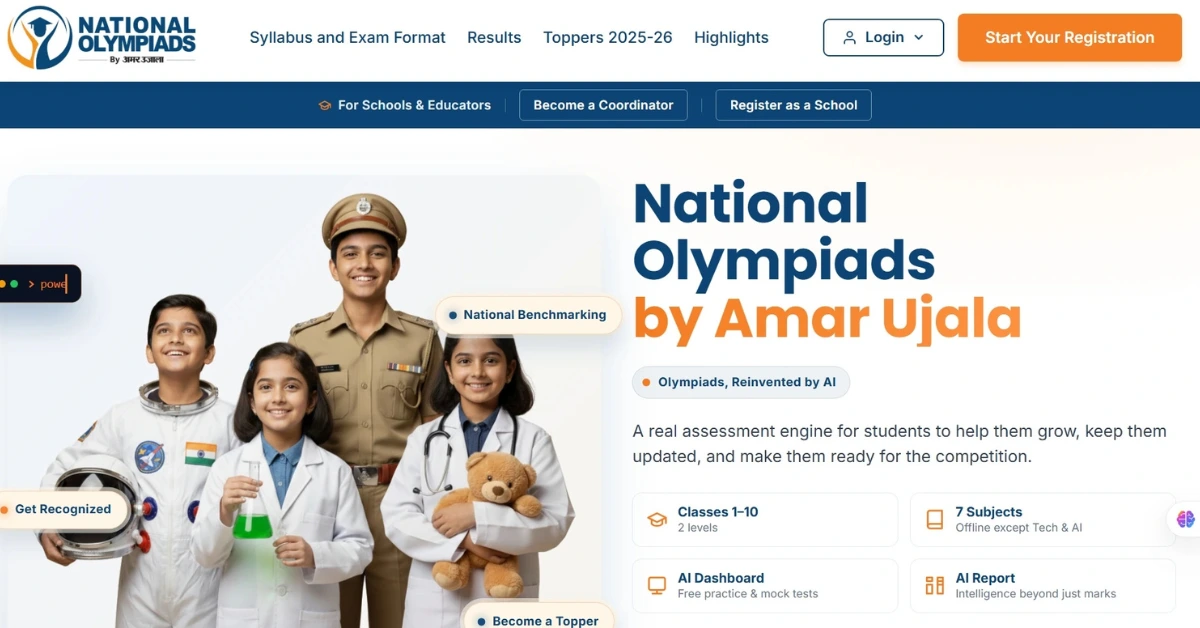
If you are from Uttar Pradesh or anywhere in North India, AUNO is likely already a trusted name in your household.
Unlike STEMLearn, AUNO isn’t just about AI. It’s a multi-subject platform (for Classes 1 to 10) where your child can take a dedicated “Tech & AI” paper alongside their usual subjects like Maths, Science, English, or Reasoning. This makes it a fantastic choice if your child is already giving traditional Olympiads and wants to try AI without signing up on a completely new platform.
Why Many Parents Prefer AUNO: The biggest draw here is the state-level ranking. Students from states like UP, Uttarakhand, Delhi, Haryana, Punjab, Bihar, and Maharashtra get separate state rankings alongside the national ones. For many families, this feels like a much more realistic, motivating, and achievable benchmark.
When you register for AUNO’s two-level competition, you are fully supported with:
- Digital practice materials and easy-to-read e-books.
- Mock tests to build confidence before the exam.
- Detailed performance reports to track progress.
Just a quick tip for the kids taking AUNO: the marking scheme rewards accuracy. This means thoughtful problem-solving will always score higher than random guessing!
👉 Register Your Child for AI Olympiad 2026 (Official Website)
Also Read: Best AI Tutors for CBSE Students (2026): 7 Smart Tools for Smarter Learning
STEMLearn vs. AUNO: Which One Should You Choose?
Eventually, almost every parent asks the same question: “So, which AI Olympiad is actually better?”
The honest truth? Neither is universally “the best.” It completely depends on your child’s current interests and learning goals. Here is a quick breakdown to help you decide:
| Feature | STEMLearn.AI | AUNO |
| Primary Focus | Strictly Artificial Intelligence | Multiple subjects (including a dedicated AI paper) |
| Classes Eligible | Grade 3 to 10 | Class 1 to 10 |
| Depth of AI | High (Deep dive into core concepts) | Beginner to Intermediate |
| Python Exposure | Yes (For higher grades) | Limited |
| State-Level Ranking | No (National focus) | Yes (Great for local recognition) |
| Best Suited For | Students wanting to specialize in AI | Students exploring Olympiads generally |
Our Recommendation:
Let me make it simple for you. If your child is genuinely fascinated by technology and wants to learn AI concepts that go way beyond their regular classroom, STEMLearn.AI is definitely the stronger choice.
However, if your child is already comfortable taking traditional Olympiads and you love the flexibility of pairing AI with subjects like Maths, Science, or English under one roof, AUNO is a fantastic fit.
And honestly, if your schedule and budget allow it, participating in both is a great idea! Since the foundational AI concepts overlap, preparing for one will naturally help your child score well in the other.
Looking Beyond School Olympiads: What Are INAIO and IOAI?
While researching AI Olympiads online, you might have stumbled across acronyms like INAIO and IOAI. Let me clear the air right away: these are very different from the beginner-friendly school Olympiads we just discussed.
The Indian National AI Olympiad (INAIO) is actually India’s official stepping stone to the International Olympiad in Artificial Intelligence (IOAI).
Unlike the school-level exams, these are heavy-duty competitions. They are designed for students who already have a solid grip on programming, mathematics, and machine learning. Participants aren’t just ticking multiple-choice boxes; they are expected to write Python code, solve real-world AI problems, and work with complex tech like computer vision and data science.
For most children, this shouldn’t be step one—it’s a long-term goal.
A much healthier approach is to let your child start with school-level Olympiads like STEMLearn or AUNO. Let them build their confidence over a few years, gradually strengthen their logical thinking and Python skills, and then aim for INAIO when they reach their senior secondary classes. That slow and steady journey is far more realistic and enjoyable than pushing them into advanced AI competitions too early.
What’s Coming Next?
Picking the right Olympiad is honestly just half the journey. The much bigger question is:
How do you actually help your child prepare without paying for expensive coaching classes or overwhelming them with heavy study schedules?
In the next part of this guide, we are going to break exactly that down. We will cover:
- A practical, age-wise preparation roadmap.
- How the CBSE AI Skill Subject (Code 417) can give your child a massive advantage.
- The best free and beginner-friendly Python resources.
- Common mistakes parents make (and how to easily avoid them).
- Answers to your most frequently asked questions about AI Olympiads.

My name is Asheesh Kumar i am a dedicated educator and have a deep understanding of artificial intelligence, I aim to transform traditional learning methods by integrating cutting-edge technology and AI-driven tools into education. As a teacher and personal tutor, I have the privilege of working with many students and understanding their individual strengths and weaknesses. With this insight, I know how to help each student overcome their challenges and improve their skills. Understanding each student’s unique learning style and needs allows me to tailor lessons that maximize their potential. This holistic approach not only boosts academic performance but also builds confidence and a lifelong love for learning.
Your explanation gave me practical information I can use this morning and I look forward to reading more from you