Best Free AI Courses for Students in 2026 (Beginner to Advanced)
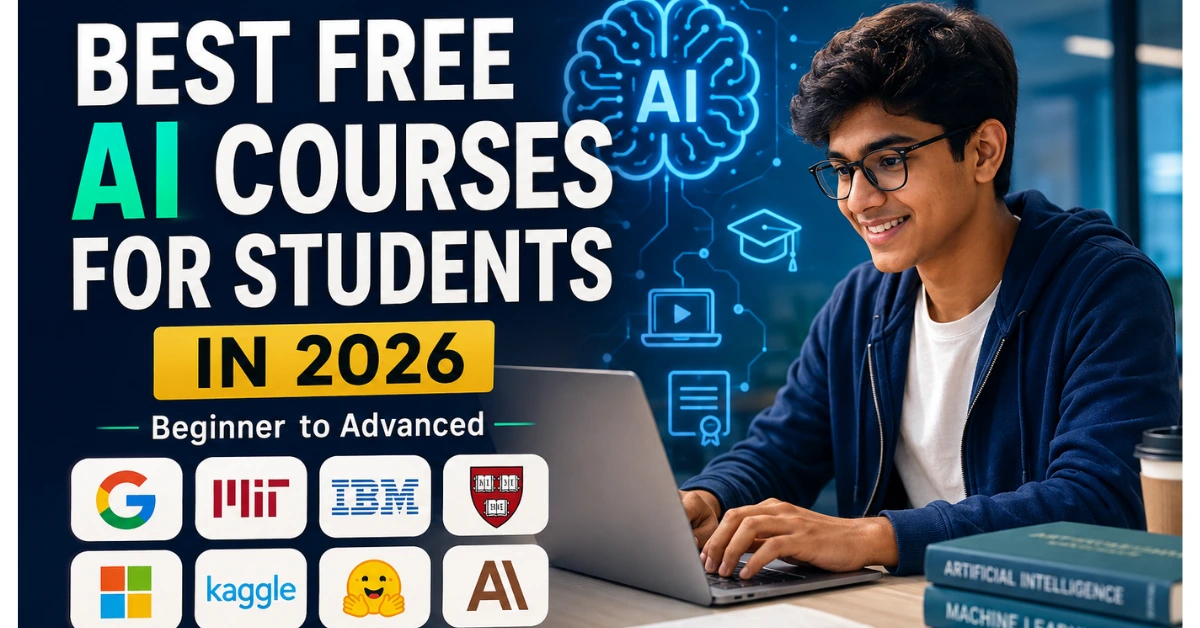
A few years ago, learning AI properly meant either paying for an expensive bootcamp or hoping your college had a professor who kept up with the field. Neither of those was ever guaranteed for a student outside a metro city. That’s changed faster than almost anyone expected. Google, Microsoft, Harvard, MIT, IBM, Anthropic, and a handful of nonprofits have all put out genuinely good, free AI courses, and most of them don’t need a coaching centre, a laptop with a GPU, or a bank account with room in it. This guide walks through ten of the best free AI courses available right now, sorted from complete-beginner to fairly advanced. Every course here was checked for what it actually teaches, how long it really takes, and whether the certificate is free or has a catch — because “free course” and “free certificate” are two different promises, and a lot of roundups blur that line. Also read: The Complete Guide to Studying With AI: 25 Practical Ways for Students (2026) Why Every Student Should Learn AI in 2026 The honest answer is that AI has stopped being a specialised skill and started being a baseline one, the way spreadsheets or basic English typing became baseline skills a generation ago. Job postings across fields that have nothing to do with computer science now casually mention “comfort with AI tools.” Boards like CBSE have been steadily working AI and data literacy into the curriculum, and most competitive exam aspirants — JEE, UPSC, CA, whatever the target — are already using AI tools for revision even if nobody formally taught them how.What makes this moment genuinely different for students in Tier 2 and Tier 3 cities is that the gap that used to separate a Delhi or Bangalore student from everyone else is shrinking. A CBSE student in a small town with a decent internet connection can now sit through the same Harvard AI lectures, learn from the same fast.ai instructors that alumni credit with landing jobs at Google Brain and Tesla, and go through the same Google training that a student in a metro coaching hub gets — for the same zero rupees. That access simply didn’t exist five years ago, and it’s the reason this list is worth taking seriously. Also Read: Best AI Tutors for CBSE Students (2026): 7 Smart Tools for Smarter Learning How We Selected These AI Courses Every course on this list had to clear four filters. First, it had to be genuinely free to learn from — not a “free trial” that locks you out after a week. Second, wherever a certificate exists, we checked whether it’s actually free or whether “free course” secretly means “pay for the piece of paper,” and we’ve said so honestly in each entry. Third, the content had to be current enough for 2026 — AI moves fast, and a course still teaching 2019-era chatbots isn’t doing anyone favours. Fourth, we leaned toward providers with a real track record: universities, the companies building the AI tools themselves, and platforms with millions of completed enrolments, rather than random creator-made courses that vanish in a year. 10 Best Free AI Courses for Students These are ordered roughly from “no experience needed” to “bring your coding shoes.” You don’t need to do them in sequence — pick the one that matches where you are right now. 1. YUVA AI for ALL (Government of India) If you are an Indian student starting from zero, this is an absolute hidden gem. Launched by MeitY, this course explains AI using relatable, everyday Indian examples. It’s perfect for school students or anyone who feels overwhelmed by heavy tech jargon. Best for: Absolute beginners and school students. Difficulty: Very Easy Duration: ~4.5 hours Certificate: Yes, a completely free, official government certificate. 2. Google AI Essentials This is the most sensible starting point if you’ve never touched an AI tool with intention before. It’s built by Google’s own AI trainers and focuses entirely on practical use: writing prompts, using generative AI for real tasks, and knowing when to trust (or not trust) an AI’s output. Aspect Details Best for Absolute beginners, non-technical students Difficulty Beginner Duration ~5–10 hours, self-paced Certificate Learning is free; the Google certificate usually requires Coursera’s paid tier, though Google.org occasionally sponsors free-certificate access through partner programs What you’ll learn Prompt writing, using Gemini and similar tools responsibly, picking the right AI tool for a task Pros: No coding, no jargon, genuinely practical exercises, backed directly by Google. Cons: The free certificate isn’t guaranteed unless you catch a sponsored access window; content stays surface-level by design. 3. Elements of AI (University of Helsinki) Built by the University of Helsinki and MinnaLearn, this is the closest thing the internet has to a proper “AI 101” taught the way a good university would teach it — except every part of it, including the certificate, is free. No hidden Coursera-style paywall anywhere. Aspect Details Best for Beginners who want real conceptual grounding, not just tool tips Difficulty Beginner Duration ~25–30 hours across the core course, self-paced Certificate Completely free (LinkedIn-shareable); Finnish learners can also earn university credit What you’ll learn What AI actually is, machine learning basics, neural networks, the societal impact of AI It’s one of two courses on this list — Google AI Essentials is the other — that comes up again and again when non-technical beginners ask Reddit’s ML communities where to actually start, specifically because there’s no fine print about the certificate later. The trade-off is format: it’s almost entirely reading-based with very little video, which suits some students and bores others. 4. AI For Everyone (DeepLearning.AI) Taught by Andrew Ng — the person who arguably did more than anyone to make online AI education mainstream — this course skips the math entirely and focuses on how AI actually gets used in organisations and where its limits are. Aspect Details Best for Students who want to understand AI strategy and limitations, not just tool usage Difficulty Beginner … Read more