
Last Updated on July 20, 2026 by Asheesh Kumar
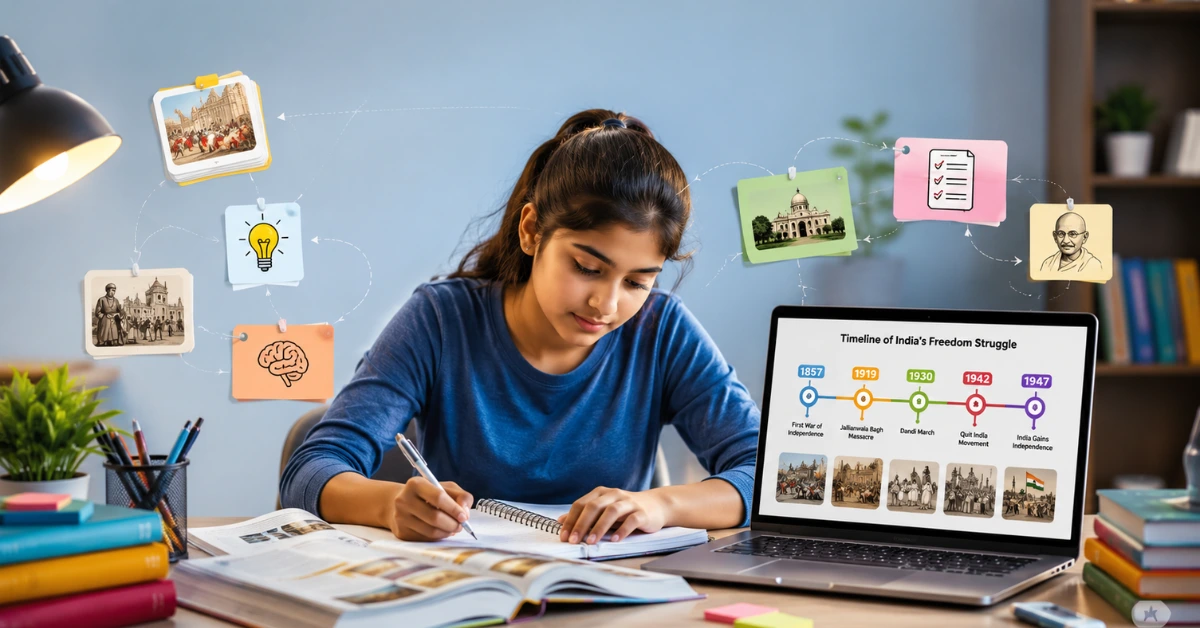
If you are wondering how to remember History dates with AI, you are not alone. It’s a familiar moment during every Social Science exam. You understand the chapter perfectly and can explain the event in your own words — but the moment you write the year, your mind goes blank. Was Jallianwala Bagh in 1919 or 1920? One forgotten date can cost marks, even when your understanding is spot on.
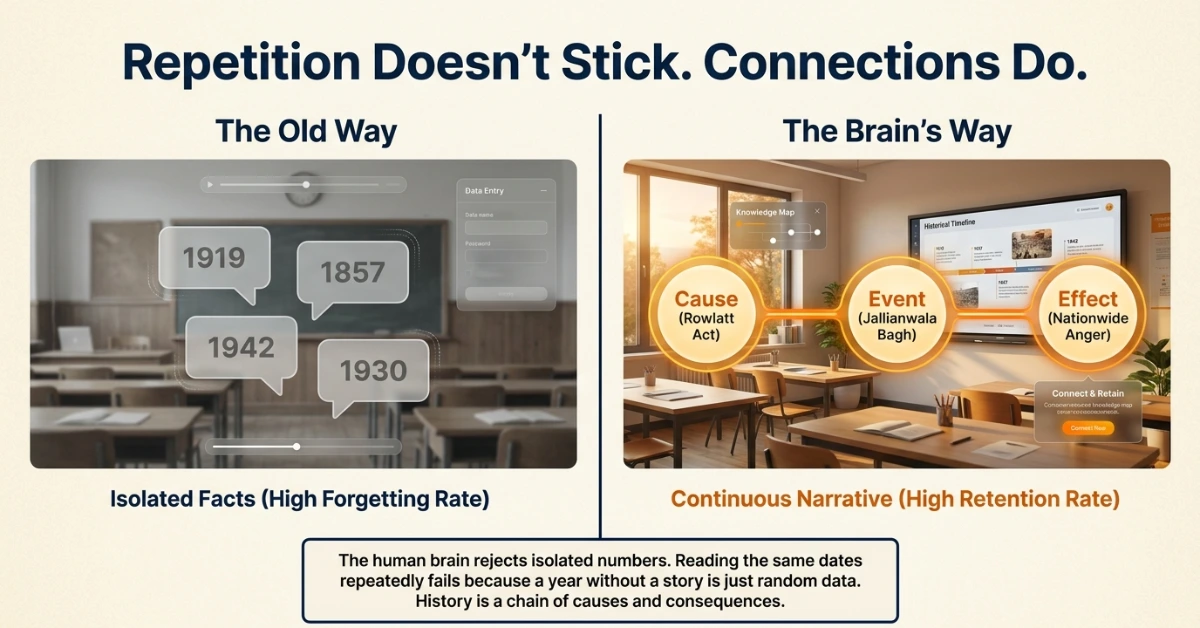
The problem isn’t that History is hard. It’s how most of us try to learn it — reading the same dates again and again, underlining them in different colours, hoping repetition will make them stick. It rarely does. The brain remembers stories, patterns and connections far better than isolated numbers.
This is where AI can become more than just an answer machine. Most students use tools like ChatGPT or Gemini only to get summaries — but used the right way, AI can turn confusing timelines into simple stories, build personalised memory tricks, and generate flashcards and quizzes that make dates genuinely easy to remember.
This guide isn’t about shortcuts. It’s about using AI as a memory coach — one that helps you understand an event first, so the date sticks naturally. If you’re preparing for CBSE Class 9 or 10 boards, these methods can make your Social Science revision far more organised, and a lot less stressful.
These strategies aren’t just for History; they are cross-disciplinary tools you can apply to Geography facts, Political Science amendments, or Economic milestones.
Also Read: Best AI Tutors for CBSE Students (2026): 7 Smart Tools for Smarter Learning
See the Method in Action: From Jallianwala Bagh (1919) to the Revolt of 1857
Instead of just telling you to “ask AI for a story,” here’s what that actually looks like.
The story version: On Baisakhi day, a crowd gathers peacefully in a walled garden in Amritsar to protest new British laws. General Dyer blocks the only exit and orders his soldiers to fire, without warning, into the unarmed crowd. Hundreds die. The massacre turns Indian public opinion firmly against British rule and pushes leaders like Gandhi toward mass movements.
The memory trick: Baisakhi (spring, new beginnings) turning into bloodshed is the twist that makes 1919 memorable — a peaceful festival gathering meeting the harshest British response yet.
The flashcard: Front — “Jallianwala Bagh.” Back — “1919, Amritsar, Dyer, turning point against British rule.”
The quiz question: “What festival was being marked when the Jallianwala Bagh massacre happened?” This one detail anchors the date in your memory far better than the number alone.
Once you see how one event breaks down this way, you can run any other event — the Revolt of 1857, the Quit India Movement of 1942, the Non-Cooperation Movement — through the exact same four steps: story, trick, flashcard, quiz.
One More Example: The Revolt of 1857
The same approach works for every major event in your syllabus. Take the Revolt of 1857, for example.
The story version: Indian soldiers, known as sepoys, were already unhappy with low salaries, poor treatment and growing British control. The introduction of the new Enfield rifle cartridges, believed to be greased with cow and pig fat, sparked widespread anger. What began as a military uprising soon spread across different parts of northern India and became one of the biggest challenges to British rule.
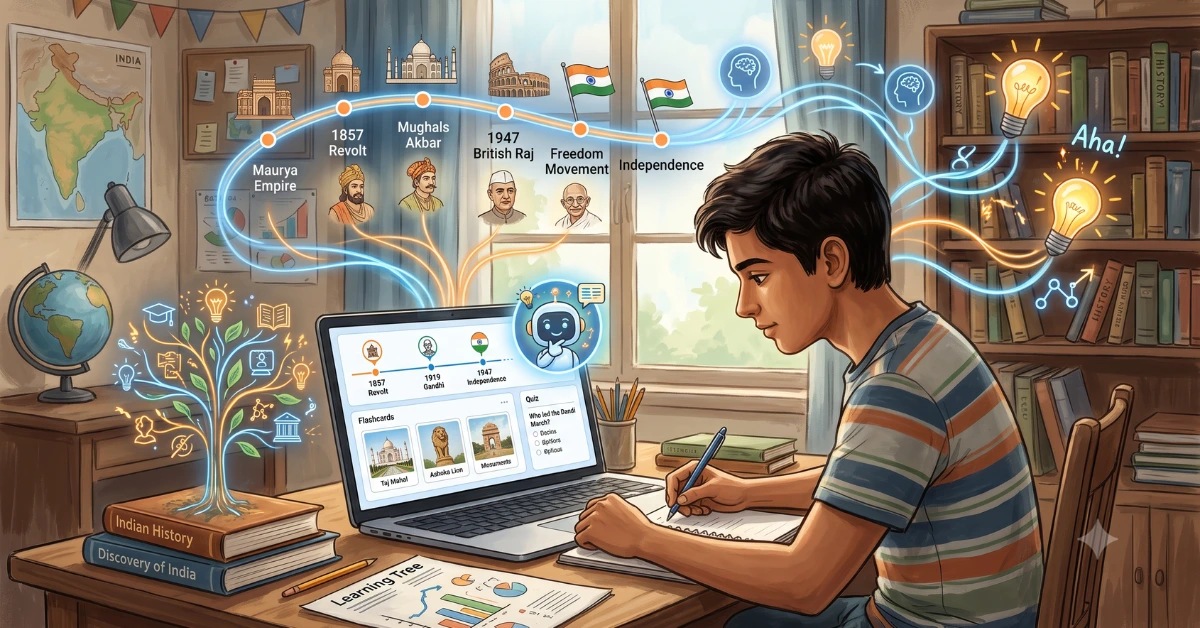
The memory trick: Think of 1857 as the year when scattered anger finally turned into open rebellion. Instead of remembering only the number, connect it with the beginning of India’s first large-scale revolt against British rule.
The flashcard: Front — Revolt of 1857
Back — 1857 | Sepoy uprising | Beginning of the First War of Independence | Major challenge to British rule.
The quiz question: What issue related to the Enfield rifle cartridges triggered the Revolt of 1857?
Once you practise a few events this way, you will realise that remembering dates becomes much easier because every year is attached to a story, a reason and an important outcome—not just a number in your textbook.
Also Read: Fear of Mathematics? How Indian Students Can Use AI to Understand Difficult Math Concepts
Build the Timeline Before You Memorise the Dates
One of the biggest mistakes students make is trying to memorise dates one by one. They begin highlighting years in the textbook without first understanding how those events are connected. A few days later, everything starts to feel mixed up because the brain is trying to remember isolated numbers instead of a sequence of events.
Before you focus on individual dates, spend a few minutes understanding the timeline of the entire chapter. Once you know what happened first, what happened next, and why one event led to another, remembering the years becomes much easier. Instead of memorising ten separate facts, your brain remembers one continuous story.
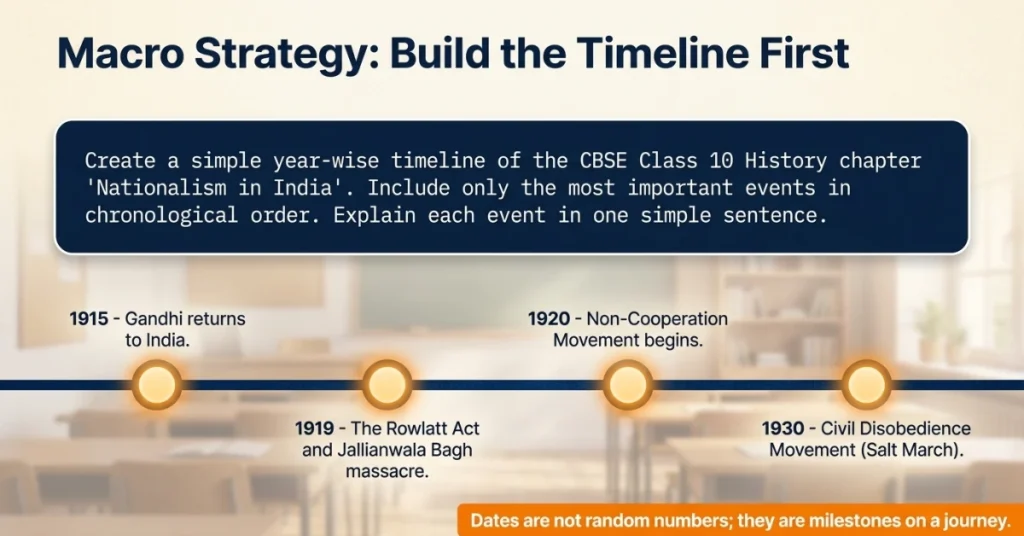
This is where AI can save a lot of time. Rather than reading the chapter repeatedly and creating your own timeline, you can ask ChatGPT or Gemini to organise the entire chapter into a simple year-wise sequence. Make sure the timeline is easy to read and includes only the most important events so that you are not overwhelmed with unnecessary details.
Try this prompt:
Create a simple year-wise timeline of the CBSE Class 10 History chapter “Nationalism in India”. Include only the most important events in chronological order. Explain each event in one simple sentence that a Class 10 student can easily understand.
Once the timeline is ready, read it from top to bottom two or three times. You will notice that the dates no longer feel random. They become milestones in a journey, making them much easier to recall during revision and in the examination hall.
Also Read: The End of the Guess Paper: How AI is Predicting Board Exams in 2026
Let AI Create Memory Tricks That Actually Work
Some dates refuse to stay in your memory no matter how many times you read them. If that happens, the problem is not your memory—it is the way you are trying to remember the information. Our brain remembers unusual, funny, or meaningful associations much better than plain numbers. That is why simple memory tricks, also known as mnemonics, have been used by students for years.
Instead of trying to invent these tricks on your own, let AI generate a few different options. Sometimes the first mnemonic may not make sense to you, but the second or third one might instantly click. The advantage of AI is that it can create personalised memory tricks based on your learning style instead of giving everyone the same example.
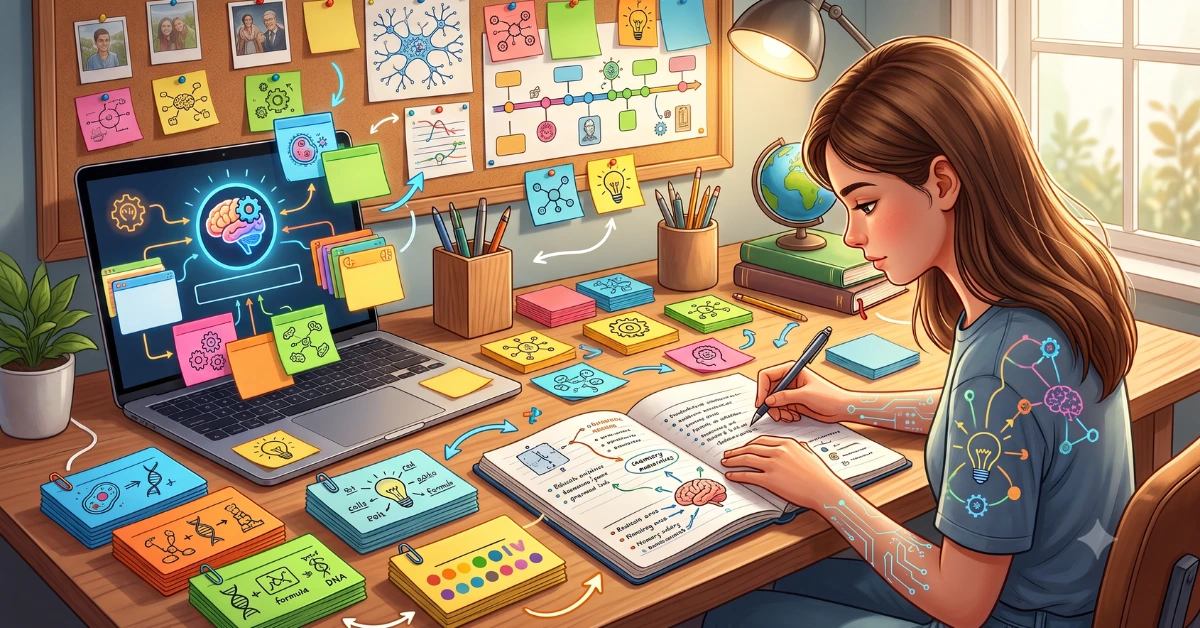
For instance, if you keep forgetting the sequence of important events during India’s freedom struggle, ask AI to create a short rhyme, an acronym, or even a funny sentence that connects those events in the correct order. The goal is not to create something academically perfect but something that your brain can recall quickly during the examination.
Try this prompt:
I am a CBSE Class 10 student. Create three different memory tricks to help me remember the important events and years from the Nationalism in India chapter. Make them simple, memorable and suitable for board exam revision.
After AI generates the memory tricks, read them aloud once or twice. If one of them makes you smile or feels unusual, there is a good chance you will remember it for much longer than a list of dates copied from the textbook.
Also Read: Beyond the Syllabus: 9 Secret AI Prompts to Predict Your Next Exam
Connect Every Date with Its Cause and Effect
One reason students confuse dates is that they try to remember only the year while ignoring the event behind it. History is not just a list of dates; it is a chain of causes and consequences. Every important event happened because of something, and almost every event led to another important development.
AI can help you organise this information into a simple table. Once you understand what caused an event and what happened afterwards, remembering the year becomes much easier because the date now has a logical place in the chapter.
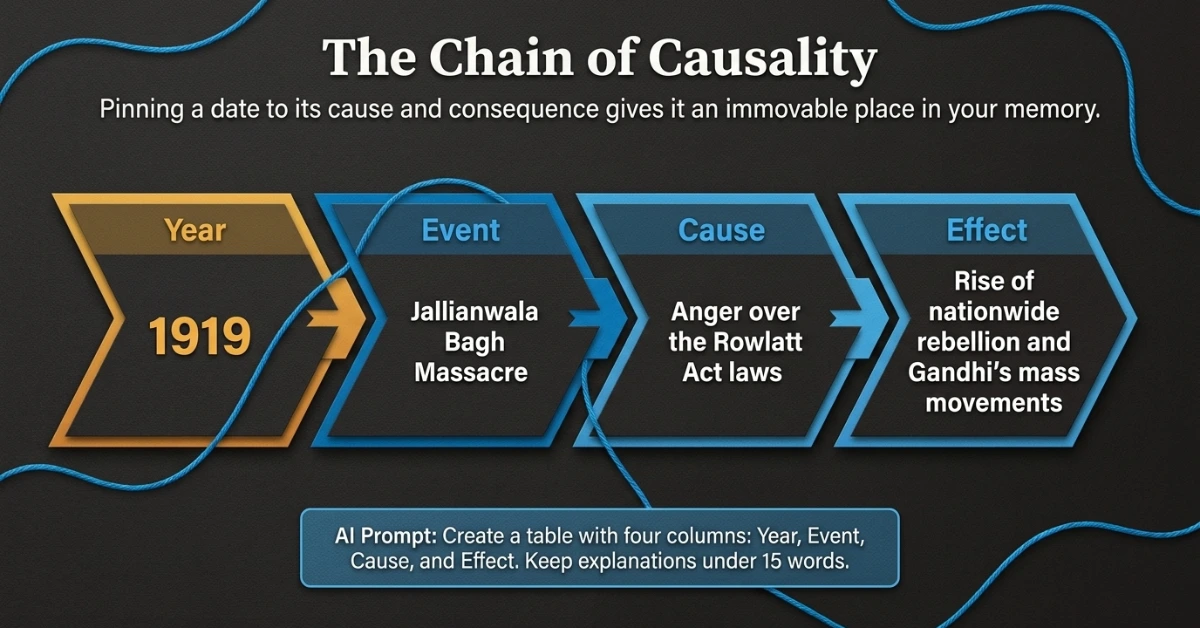
For example, instead of memorising 1919 by itself, connect it with the Rowlatt Act, the Jallianwala Bagh massacre, and the rise of nationwide anger against British rule. Suddenly, the year becomes part of a sequence rather than an isolated fact.
Try this prompt:
Act as a CBSE History teacher. Create a table with four columns: Year, Event, Cause and Effect. Include only the most important events from the chapter “Nationalism in India” and keep each explanation under 15 words.
This type of table is especially useful during the final week before the examination because you can revise an entire chapter in just a few minutes while still understanding the bigger picture.
Learn History by Having a Conversation
Reading the same chapter again and again can quickly become boring, especially during revision. After a point, you may feel as if you know everything, but the real test comes when someone asks you a question and you struggle to answer it. Instead of passively reading your notes, try turning your revision into a conversation.
AI can play the role of a history teacher, an examiner, or even a historical figure. Rather than giving you a ready-made answer, it can ask questions, challenge your understanding, and explain events from different perspectives. This makes revision far more engaging and helps you remember both the event and its context.
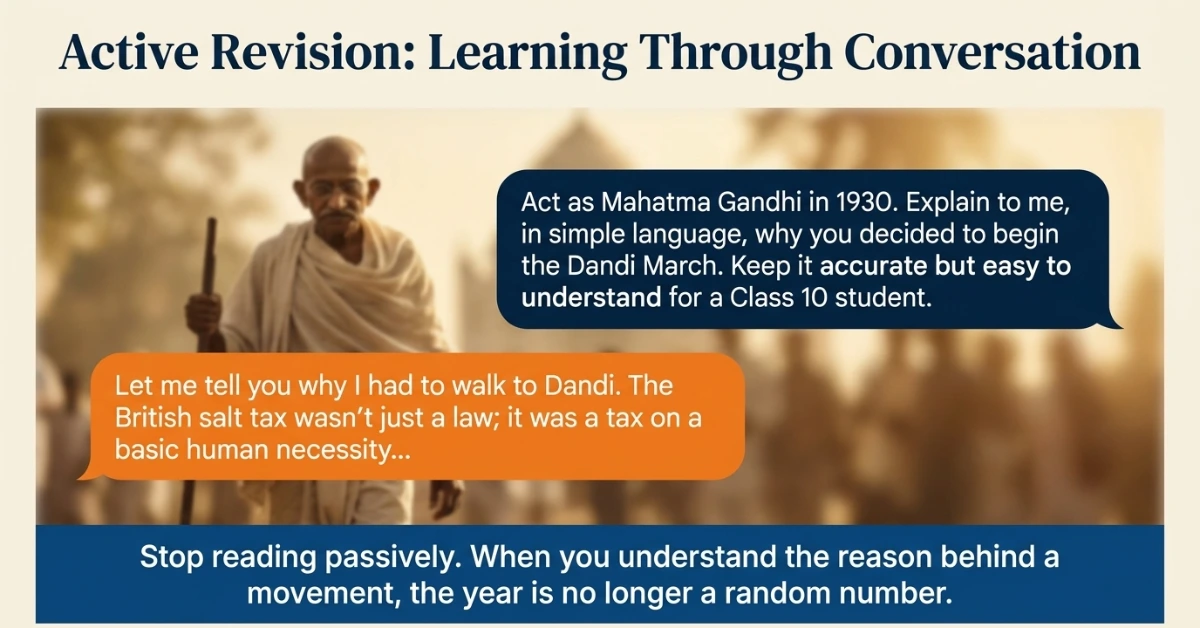
For example, instead of asking, “When did the Dandi March happen?“, ask AI to become Mahatma Gandhi and explain why the Salt March began in 1930. When you understand the reason behind the movement, the year no longer feels like a random number—it becomes part of a meaningful event.
Try this prompt:
Act as Mahatma Gandhi in 1930. Explain to me, in simple language, why you decided to begin the Dandi March. I am a CBSE Class 10 student, so keep the explanation accurate but easy to understand.
You can use the same method for Bhagat Singh, Subhas Chandra Bose, Dr B.R. Ambedkar, or even King Louis XVI while studying the French Revolution. Learning through conversation makes history feel much more alive than reading paragraphs from a textbook.
Also Read: AI Tools for CBSE English Students: Grammar, Writing, and Safe Use (A Teacher’s Guide)
A Simple 7-Day Revision Plan
Day 1, read and build a timeline. Day 2, turn events into stories. Day 3, make flashcards. Day 4, take a quiz. Day 5, revisit the dates you got wrong. Day 6, mix everything together. Day 7, attempt a short mock test.
Mistakes to Avoid
Don’t copy AI’s story or answer straight into your notebook without actually understanding it — the point is memory, not paperwork. Don’t rely on one memory trick for every date; what works for a friend may not work for you. And don’t skip revision — even the sharpest story fades if you never return to it.
For Parents and Teachers Too
Teachers can run this same story-and-quiz method for a five-minute class revision before a test. Parents don’t need to know the history themselves — just ask your child to narrate the story back to you. If they can tell it in their own words, the date has actually stuck.
The goal was never to remember faster. It’s to remember in a way that’s still there three months later, when it actually counts — in the exam hall.
Final Thoughts
Remembering History dates is not about having a perfect memory. It is about understanding the sequence of events and revising them in a smarter way. AI can help you create timelines, stories, flashcards, and quizzes that make revision more engaging and effective.
Just remember one thing—AI should support your learning, not replace it. Always verify important facts with your NCERT textbook and use AI as a study partner, not a shortcut. When you combine smart revision with regular practice, remembering Social Science dates becomes much easier than you might think.
Frequently Asked Questions (FAQs)
Can ChatGPT help me remember History dates?
Yes. ChatGPT can create timelines, stories, flashcards, quizzes, and memory tricks that make History dates easier to remember. However, always verify important facts with your NCERT textbook or your teacher.
Which AI tool is best for Social Science revision?
Tools like ChatGPT and Gemini are both useful for creating summaries, quizzes, timelines, and revision notes. The best choice is the one that helps you understand the chapter rather than simply giving direct answers.
Is it safe to use AI for CBSE board exam preparation?
Yes, as long as you use AI responsibly. Treat it as a study assistant for practice and revision, not as a replacement for your textbook or classroom learning.
Can AI create revision questions for board exams?
Yes. AI can generate chapter-wise quizzes, multiple-choice questions, assertion-reason questions, and short-answer questions based on your syllabus. These are useful for self-assessment, but the difficulty level may vary, so practise with previous years’ papers as well.
Should I memorise every History date?
No. Focus on the important dates mentioned in your NCERT textbook and understand the events connected to them. Learning the story behind an event is usually more effective than trying to memorise every year separately.

My name is Asheesh Kumar i am a dedicated educator and have a deep understanding of artificial intelligence, I aim to transform traditional learning methods by integrating cutting-edge technology and AI-driven tools into education. As a teacher and personal tutor, I have the privilege of working with many students and understanding their individual strengths and weaknesses. With this insight, I know how to help each student overcome their challenges and improve their skills. Understanding each student’s unique learning style and needs allows me to tailor lessons that maximize their potential. This holistic approach not only boosts academic performance but also builds confidence and a lifelong love for learning.
1 thought on “How to Use AI to Remember Social Science Dates and Historical Events Easily (CBSE Guide)”