
Last Updated on July 20, 2026 by Asheesh Kumar
Ask any CBSE or CISCE student which subject gives them sleepless nights before an exam, and chances are math tops the list. It’s strange when you think about it. The same student who can memorise an entire history chapter or write a beautiful English essay suddenly freezes when a quadratic equation shows up on the page. That’s not a coincidence, and it’s definitely not because they’re “bad at math.” It usually comes down to one simple thing: somewhere along the way, a concept was taught once, the class moved on, and the gap never got filled.
CBSE and ICSE syllabi don’t make this easier. Both boards move fast, especially from Class 9 onwards, and topics like trigonometry, mensuration, and algebra build directly on what came before. Miss one link in that chain, and everything after it feels like a foreign language. This is exactly where AI tools can step in, not as a shortcut to answers, but as a patient tutor that
Also Read: Google NotebookLM + Notion AI: A Complete AI Study System for Students (Build Your Second Brain)Your Personal Math Tutor, Minus the Pressure
Instead of using AI to copy answers for your homework, think of it as a tool to sharpen your logic. Here are a few ways students are already doing this, and why each one actually works.
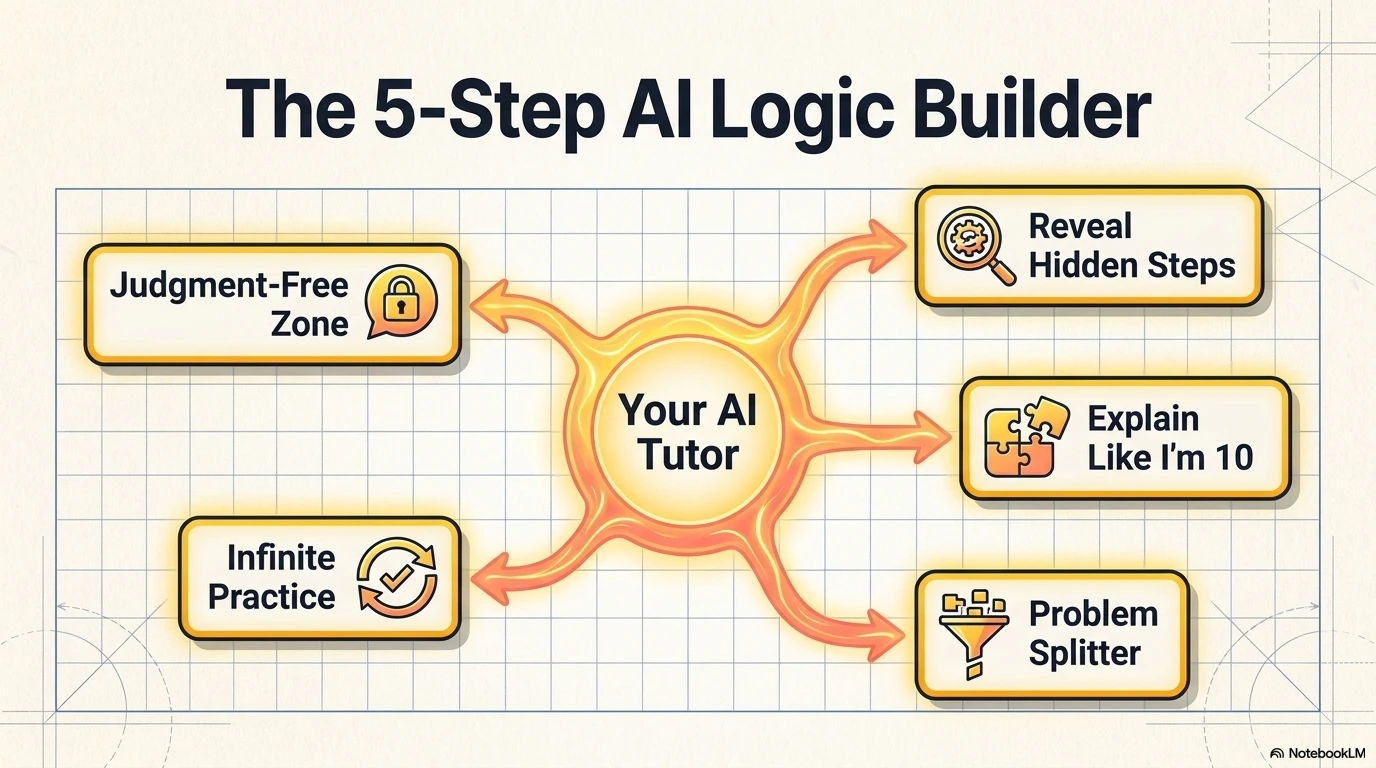
1. Ask AI to “Fill in the Missing Steps”
Start with the simplest habit: when you get stuck halfway through a CBSE sample paper or an ICSE proof, don’t just skip to the solutions section. Type the problem into an AI tool and say something like:
“Here is a math problem. Don’t just give me the final answer. Show me every single hidden step and explain why we changed the signs in step 3.”
This one shift matters more than it sounds. Most students lose marks not because they don’t know the formula, but because they don’t know why a particular step happens. Ask the AI to walk through the quadratic formula this way, and it’ll explain what’s actually happening inside that square root before it ever reaches the final number.

—and explain exactly what happens inside the square root before moving forward.
Also Read: Best AI Tools for CBSE Students to Solve Math Problems (2026): Free & Paid Options2. Use the “Explain Like I am 10” Rule
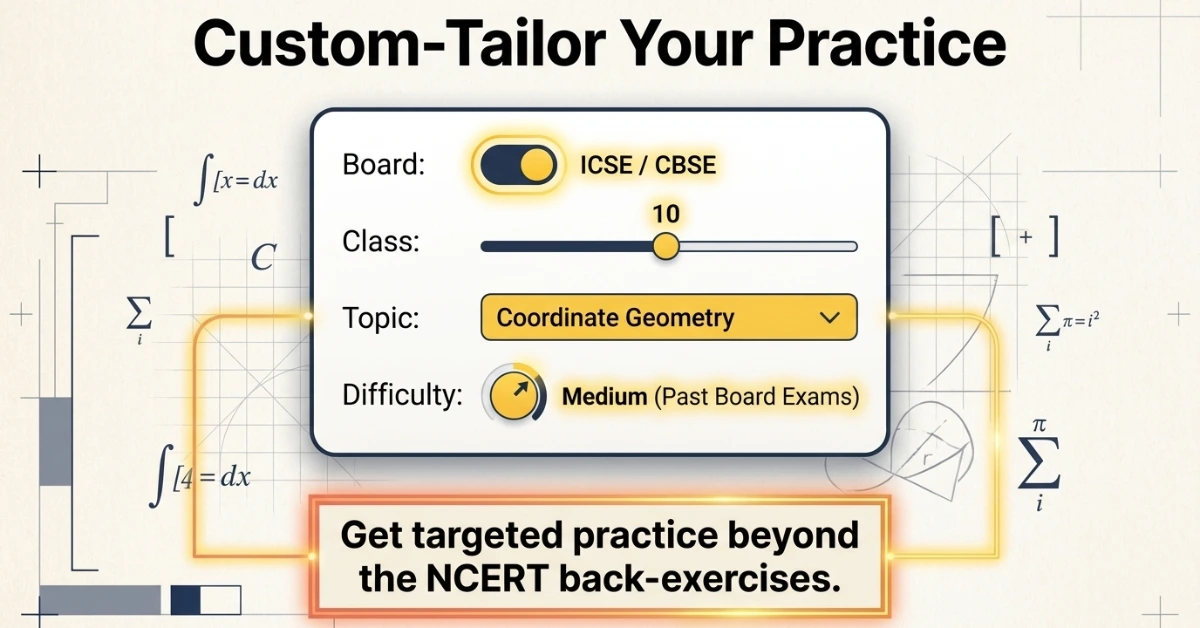
There’s also a trick worth trying when a topic feels needlessly complicated on paper. Concepts like Probability, Matrices, or Surface Areas often read like they were written for someone twice your age. In moments like this, skip the textbook definition and ask the AI to explain it the way you’d explain something to a younger sibling. Try a prompt like:
“Explain Permutations and Combinations using an IPL team selection example.”
It sounds like a small change, but a confusing formula turning into a cricket-team puzzle is the kind of thing that actually sticks in your head walking into the exam hall.
Also Read: 50+ Best AI Prompts for Students in 2026 – Study Smarter with ChatGPT & AI Tools3. Breaking Big Problems into Small Steps
CBSE board exams are notorious for word problems that look intimidating at first glance, especially in topics like time and work, or profit and loss. The instinct for most students is to either panic or jump straight to a formula without understanding what’s actually being asked.
This is where AI becomes genuinely useful. Instead of asking it to “solve this problem,” ask it to break the problem into smaller steps first. For example, paste a tricky word problem and add a line like
“explain what’s happening in this problem before solving it.”
You’ll often see the problem split into plain, logical pieces: what is given, what is being asked, and which formula connects the two. Once you see math broken down like this a few times, you start doing it on your own, without needing AI at all. That’s really the goal.
4. Create Unlimited Practice Questions
Finished all the back-exercises of your NCERT book but still feel shaky about Triangles or Coordinate Geometry?
You can tell AI: “I am a Class 10 ICSE student. Give me 5 medium-difficulty questions on Circles, similar to past board exam questions, and check my answers one by one.” This gives you customized practice papers tailored perfectly to your target board.
5. Clear Your “Silly” Doubts Without Hesitation
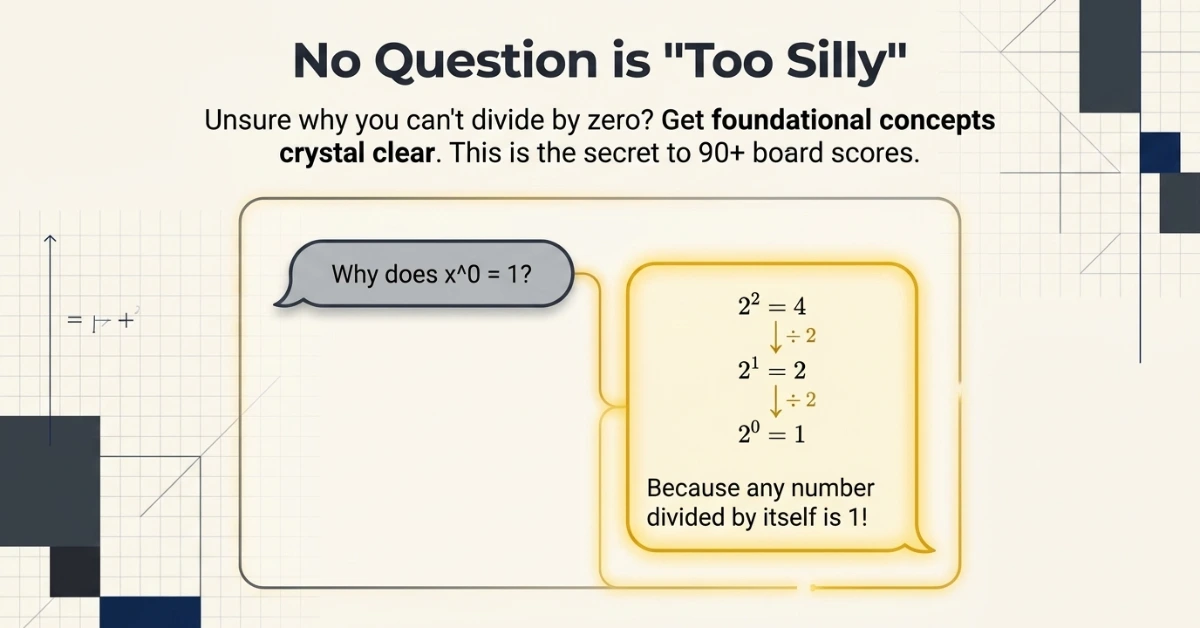
And then there are the doubts nobody likes to raise in class. Why does x^0 equal 1? Why can’t you divide a number by zero? These questions feel too basic to ask out loud, but they’re often exactly what’s missing when a topic doesn’t make sense later on. Getting these small foundational gaps cleared early is usually the real difference between a student who scrapes through and one who scores 90+.
A Few Ground Rules Worth Following
AI can make math less intimidating, but only if it’s used the right way. Always attempt a problem on your own first, even if it takes a few tries. Use AI to check and clarify, not to skip the thinking part entirely. And resist the temptation to copy-paste an answer straight into your notebook. The point isn’t to finish your homework faster; it’s to actually understand the chapter so the next test doesn’t feel like a surprise.
Also Read: Beyond the Syllabus: 9 Secret AI Prompts to Predict Your Next ExamMath Fear Doesn’t Have to Be Permanent
Fear of math is common, and for CBSE and ICSE students juggling tight syllabi and constant testing, it’s almost expected. But it isn’t permanent. With the right approach, AI can turn into the kind of patient, judgment-free tutor most students wish they had in the classroom, one explanation, one step, and one small win at a time.
And if you’re curious about how AI is reshaping education, explore more guides here on FutureReadyStars.com — where we break down new AI tools in simple language for students, parents, and teachers.
If you’re more comfortable learning in Hindi, visit our Hindi website AISePadhai.in. We publish easy-to-understand guides on ChatGPT, AI tools, CBSE, UP Board, and smart study tips for students.
👉 Read in Hindi at AISePadhai.in

My name is Asheesh Kumar i am a dedicated educator and have a deep understanding of artificial intelligence, I aim to transform traditional learning methods by integrating cutting-edge technology and AI-driven tools into education. As a teacher and personal tutor, I have the privilege of working with many students and understanding their individual strengths and weaknesses. With this insight, I know how to help each student overcome their challenges and improve their skills. Understanding each student’s unique learning style and needs allows me to tailor lessons that maximize their potential. This holistic approach not only boosts academic performance but also builds confidence and a lifelong love for learning.
I do agree with all the ideas you have introduced on your post They are very convincing and will definitely work Still the posts are very short for newbies May just you please prolong them a little from subsequent time Thank you for the post