
Last Updated on July 20, 2026 by Asheesh Kumar
It’s past 11 PM, and a CBSE Class 11 student is staring at the same rotational motion problem she has been trying to solve for over an hour. Her tuition teacher isn’t picking up the phone. Her parents want to help but haven’t studied Physics in years. Even the answer key at the back of her guidebook gives nothing more than the final answer, with no explanation of how to get there.
That’s the real story of AI tutoring in 2026, and it has very little to do with which app has the flashiest homepage. It’s not that AI has replaced teachers. It’s that, for the first time, a student in a small town with a decent phone and patchy internet can get something close to what a well-off student in Delhi or Bangalore has always taken for granted — someone, or something, to ask “why” at midnight and actually get an answer.
This isn’t just a trend students are chasing on their own, either. CBSE itself rolled out an official AI and Computational Thinking curriculum for Classes 3 to 8 starting the 2026-27 session, with Classes 9 and 10 expected to get their own version from 2027-28. The board isn’t teaching AI as a separate coding subject — it’s teaching students to think alongside it, right from the primary years. Read between the lines and the message is simple: CBSE has already decided AI literacy isn’t optional anymore. The tools below are just where that shows up first, for students already sitting board exams today.

Unlike a traditional search engine that simply lists information, an AI tutor can explain the same concept in different ways, adjust its explanations based on your questions, and even generate practice problems to help you improve. That’s what makes these tools different from simply searching for an answer on Google.
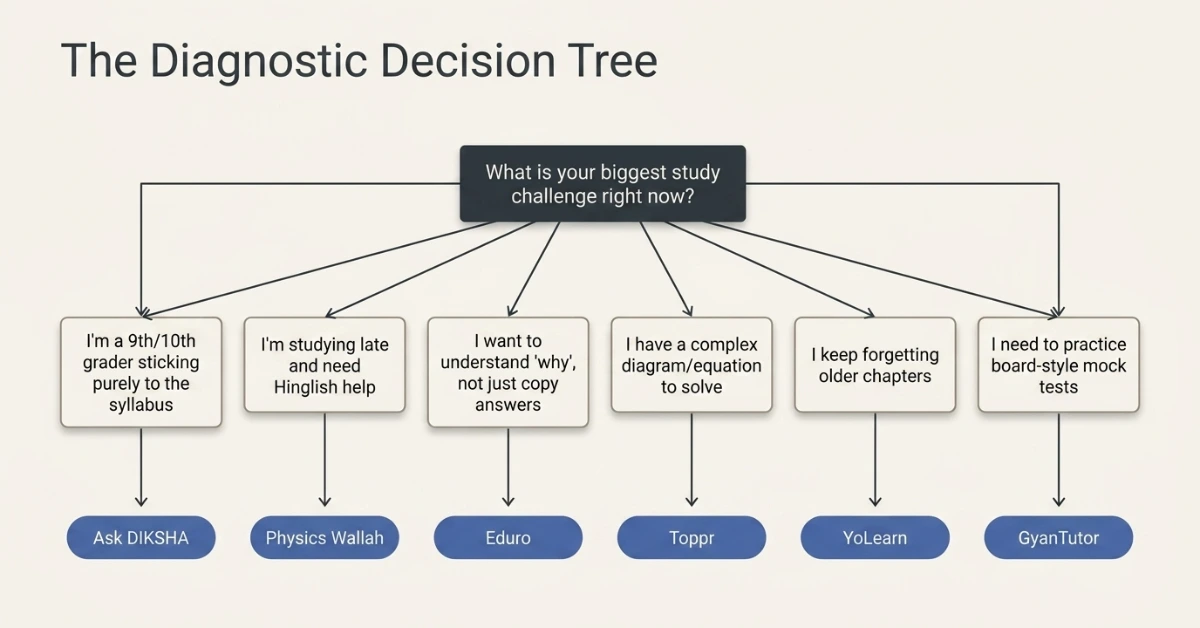
Here’s what I found, organised around the problems students actually run into, not a ranked “best to worst” list. The honest answer is that no single tool does everything well. Match the tool to the problem you actually have, and you’ll get far more out of this list than you would from downloading all seven at once.
Also Read: Fear of Mathematics? How Indian Students Can Use AI to Understand Difficult Math Concepts
1. Physics Wallah (Ask AI)
Best for: Students who prefer learning through conversation in Hindi or Hinglish.
Physics Wallah has built a strong reputation among CBSE and JEE students, and its Ask AI feature extends that experience beyond recorded lectures. Instead of reading long blocks of text, students can ask questions naturally and receive explanations in a conversational style that feels closer to speaking with a teacher than using a search engine.
This makes it particularly useful when you’re stuck on a Physics numerical or a tricky Maths concept late at night and simply need someone to explain why a step works instead of showing only the final answer.
What I liked
- Explains concepts in simple language.
- Supports natural Hindi and Hinglish conversations.
- Helpful for everyday doubt solving.
Things to keep in mind
- Some advanced features require a paid subscription.
- Like any AI tool, it’s still worth verifying important answers with your NCERT textbook or teacher.
Best suited for: Students who regularly need quick explanations while studying at home.
Also Read: Best AI Tools for CBSE Science Students in 2026
2. Eduro
Best for: Students who want to understand concepts instead of memorising answers.
Many AI chatbots can solve a question in seconds, but very few actually help students understand why the solution works. That’s where Eduro feels different. Instead of immediately revealing the answer, it follows a guided learning approach. It asks questions, gives hints, and encourages students to think before moving to the next step.
This teaching style can be especially useful for CBSE students because board exams increasingly test conceptual understanding rather than simple memorisation. If you often feel confident while reading a chapter but struggle to solve new questions on your own, Eduro can help bridge that gap.
One feature I particularly liked is that it generates additional practice questions after explaining a concept. Instead of stopping after one solution, you get a chance to apply what you’ve just learned, which is exactly how real learning happens.
What I liked
- Encourages conceptual learning instead of answer copying.
- Creates practice questions automatically.
- Well suited for regular self-study.
Things to keep in mind
- Some explanations can become lengthy for very simple questions.
- It works best when you already know the basics of the topic.
Best suited for: Students preparing for CBSE board exams who want stronger concepts rather than quick answers.
3. Ask DIKSHA (Ministry of Education)
Best for: Students who want learning aligned with official NCERT content.
When preparing for CBSE board exams, most teachers repeatedly say one thing—don’t ignore NCERT. That’s exactly why Ask DIKSHA deserves a place on this list.
Unlike many commercial AI platforms, Ask DIKSHA is connected to India’s official digital learning ecosystem. It focuses on textbook-based learning and supports multiple Indian languages, making it a reliable choice for students studying in different regions of the country.
If your goal is to understand an NCERT concept, revise textbook chapters, or stay close to the official syllabus, this is probably one of the safest platforms to begin with.
What I liked
- Closely aligned with NCERT resources.
- Backed by the Ministry of Education.
- Supports learning in multiple Indian languages.
Things to keep in mind
- It isn’t designed for advanced competitive exam preparation.
- Some features may continue evolving as the platform expands.
Best suited for: Students who want trustworthy, syllabus-focused learning without unnecessary distractions.
4. GyanTutor
Best for: Personalised practice and board-style mock tests.
One of the biggest challenges in board exam preparation is identifying your weak areas. Most students keep solving random questions without knowing which chapters actually need more attention.
GyanTutor tries to solve this problem by analysing your performance over time. Instead of giving every student the same set of questions, it focuses more on the topics where you’re making repeated mistakes.
I also found its mock test approach useful because regular practice under exam-like conditions often improves confidence far more than simply rereading notes.
What I liked
- Personalised study recommendations.
- Board-style mock tests.
- Useful progress tracking.
Things to keep in mind
- Some advanced analytics may not be available in the free version.
- Results are more useful when you study consistently over several weeks.
Best suited for: Students preparing for Class 10 or Class 12 board examinations who want structured practice.
5. YoLearn
Best for: Smart revision and long-term memory retention.
Many students spend hours preparing a chapter, only to realise a few months later that they’ve forgotten most of it. Revision often becomes stressful because they don’t know what to revise first.
YoLearn AI approaches revision differently. Instead of asking you to go through the entire textbook again, it identifies topics that need more attention and creates a personalised revision schedule.
This targeted approach can save a lot of time during board exam preparation, especially when multiple subjects need revision together.
What I liked
- Helps organise revision efficiently.
- Focuses on weak concepts instead of repeating everything.
- Encourages regular revision habits.
Things to keep in mind
- It works best when you use it consistently.
- Students expecting instant results may not get the full benefit.
Best suited for: Students who struggle to remember concepts over long periods.
6. Toppr (Ananda AI)
Best for: Solving visual questions using images.
Sometimes the biggest difficulty isn’t solving the question—it’s typing it.
Whether it’s a complicated Biology diagram, a Geometry figure, or a lengthy Chemistry equation, entering everything manually can be frustrating. Toppr makes this process easier by allowing students to scan questions directly from their textbooks or notebooks.
Its image recognition works well for many school-level problems, and the step-by-step explanations are generally easy to follow.
What I liked
- Excellent image-based doubt solving.
- Helpful visual explanations.
- Large question database.
Things to keep in mind
- Image quality affects accuracy.
- Some premium learning features require a subscription.
Best suited for: Students who prefer scanning questions instead of typing them.
7. Vedantu (W.A.V.E & AI Insights)
Best for: Students who attend live online classes.
Unlike most tools on this list, Vedantu combines human teachers with AI-powered learning insights. During live classes, its AI analyses participation, quiz performance, and learning progress to identify where students might need additional support.
This combination of live teaching and AI analytics can be particularly useful for students who prefer classroom-style learning but still want personalised feedback.
Parents may also appreciate the detailed learning reports, which provide a clearer picture of a student’s strengths and areas for improvement instead of relying only on test scores.
What I liked
- Combines experienced teachers with AI support.
- Useful performance insights.
- Strong ecosystem for regular online learners.
Things to keep in mind
- Many advanced features are linked to Vedantu’s paid courses.
- Less useful if you’re only looking for a free doubt-solving app.
Best suited for: Students who already attend online coaching and want detailed learning analytics.
Also Read: 15 Best AI Apps That Make CBSE Studying 10× Easier [By Class & Subject]
Quick Comparison: Best AI Tutors for CBSE Students
| AI Tutor | Best For | Free Version | Ideal For |
|---|---|---|---|
| Physics Wallah Ask AI | Voice-based doubt solving in Hinglish | Yes (limited) | Daily concept clarification |
| Eduro | Guided, step-by-step learning | Yes | Building strong fundamentals |
| Ask DIKSHA | Official NCERT-aligned support | Yes | Board exam preparation |
| GyanTutor | Personalized mock tests | Varies | Identifying weak areas |
| YoLearn AI | Smart revision planning | Yes | Long-term retention |
| Toppr (Ananda AI) | Image-based doubt solving | Limited | Science and Maths questions |
| Vedantu (W.A.V.E. & AI Insights) | AI-supported live learning | Limited | Students attending online classes |
Which AI Tutor Should You Choose?
| If you are… | Choose |
|---|---|
| Class 9–10 Student | Ask DIKSHA |
| Class 11–12 Student | Physics Wallah Ask AI |
| Need Better Concepts | Eduro |
| Preparing for Boards | GyanTutor |
| Revising Chapters | YoLearn AI |
| Prefer Visual Learning | Toppr |
| Already Taking Online Coaching | Vedantu |
The Bottom Line
Having access to smart AI tools does not automatically guarantee 95% marks. What truly matters is how you use them. Treat these platforms as your personal support system to clarify doubts, manage your time smartly, and test your knowledge rigorously—not as a shortcut to skip hard work.
Over to you: Which of these AI tutors are you planning to try this academic year? Do you prefer voice assistants or visual doubt-solvers? Let me know in the comments below, and let’s get a discussion going!
And if you’re curious about how AI is reshaping education, explore more guides here on FutureReadyStars.com — where we break down new AI tools in simple language for students, parents, and teachers.
If you’re more comfortable learning in Hindi, visit our Hindi website AISePadhai.in. We publish easy-to-understand guides on ChatGPT, AI tools, CBSE, UP Board, and smart study tips for students.
👉 Read in Hindi at AISePadhai.in

My name is Asheesh Kumar i am a dedicated educator and have a deep understanding of artificial intelligence, I aim to transform traditional learning methods by integrating cutting-edge technology and AI-driven tools into education. As a teacher and personal tutor, I have the privilege of working with many students and understanding their individual strengths and weaknesses. With this insight, I know how to help each student overcome their challenges and improve their skills. Understanding each student’s unique learning style and needs allows me to tailor lessons that maximize their potential. This holistic approach not only boosts academic performance but also builds confidence and a lifelong love for learning.
4 thoughts on “Best AI Tutors for CBSE Students (2026): 7 Smart Tools for Smarter Learning”