Karnataka AI Tutor Program Explained: How AI Tutors Could Change Government Schools in India

Karnataka AI Tutor Program Explained: How AI Tutors Could Change Government Schools in India

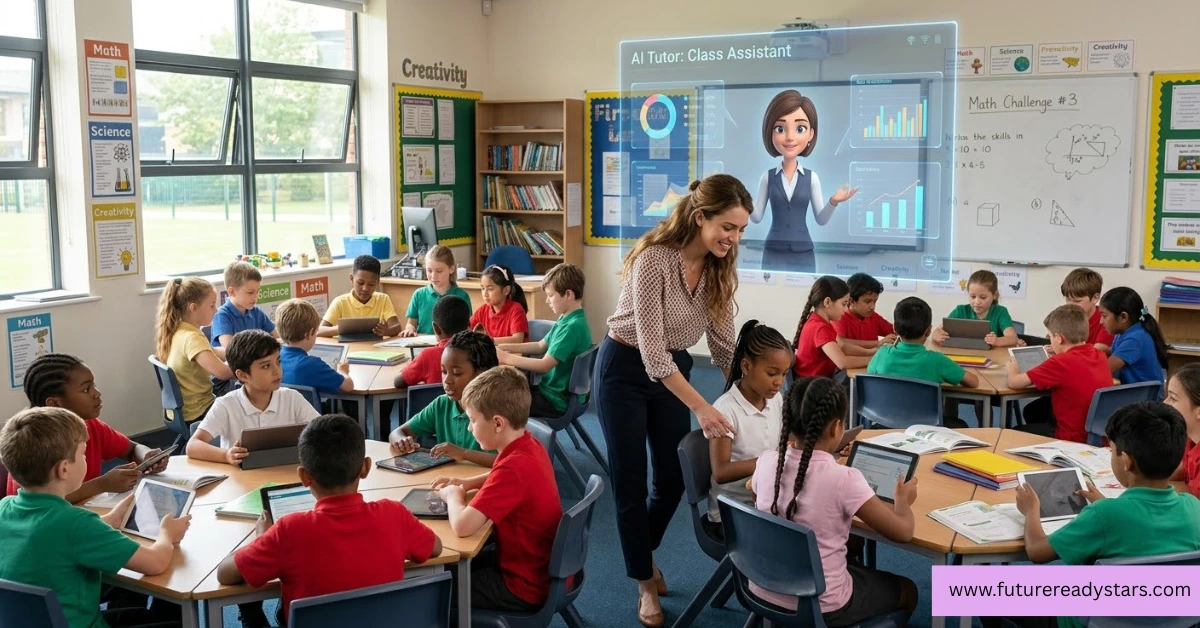
A state that educates millions of kids in Kannada is now betting that artificial intelligence can do what decades of teacher shortages couldn’t. Here’s what’s actually happening — and why it might matter far beyond one state. “Picture a child in a government school in Kalaburagi — no private tutor, no internet at home, one teacher handling five subjects — suddenly having something that answers every question, in Kannada, without getting tired.” That sounds like science fiction. But Karnataka’s government has quietly set the wheels in motion on exactly this kind of experiment. And whether you’re skeptical or hopeful, the sheer ambition of what they’re attempting deserves more attention than it’s been getting. This isn’t about fancy tablets for elite schools. This is about deploying AI-powered learning tools across government schools — the schools that educate kids from the most under-resourced families in the state. Let that sit for a second. Also Read: CBSE Is Teaching AI to 8-Year-Olds From 2026 — Here’s Exactly What Your Child Will Learn Grade by Grade So What Are They Actually Doing? Karnataka’s Department of School Education and Literacy has been piloting an AI-assisted learning program in select government schools — part of a broader push that’s been building since the state’s NEP 2020 implementation began. The idea is to bring in AI tutoring tools that can interact with students in their native language, adapt to their learning pace, and fill the gap that exists when a teacher simply cannot give every child individual attention. The tools being looked at aren’t just digital textbooks dressed up with a chatbot. Think more along the lines of adaptive learning engines — platforms that track where a student is struggling, adjust the difficulty in real time, explain concepts differently when the first explanation doesn’t land, and quiz students in ways that feel less like tests and more like a conversation. The goal is personalisation at scale — something human teachers, stretched thin across thirty-plus students and multiple subjects, genuinely can’t pull off alone. 43K+ Government schools in Karnataka — the potential scale of this rollout ~60% Of Karnataka’s school-going children enrolled in government institutions 1:35 Average student-to-teacher ratio in many government schools 12+ Languages spoken across Karnataka — localisation is the hard part What Does a “Digital AI Tutor” Actually Look Like? When people hear “AI teacher,” the brain immediately conjures a robot standing at a chalkboard. The reality is far more practical — and honestly, far more interesting than that. Think of it less as a replacement teacher and more as a 24/7 co-teacher who never loses patience. Here’s the problem it’s solving: in a traditional classroom, if a student misses the logic behind an algebra equation on Tuesday, the class moves to the next chapter on Wednesday. That gap doesn’t close — it compounds. Week after week, the child falls a little further behind, and nobody has the bandwidth to go back and fix the root cause. The AI tutor is designed to interrupt exactly that pattern. It sits alongside the regular curriculum — not replacing it, running parallel to it. A student who struggles with fractions but breezes through geometry gets a different experience than the student who’s the opposite. The tool adjusts, not because someone programmed in a rigid set of rules, but because it’s tracking in real time what’s landing and what isn’t. It doesn’t move on until the child is ready to move on. That’s not a small thing. That’s actually the thing most children in large classrooms never experience. Also Read: ChatGPT Just Dropped 70+ Interactive Math & Science Visualizations — Here’s Every Topic Covered & How to Use It Before Your Exam Real Talk for Educators: And it’s worth being honest with educators here, because this part matters: the hardest thing about teaching forty-plus kids in one room isn’t knowing the subject. It’s the relentless, energy-draining reality of fifty different learning speeds moving in fifty different directions at once. The AI takes over the exhausting repetitive work — the drills, the basic doubt-clearing, the same explanation for the fourteenth time — so the teacher can do what only a human can do. The quiet kid in the back row gets the same quality of explanation as the loudest kid at the front. No favouritism, no fatigue, no moving on just because the clock says to. The Obvious Question: Will AI Replace the Human Teacher? Nobody who’s thought about this carefully believes AI tutors replace teachers. That’s not the pitch, and it would be a terrible pitch. What’s actually being argued is something subtler: AI can handle the repetitive, individual-paced, drill-and-practice work that teachers currently have no time for — which frees the teacher to do the things AI genuinely can’t do. Motivating a disengaged kid. Noticing when something is wrong at home. Building the kind of trust that makes a student show up even when they don’t want to. The worry, though, is real and worth naming. In under-resourced schools, technology initiatives have a history of looking great on paper and then quietly dying in practice. Devices that never get charged. Platforms in English when the kids speak Tulu. Software that requires internet, in schools where connectivity is a pipe dream. The graveyard of well-intentioned EdTech initiatives in India is long and sobering. The Kannada Problem — And Why It’s Actually the Most Interesting Part Here’s something that doesn’t get enough attention: building AI tutors for English-medium, urban students is relatively solved. There are fifty companies doing it. The hard, interesting, meaningful problem is building one that works for a first-generation learner in Raichur whose home language is a dialect of Kannada mixed with Urdu, who’s never seen a device before, and who learns at a different pace than the curriculum assumes. Karnataka is genuinely wrestling with this. The state has pushed vendors on Kannada-medium content, on local-language voice interfaces, on making sure the tool doesn’t assume prior familiarity with technology. It’s not perfect — it can’t be yet — but the fact that this is being treated as … Read more

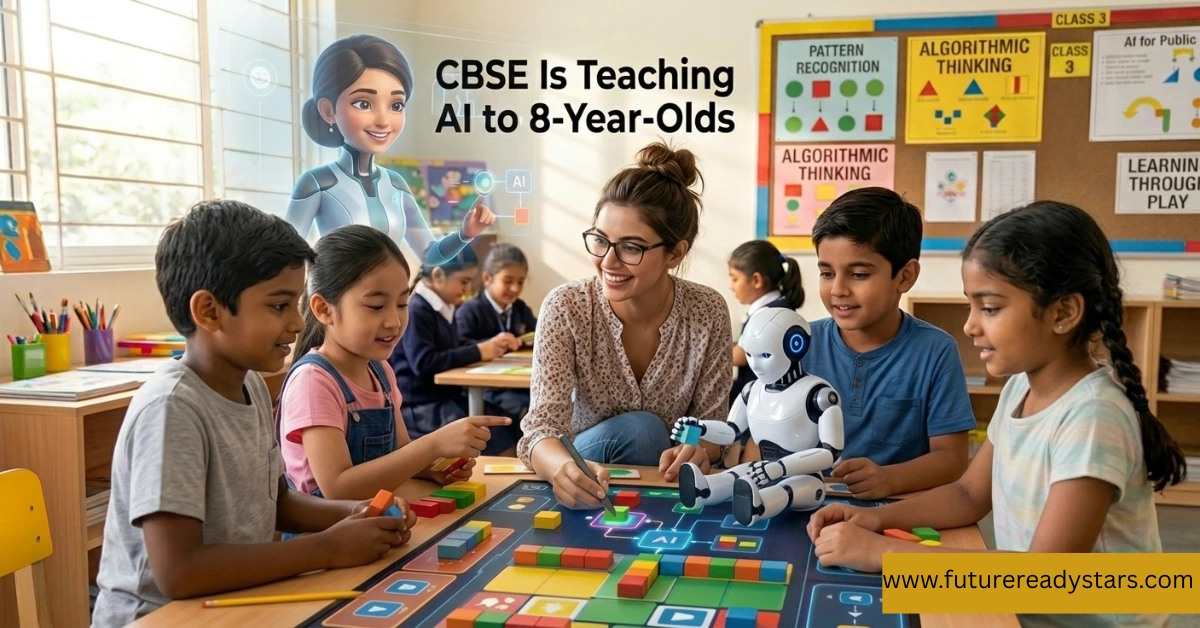
CBSE Is Teaching AI to 8-Year-Olds From 2026 — Here’s Exactly What Your Child Will Learn Grade by Grade

CBSE Is Teaching AI to 8-Year-Olds From 2026 — Here's Exactly What Your Child Will Learn Grade by Grade

The CBSE AI curriculum 2026 is one of the biggest changes in India’s school education system, aiming to build real-world thinking skills from an early age It’s not a pilot project. It’s not a “tech elective” for gifted kids. From this academic year, every child in a CBSE school — starting Class 3 — will begin learning Artificial Intelligence. Here’s what that actually looks like, classroom by classroom. Think back to when you first encountered a computer in school. Maybe it was Class 5 or 6. Maybe you typed your name in MS Paint and thought that was revolutionary. Your kids won’t have that experience — because their generation is going to learn how the machine thinks, not just how to use it. On October 30, 2025, the Ministry of Education made it official: AI and Computational Thinking will be embedded into every CBSE school, starting from Class 3, from the 2026–27 academic year. Not as a fancy optional subject. Not just in tech-heavy private schools. All schools. All students. If you’re a parent trying to figure out what this means for your child — or a student wondering what’s coming — this is the breakdown you need. Also Read: Help Your Child Read English: 5 Useful Educational Gadgets for Indian Students (Teacher’s Guide) The Numbers That Put This in Perspective 31K+ CBSE schools that will implement this curriculum nationwide 10M Teachers who need to be trained before this rolls out Class 3 The earliest grade — roughly 8-year-olds — where AI learning begins That teacher number — 10 million — is the one that tells you how ambitious (and honestly, how challenging) this really is. India is attempting one of the world’s largest integrations of AI education into school learning. No country has done this at this scale, at this age, this fast. CBSE AI Curriculum 2026 Explained (Class 3 to 12) Here’s the part most news articles skip — the actual classroom content. The curriculum is designed in four stages, each building on the last. Think of it like a staircase, not a jump. 🟠 Class 3–5 · Ages 8–11 The Foundation Stage — “AI Without Screens” Real talk for parents: Under the CBSE AI curriculum 2026, your 8-year-old will not be coding. They won’t touch Python; they won’t see a terminal screen. And that’s completely intentional. CBSE and the NCERT team have designed this stage around one idea — build the thinking first, tools come later. The child who can break a problem into steps, spot a pattern, and think about “what happens if I change this rule” is already thinking computationally. Also Read: Help Your Child Write Better English: Simple Educational Tools That Actually Work (Teacher’s Guide for Indian Parents) 🔵 Class 6–8 · Ages 11–14 The Exploration Stage — “What AI Actually Does” Real talk: This is where the curriculum becomes genuinely impressive. The ethics and bias module in particular is something most university computer science programmes still don’t teach properly. A Class 8 student who can articulate why an AI system might be unfair — and to whom — has a critical thinking edge that will matter in every career path, not just technology. If your child is in this age group right now, the best head start you can give them costs nothing: have dinner-table conversations about the apps they already use. “Why do you think Instagram showed you that reel?” is a perfect warm-up for what’s coming in their classroom. Also Read: AI for Indian Students: Your Teacher’s Real Talk on Learning Smarter in 2025 🟢 Class 9–10 · Ages 14–16 The Application Stage — AI as a Compulsory Subject The AI Project Cycle — The framework running through everything: Define the problem → Collect & clean data → Build the model → Test → Improve. Students apply this to real self-chosen problems — predicting electricity usage, detecting plant diseases in photos — not textbook exercises. Python Programming — Students graduate from block-based coding to Python, the world’s most used AI language. Starting with variables, loops, and functions in Class 9 — by Class 10 they’re using NumPy and Pandas on actual datasets. With the Class 6–8 foundation, the jump is manageable. Data Science Fundamentals — The full workflow: collecting data, cleaning it, analysing it, visualising it. Charts, heat maps, spotting outliers. A skill that’s useful in every career — medicine, journalism, economics, public policy — not just tech. Neural Networks — How AI Actually “Learns” — First real look under the hood. What a neural network is, how it learns from examples instead of explicit rules, and what happens when you train one on a dataset and watch accuracy climb. One of those concepts that clicks and changes how you see everything. Computer Vision — How AI identifies a face, reads a handwritten digit, or detects a tumour in an X-ray. Students label training data and discover why image quality and diversity matter. Directly connected to things they use daily — face unlock, Google Lens, Instagram filters. Natural Language Processing (NLP) — How does ChatGPT understand a question? How does autocorrect know what you meant? Students do hands-on sentiment analysis, text classification, and basic language models — using tools they already interact with every day. Machine Learning — Regression, Classification, Clustering — The three core types, each with real examples. Predicting tomorrow’s temperature. Filtering spam. Grouping customers by behaviour. All practiced in Python, not just defined in notes. Mathematics for AI — Probability, statistics, basic linear algebra — taught with one purpose: showing students that the math from their other subjects is the actual engine inside every AI model they’ve ever used. Real talk: This is a significant leap — and an exciting one. A Class 10 student who completes this curriculum will have built real AI projects, written actual Python code, and understood how models learn from data. That’s not exaggeration — that’s the syllabus. The AI Project Cycle assessment means marks aren’t just from memorising definitions; students are evaluated on the quality of the problem they chose, how they approached it, and what … Read more

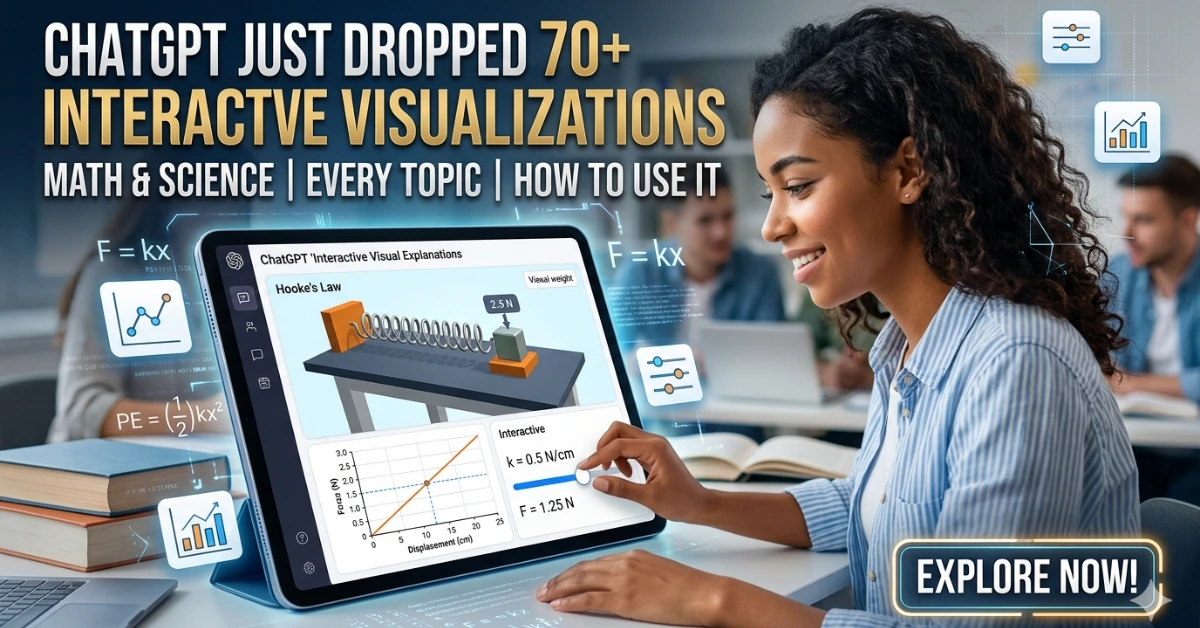
ChatGPT Just Dropped 70+ Interactive Math & Science Visualizations — Here’s Every Topic Covered & How to Use It Before Your Exam

ChatGPT’s interactive visualizations

By Asheesh Kumar 2026 · 8 min read ChatGPT’s interactive visualizations are built-in learning modules that show math and science concepts through live graphs, sliders, and dynamic diagrams—helping students understand concepts instead of just reading them. On March 10, 2026, OpenAI pushed out a feature that didn’t make as much noise as it deserved. No flashy demo reel, no celebrity tweet. Just a quiet update that changed how 140 million weekly ChatGPT users can study math and science — forever. It’s called Interactive Visual Explanations, and if you haven’t stumbled across it yet, here’s the simplest way to describe it: you ask ChatGPT about a concept — say, Ohm’s Law — and instead of getting a wall of text, you get a live, draggable module where you can slide the voltage up, watch the current change, and feel the relationship in your fingers rather than just read about it. Research shows that visual learning improves retention and conceptual understanding compared to text-only methods. That might sound like a small thing. It isn’t. Here’s everything you need to know. Also Read: US Universities Are Rewriting Their AI Rules Right Now — Here’s What Students Can (and Can’t) Do The Numbers First — Because They Matter 140M People use ChatGPT weekly for math & science help alone 70+ Core topics now covered with interactive visual modules 50%+ Of US adults say they struggle with math (Gallup, 2026) That last stat hits differently. More than half of American adults don’t feel confident with math. And many parents told the same Gallup survey they don’t feel equipped to help their kids with it either. That’s not a niche problem — that’s a generational one. And this feature is a direct, thoughtful response to it. Before vs. After: What Actually Changed Before (Text-Only) After (Interactive) The shift isn’t cosmetic. The whole point is what researchers call interaction-based learning — the idea that when you manipulate variables yourself and see the effect immediately, you build intuition that passive reading simply can’t give you. Adjust the sides of a triangle and watch the hypotenuse update live. Change temperature in Charles’ Law and watch volume respond. Double the velocity in a kinetic energy problem and see why the energy quadruples — not just memorize that it does. “What stands out is how strongly this feature emphasizes conceptual understanding. When learning math, understanding why something works helps concepts stick long term.” — OpenAI educator partner, March 2026 Tools like Desmos allow graph-based learning, but require switching platforms—something ChatGPT eliminates. Every Topic Currently Covered (The Full List) OpenAI has been a little coy about the exact full list — they say “70+” but haven’t published every single one. Here’s what’s confirmed across the official announcement and early user reports, grouped by subject: * OpenAI says more topics are actively being added. The full catalog will expand beyond these categories over 2026. Also Read: NotebookLM Cinematic Video Overview: Turn Your Notes Into a Mini Documentary (Student Guide) How to Use This Before Your Next Exam This isn’t just a cool party trick. Used right, it can seriously change how prepared you feel walking into an exam. Here’s a step-by-step study workflow: Platforms like Khan Academy have long used visual learning to improve understanding, but integrating it directly inside ChatGPT removes extra friction. Also Read: AI Tools Students Use for Smart Exam Practice & Revision (2026) The Exam Cheat Sheet: Exact Prompts That Trigger Visualizations 📋 Ready-to-Use Prompts by Subject Subject Try This Exact Prompt Algebra Show me how slope and intercept affect a linear equation Geometry Visualize the Pythagorean theorem interactively Physics How does voltage affect current in Ohm’s Law? Show me a live demo Chemistry Show me what happens to gas volume as temperature changes — Charles’ Law Trigonometry Show me the unit circle and how sin/cos values change with angle Finance Math Visualize compound interest — show what happens when I change the rate and time Optics What is a lens equation? Show me an interactive diagram One Honest Limitation to Know This feature is genuinely impressive — but it’s not magic. A few things worth keeping in mind: It only works for the ~70 supported topics right now. Ask ChatGPT to visualize something off-list — like, say, enzyme kinetics or orbital mechanics — and you’ll get a text explanation instead. More topics are coming, but they’re not here yet. Accuracy still matters. Generative AI can occasionally get parameter ranges subtly wrong or draw a diagram that’s slightly off. If something looks strange in a visualization, cross-check against your textbook. For exam prep, treat it as a thinking tool, not a ground truth. It’s not a replacement for doing problems. Understanding why energy quadruples when velocity doubles is powerful. But you still need to work through the actual algebra on paper. The visual builds intuition; practice builds skill. You need both on exam day. Also Read: Top 15 Banned AI Tools Students Love (Why Schools Can’t Stop Them) Why This Is Actually a Bigger Deal Than It Looks Tools like GeoGebra, Desmos, and PhET simulations have existed for years. Teachers love them. Students barely use them — because switching apps, finding the right simulation, and figuring out the interface is friction most students just won’t push through at 11pm before an exam. ChatGPT’s version isn’t better in every technical way. But it has one massive advantage: it’s already where you are. You’re already asking it questions. The visual just appears. No extra tab, no login, no tutorial. That frictionless access is, honestly, the whole point. OpenAI isn’t trying to replace Desmos. They’re trying to remove the 3-second mental hurdle that stops most students from ever using a visualization tool in the first place. Try It Right Now — No Setup Needed Open ChatGPT, type “Show me an interactive visualization of kinetic energy” and see what appears. It’s available to every logged-in user — free or paid — globally. No settings to toggle. No feature to enable. Just ask. … Read more

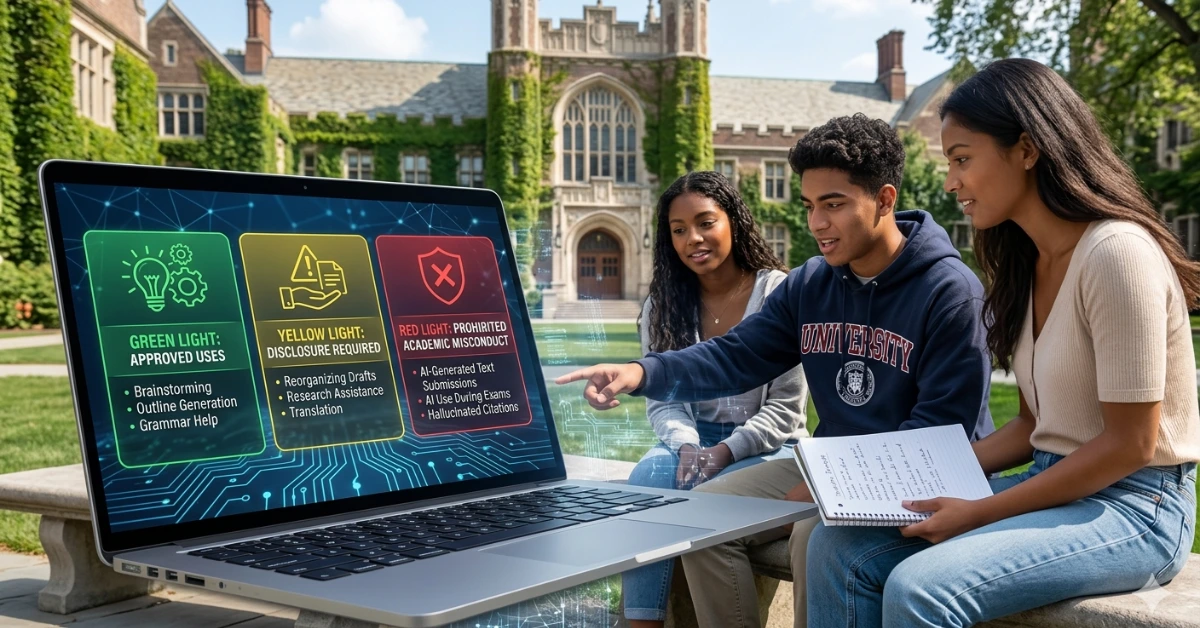
US Universities Are Rewriting Their AI Rules Right Now — Here’s What Students Can (and Can’t) Do

US Universities Are Rewriting Their AI Rules Right Now — Here's What Students Can (and Can't) Do

If you feel like your college syllabus looks a little different this semester, you’re not imagining it. After two years of “wait and see,” US universities have officially entered the era of the Great AI Rewrite. The days of vague warnings about “unauthorized technology” are over. In 2026, institutions from the Ivy League to local community colleges are rolling out granular, high-stakes policies that define exactly where the line is between a “helpful digital assistant” and “academic misconduct.” Here is the breakdown of the new landscape: what’s officially on the “green light” list, what will land you in the dean’s office, and how to protect yourself in an era of unpredictable AI detectors. Also Read: NotebookLM Cinematic Video Overview: Turn Your Notes Into a Mini Documentary (Student Guide) 🚦The Stoplight System: Green, Yellow, and Red The most useful thing to know is that the “ban everything” era is largely over. Instead, most updated policies in 2026 have quietly adopted a three-zone framework. Think of it as a traffic light — and your syllabus is the signal. Pro tip: When you open a new syllabus, Ctrl+F for “AI,” “artificial intelligence,” or “generative.” If you find nothing — assume Yellow Light rules apply and disclose anything you use. What the Big Schools Are Actually Doing Policies vary wildly, but here’s what some of the most-watched institutions have landed on: Harvard University No single university-wide rule — faculty set their own policies per course. Permitted uses include brainstorming, concept clarification, and scenario generation. But for any permitted use, students must submit a Disclosure Statement: what tools they used, what prompts they typed, and how the output shaped the final work. At Harvard, submitting AI-generated work as your own is treated the same as asking someone else to do your assignment. MIT Heavy focus on data security. Students are forbidden from entering unpublished research, interview transcripts, proprietary data, or personally identifiable information into any public AI tool. Graduate researchers, take note — this one’s for you. At MIT, transparency is key — students are expected to clearly disclose when AI tools are used in academic work. Columbia University Openly describes its policy as a “work in progress as the technology, the law, and community usage evolves.” A working group is actively drafting formal guidelines. Until then: explore responsibly, always disclose. 67% Of 174 US universities analyzed in a February 2026 study, 117 had no explicit AI policy, no disclosure requirement, and no enforcement mechanism — at all. But “no rule” doesn’t mean “anything goes.” Undisclosed AI use can still constitute academic misconduct. Your Draft History Is Your Best Friend Here’s the shift that most students are missing: AI detection software is no longer the main tool schools are using. After high-profile false-positive scandals — where legitimate essays by non-native English writers were flagged as AI-generated — most major schools, including Harvard and the entire UC system, now treat detectors as indicators, not proof. The burden of proof has moved to your process. And that changes everything. 💡The Bigger Picture: Why Universities Are Changing Now Here’s the thing most policy documents won’t say out loud: universities are realizing that when you graduate, your employer will probably expect you to know how to use AI. The goal of these new rules isn’t to keep you in the dark ages — it’s to make sure you don’t lose the ability to think for yourself while using the tools of the future. The students who navigate this era best won’t be the ones who use AI the most. They’ll be the ones who understand why the rules exist — and use AI to sharpen their thinking rather than replace it. Disclosure is now the baseline expectation across almost every updated policy. Failing to disclose AI assistance can now constitute a standalone integrity violation — even if the content itself is perfectly original and factually accurate. The crime, in 2026, is stealth. ⭐ The 2026 Golden Rule When in doubt — disclose. A footnote explaining that you used AI to help organize your thoughts will almost never get you in trouble. Pretending you did it all alone just might. The policies are changing. The stakes are real. But the principle is simple: be honest about your process.

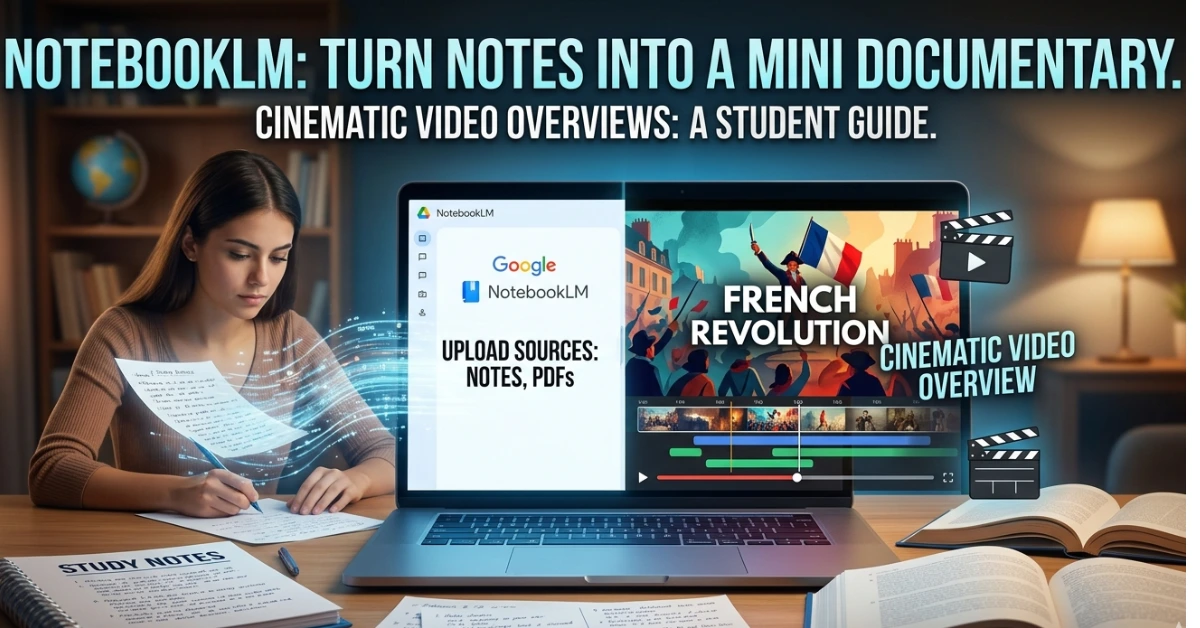
NotebookLM Cinematic Video Overview: Turn Your Notes Into a Mini Documentary (Student Guide)

NotebookLM Cinematic Video Overview

Imagine this. You upload your messy class notes, a PDF of your textbook chapter, and a few lecture slides.Five minutes later, an AI turns them into a short cinematic documentary explaining the topic with visuals, narration, and structured concepts. Google’s NotebookLM recently introduced a new feature called Cinematic Video Overviews, and most students still don’t know it exists. But for those who discover it early, it could completely change how revision works. Instead of rereading notes for hours, you can literally watch your chapter like a mini educational film. Let’s break down what this feature actually does, how students can use it, and why it might become one of the most powerful AI study tools in the next few years. What NotebookLM Actually Is (If You’ve Never Used It) NotebookLM is Google’s AI research tool that works differently from ChatGPT or Gemini. Those tools pull from everything they’ve ever been trained on. NotebookLM only uses what you give it — your PDFs, your notes, your textbooks, your lecture slides. Nothing else. That matters because when it generates something, it’s grounded in your actual material. Not hallucinated. Not generic. Yours. It already had a popular “Audio Overview” feature — where two AI hosts would have a podcast-style conversation about your notes, which students used for passive studying on commutes. That alone changed how a lot of people revised. This new NotebookLM Cinematic Video Overview feature is a whole different level. What NotebookLM’s Cinematic Video Overview Actually Does Instead of only generating summaries or flashcards, NotebookLM can now produce a short animated, narrated video built entirely from your uploaded study material. Think of it as: your notes + AI storytelling + educational animation — compressed into a few minutes of video you’ll actually want to watch. It reads your sources, figures out the narrative structure, writes the narration, and generates the visuals automatically. If your notes cover Organic Reaction Mechanisms, it doesn’t give you a generic chemistry video from YouTube. It gives you a video about your notes, using your terminology, your examples, your chapter structure. That’s the thing that makes this genuinely different. How Students Can Use It (Step-by-Step) This is simpler than you’d expect. Step 1: Prepare Your Sources Go to notebooklm.google.com and create a new notebook. Upload your sources. You can add PDFs, Google Docs, paste in text, drop a YouTube link (it pulls the transcript automatically), or add web articles. You can upload up to 50 sources per notebook. Step 2: Open the Studio Panel Inside NotebookLM you’ll find a Studio or creation panel where different content formats can be generated. This is where the cinematic overview option appears. Once selected, you can provide a short instruction describing what kind of explanation you want. For example: “Create a 3-minute cinematic explanation of the causes of World War I with a timeline and key events.” Step 3: Add a Direction Prompt This step makes a big difference. Instead of leaving the AI completely open-ended, guide it like a director. Students often write prompts like: • “3 minute revision video for Class 12 Chemistry equilibrium with formulas and examples.”• “Short visual explanation of supply and demand curves for economics exam prep.”• “Timeline documentary explaining the French Revolution.” These instructions help the system choose what information to highlight. Step 4: Generate the Video After submitting the request, the AI analyzes the uploaded sources and generates the cinematic overview. The result usually includes: Generation typically takes a few minutes. Once it finishes, you can watch the video directly inside NotebookLM. A Smart Way Students Are Using It for Exam Revision One particularly effective strategy is something students call the 3-minute revision method. Here’s how it works. For every chapter: The video acts like a mental map of the chapter. By the time you read the text again, the structure of the topic already makes sense. Some students even create multiple micro-videos for different subtopics. For example: Physics chapter: • Electric field explanation• Potential difference concept• Capacitor formulas Each becomes its own short visual revision clip. The Pricing — Let’s Be Honest About This Most articles either hide the pricing or make it sound worse than it is. Here’s the full picture: The cinematic upgrade builds on NotebookLM’s earlier audio and video overview features. Free Plan — ₹0 / $0 You get 50 chat queries per day, 3 audio overviews, and limited video overview access. Cinematic Video is not included on the free plan. But the standard features — chat with your notes, study guides, quizzes, audio overviews — are still genuinely useful. Google AI Pro / NotebookLM Plus — $19.99/month This is where the real power lives for most students. It includes NotebookLM Plus, Gemini Advanced, AI features in Gmail and Docs, and 2TB of Google storage. You get standard Video Overviews (not Cinematic, but still very good), expanded notebook limits, and better citation tools. The student discount: If you’re 18 or older and enrolled in a college or university, you can get this at $9.99/month — 50% off — for your first year. You verify through a service called SheerID, which just checks your .edu email or student ID. India is supported. So is the UK, US, most of Europe, and several other countries. Google AI Ultra — $249.99/month This is where Cinematic Video Overviews live at launch. It also includes Gemini 3 Deep Think, Veo 3, a video editing tool, and 30TB of storage. This is not a student plan. This is for professionals and creators with a budget. Skip it unless money genuinely isn’t a concern. The honest verdict on pricing: The $9.99 student plan is the sweet spot. You get standard Video Overviews, audio overviews, unlimited chat with your notes, study guides, and quizzes. That’s a lot for less than a textbook costs per month. Prompt templates (student-ready — paste & tweak) Use these directly in the “add prompt” box: A Few Things It Can’t Do (Be Aware) No tool is perfect. Here’s what NotebookLM can’t do … Read more

CBSE Class 12 Resources 2026: Free PDFs, Formula Sheets & Competency Questions

CBSE Class 12 Resources 2026: Free PDFs, Formula Sheets & Competency Questions

Let me be honest with you—after teaching Class 12 students for over a decade, I’ve seen the panic that sets in around October. Students rush to me asking, “Sir, where do I find the right study material?” or “Are these third-party guides enough?” And every single time, I tell them the same thing: you’re sitting on a goldmine of free resources, but you just don’t know where to dig.

Read more

Help Your Child Write Better English: Simple Educational Tools That Actually Work (Teacher’s Guide for Indian Parents)

Parent supporting a young child while practicing English writing at home using simple learning tools.

“Sir, padhna toh theek ho gaya hai, par likhne mein bahut problem hoti hai.”

I hear this from parents very often. And honestly, it makes sense.

Reading is recognising words. Writing is creating them. Writing needs spelling, sentence order, and confidence — all at the same time. That’s why many children who read reasonably well still avoid writing.

Help Your Child Read English: 5 Useful Educational Gadgets for Indian Students (Teacher’s Guide)

Indian mother helping her child read an English book at home in a calm and supportive learning environment

Why Many Indian Children Struggle with English Reading (A Teacher’s Perspective)

“Mera bachcha English padh hi nahi paata” – parents tell me this with such worry in their voices.

The real problem is not that children can’t read. It’s that they’re afraid to read. I’ve seen it so many times – a child sits alone with a book and manages fine. But put a parent or teacher next to them, and suddenly every word becomes difficult.

Read more

Oh hi there 👋
It’s nice to meet you.

Subscribe & get your free AI Study Guide now — packed with tools, tips, and strategies to boost learning worldwide

We don’t spam! Read our privacy policy for more info.