
Introduction: Why Ethics Matter More Than Ever
In this guide, we explore how to use AI ethically in school while enhancing learning, critical thinking, and academic integrity.
Will my teacher know I used ChatGPT for my essay?” This question keeps thousands of students awake at night. After teaching high school for eight years and watching the AI revolution unfold in classrooms, I’ll give you the honest answer: Yes, most teachers can spot AI-generated content—but not when it’s used correctly. A few weeks ago, a student named Sara came to me completely stressed out. She had used ChatGPT for a history essay and her teacher had immediately flagged it for plagiarism. “It just sounded too… perfect,” her teacher had said. Sara had to re-do the entire assignment and, worse, she lost her teacher’s trust.
Why Read This:
A 2024 survey by the Digital Education Council found that 86% of students use AI in their studies, while research shows 51% would continue using AI tools even if prohibited by their institutions. This gap is creating a crisis where well-meaning students face serious consequences for innocent mistakes. This gap is creating a crisis where well-meaning students face serious consequences for innocent mistakes.
Let me share what actually happens in faculty meetings, what detection software really catches, and most importantly—how to use AI as a learning tool without risking your academic future.
For students just starting their AI journey, check out our [The Future of AI in Education: Key Benefits & Trends in 2025],
What Can Teachers Actually Detect When Students Use AI?
The Technology Behind AI Detection

Modern AI detection tools—like Turnitin, GPTZero, and Copyleaks—analyze writing patterns, sentence complexity, and how ideas flow together. Turnitin claims about 85% accuracy when spotting direct AI content, looking for sudden shifts in structure or vocabulary. GPTZero measures “perplexity,” or how predictable your writing is, with around 78% accuracy on longer texts. Copyleaks focuses on sentence relationships and AI-style transitions, scoring about 82% accuracy on mixed AI-human writing.
Teacher’s Perspective: Red Flags We Notice
But here’s the truth: teachers don’t rely only on software. They also notice when your work suddenly feels “off.” Maybe your vocabulary jumps three levels overnight, or your essay has a flawless intro but a shaky conclusion. As one AP Literature teacher put it: “It’s not the sophistication—it’s the inconsistency.
“When a student who typically writes in simple sentences suddenly submits work with complex subordinate clauses and academic jargon, that’s a red flag,” explains Dr. Martinez, who teaches AP Literature. “It’s not the sophistication—it’s the inconsistency.”
Common teacher observations:
- Absence of personal voice or unique perspectives
- Sudden improvement in grammar but same conceptual errors
- Generic examples that don’t connect to class discussions
- Perfect introduction paragraphs followed by weaker conclusions
Is Using ChatGPT for Homework Cheating? Understanding Academic Integrity Policies
The Spectrum of AI Academic Policies
Universities and high schools have adopted varying approaches to AI use. According to recent analysis by HEPI, only 29% of students feel their institutions encourage AI use:
Restrictive Policies (35% of institutions):
Complete prohibition of AI tools for any academic work. Examples include many traditional liberal arts colleges and competitive high schools.
Moderate Policies (48% of institutions):
Allow AI for research and brainstorming with mandatory disclosure. Most state universities and community colleges fall here.
Liberal Policies (17% of institutions):
Encourage AI literacy while requiring proper attribution. Some progressive institutions and tech-focused schools embrace this approach.
What Constitutes Academic Dishonesty with AI Definitely Cheating:
Submitting AI-written essays as original work Using AI to solve math problems without showing work Having ChatGPT write code for computer science assignments Generating entire research paper sections without attribution
Generally Acceptable (with proper citation):
Research assistance and source recommendations Concept explanation and clarification Study guide and flashcard creation Practice problem generation
Also Read: Top 15 Banned AI Tools Students Love (Why Schools Can’t Stop Them)Homework Help: Investigate Like a Detective, not a Copy-Paste Bandit 🕵️♀️
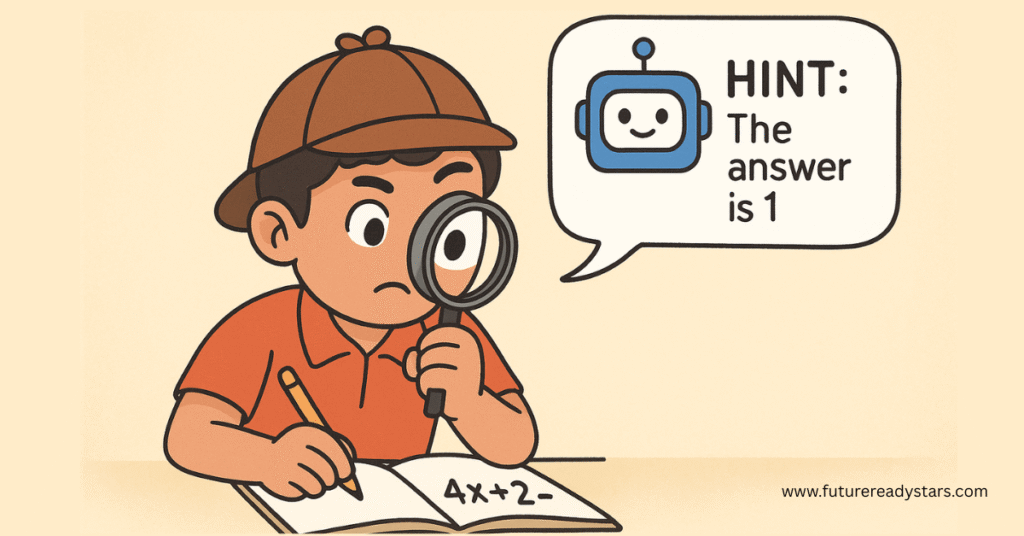
We’ve all been there stuck on a tough homework question, tempted to let AI do the work. But instead of copy-pasting, why not think like a detective? Ask ChatGPT for hints, step-by-step explanations, or alternative ways to solve a problem. Then, take a moment to analyze and cross-check the response. This way, AI becomes your study partner, not a shortcut, helping you learn smarter, not just faster!
Safe AI Study Strategies That Enhance Learning
1. The Socratic Method Approach
Instead of asking for answers, engage AI in dialogue:
Poor prompt: “Write a summary of photosynthesis”
Better prompt: “I’m learning about photosynthesis. Can you ask me questions to test my understanding, then explain what I might be missing?”
2. Concept Bridging Technique
Use AI to connect classroom concepts to real-world applications:
Example: “I learned about supply and demand in economics class. Can you give me three current events examples where I can practice identifying these principles?”
3. The Teaching Method
Explain concepts to AI and ask for feedback:
Example: “I’m going to explain the causes of World War I as if you’re a middle school student. Tell me what’s unclear or what I should add.”
Creating Study Materials with AI Assistance
Flashcard Generation:
Transform your notes into interactive study tools. Instead of copying definitions, create scenarios and applications.
Practice Test Creation:
Ask AI to generate questions in different formats (multiple choice, short answer, essay prompts) based on your study materials.
Memory Palace Techniques:
Have AI help create vivid, memorable associations for complex information you need to memorize.
Also Read: Top 20 ‘No Internet Needed’ AI Tools Bridging the Digital Divide in 2025How to Write Essays with AI Help Without Plagiarizing
Think of AI as your research assistant and writing coach, not your ghostwriter. The key is maintaining control over your ideas while leveraging AI’s strengths in organization and feedback. Here’s how successful students approach essay writing with AI support:
The Ethical Essay Writing Process
Phase 1: Understanding and Research (AI-Assisted) This is where AI truly shines—helping you grasp complex topics and discover new angles you might miss on your own.
- Use AI to break down complex assignment requirements
- Generate research questions and keywords
- Explore different angles and perspectives
- Understand opposing viewpoints
Phase 2: Planning and Organizing (Collaborative) Once you understand the topic, AI becomes your brainstorming partner. Think of this as having a study buddy who never gets tired of helping you organize your thoughts.
- Brainstorm thesis ideas with AI feedback
- Create detailed outlines with logical flow
- Identify strongest supporting evidence
- Plan transitions between arguments
Phase 3: Writing (Student-Led) Here’s where you take the driver’s seat. Your voice, your arguments, your unique perspective—this is what makes your essay yours, not just another AI-generated paper.
- Write all original sentences in your voice
- Develop arguments based on your research and thinking
- Use AI for grammar checks and clarity suggestions
Phase 4: Revision (AI-Enhanced) The final polish is where AI can spot things your tired eyes might miss. It’s like having a fresh pair of eyes review your work before submission.
- Ask AI to identify weak arguments or logic gaps
- Get suggestions for stronger word choices
- Check for repetitive phrasing or unclear ideas
- Verify citation format and accuracy
Proper AI Citation Methods
Here’s the truth nobody tells you: citing AI isn’t just about following rules—it’s about protecting yourself. When you cite AI properly, you’re showing transparency and academic honesty, which teachers actually appreciate more than they let on.
APA Format: OpenAI. (2024). ChatGPT (Version GPT-4) [Large language model]. https://chat.openai.com/chat
MLA Format: OpenAI. “ChatGPT.” Chat.openai.com, 6 Mar. 2025, chat.openai.com/chat.
Chicago Style: OpenAI, “ChatGPT,” accessed March 6, 2025, https://chat.openai.com/chat.
When to Include Citations: Think of this as your safety net—when in doubt, cite it. It’s better to over-cite than face accusations of academic dishonesty later.
Any direct quotes from AI responses Ideas or arguments suggested by AI Statistical data or facts provided by AI Structural suggestions that shaped your work
Can My School Tell If I Used ChatGPT? Detection Methods Explained
Schools can often tell when AI has been used, thanks to a mix of detection software and teacher intuition. Popular tools like Turnitin AI Detection, GPTZero, and Copyleaks AI Detector analyze writing patterns, sentence structure, and semantic flow to flag AI-generated content.
Commercial Detection Software Capabilities
- claim 85% accuracy on direct AI content
- Analyzes sentence structure patterns
- Compares against known AI writing samples
- Flags sudden changes in writing complexity
- Measures “perplexity” (predictability) in text
- Examines semantic relationships between sentences
- Detects AI-characteristic transitions and flow
Teacher Detection Beyond Software
Experienced educators develop intuition about student work:
Writing Pattern Analysis: Teachers notice when students deviate from established writing patterns, vocabulary levels, or argument structures. Knowledge Assessment: If a student can’t explain concepts they wrote about, teachers become suspicious. Assignment-Specific Inconsistencies: AI often misses assignment nuances that students would catch from class discussions.
Also Read: Top 10 AI Tools That Predict Exam Questions (2025’s Secret Weapon)What Happens If You Get Caught Using AI for School Work
Let’s talk about the elephant in the room—the consequences nobody wants to think about but everyone should understand. I’ve sat through countless academic integrity hearings, and trust me, the “I didn’t know” defense rarely works. Here’s what actually happens when schools catch AI misuse:
Typical Consequences by Education Level
The reality is harsh: consequences escalate quickly, and they follow you longer than you think. Each level of education treats violations differently, but all take them seriously.
High School Violations:
Your parents will definitely find out, and that’s often the least of your problems. Most schools have a three-strike system that can derail your college plans.
First offense: Assignment redo with parent conference Second offense: Course grade penalty (often one letter grade reduction) Multiple offenses: Suspension and academic integrity probation
College Violations:
College consequences are permanent and can affect your entire career trajectory. Unlike high school, there’s no “learning experience”—it’s straight business.
Initial violation: Zero on assignment plus academic integrity workshop Repeated violations: Course failure and disciplinary probation Severe cases: Suspension or expulsion with transcript notation
Future-Proof Strategies for AI and Academic Success
Building AI Literacy Skills
Prompt Engineering: Learn to ask questions that generate useful learning materials rather than finished products.
Critical Evaluation: Develop skills to assess AI responses for accuracy, bias, and relevance.
Integration Techniques: Master combining AI assistance with original thinking and research.
Staying Updated with Evolving Policies
Regular Policy Checks: School AI policies change frequently. Check your student handbook each semester.
Professor Communication: Ask specific questions about AI use for each class—policies vary by subject and instructor.
Industry Awareness: Understanding how professionals use AI in your field helps inform academic choices.
Practical Tips for Responsible AI Use in School
Using AI responsibly doesn’t have to be complicated. Start small with your daily habits—use AI to create quick quizzes in the morning to review yesterday’s lessons, get explanations for tricky homework concepts, and then work through the problems on your own. When preparing for tests, let AI generate practice questions or scenarios to help you study more effectively. In the long term, focus on building skills that AI can’t replicate, such as critical thinking, creativity, and analysis. Learn to use AI as a research and learning assistant rather than a replacement for your own work, and set an example by modelling ethical AI use for your peers and younger students.
The Ultimate AI Cheat Sheet—Because You Deserve to Stay Ahead!
Free Resource: Ethical AI Cheat Sheet for Students
You’ve invested time in understanding AI, and now it’s time to put that knowledge into action! This FREE Ethical AI Cheat Sheet is your key to using AI wisely, responsibly, and to your advantage.
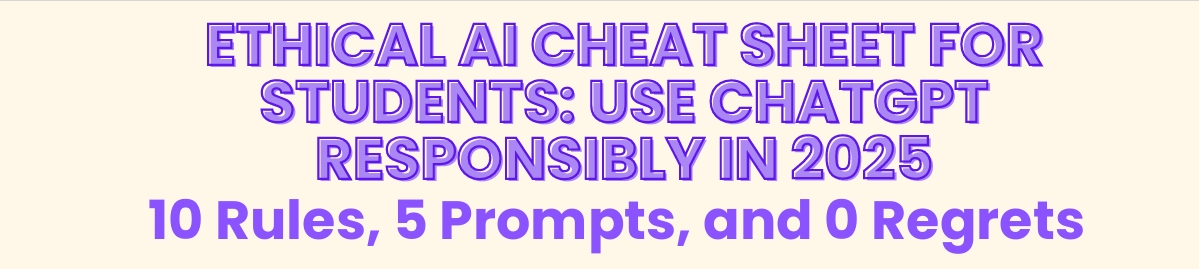
📥 [Download Here] and unlock:
- ✅ 10 golden rules for using ChatGPT responsibly.
- ✅ Template for citing AI-generated content.
- ✅ 5 prompts to boost learning (not replace it).
FAQs: What Students Really Want to Know
Q: Is it cheating if I only use AI to help me understand concepts?
A: No, that’s actually smart studying. Using AI to explain difficult topics, break down complex problems, or generate practice questions is legitimate learning support. The line gets crossed when AI starts doing your thinking for you instead of helping you think better.
Q: Can I get in trouble for using AI if I cite it properly? A: It depends on your school’s policy and how you used it. Proper citation protects you from plagiarism accusations but doesn’t automatically make AI use acceptable. Some schools prohibit AI entirely, even with citation. Always check your specific institution’s rules.
Conclusion: Your Path to AI-Enhanced Learning
The question isn’t whether AI will be part of education—it already is. The question is whether you’ll use it wisely or recklessly.
Smart students recognize that AI is most powerful when it amplifies human intelligence rather than replacing it. By understanding detection methods, following ethical guidelines, and focusing on genuine learning, you can harness AI’s benefits while building the critical thinking skills that will serve you throughout your career.
Remember: The goal isn’t to outsmart your teachers or dodge detection software. It’s to become a better learner, thinker, and scholar. AI can help you get there, but only if you use it with integrity, transparency, and wisdom.
Start small, be honest, and always prioritize understanding over convenience. Your future self will thank you for building these habits now.
For more comprehensive information on AI ethics and academic policies, consult your institution’s academic integrity office or visit EDUCAUSE’s resource center for the latest research on AI in higher education.
Ready to Use AI the Right Way? Start applying these ethical AI strategies today and take your learning to the next level! For more tips and insights, visit FutureReadyStars.com.
Hello !
Hello. A 27 fine website 1 that I found on the Internet.
Check out this website. There’s a great article there. https://www.likefigures.com/dry-air-why-its-bad-for-your-health-and-how-to-avoid-it/|
There is sure to be a lot of useful and interesting information for you here.
You’ll find everything you need and more. Feel free to follow the link below.
Can you be more specific about the content of your article? After reading it, I still have some doubts. Hope you can help me.
Your point of view caught my eye and was very interesting. Thanks. I have a question for you.
Your point of view caught my eye and was very interesting. Thanks. I have a question for you.