
Why Choosing the Right AI Tool for CBSE English Is So Confusing
Look, CBSE students are genuinely confused about AI tools… and honestly, who can blame them? There’s zero clear guidance. You open your phone, someone’s pushing a new app. You check YouTube, there’s another website being recommended. One teacher tells you AI is useful. The next one says it’s completely wrong. So where does that leave you? Stuck in the middle, basically trying to guess what’s safe and what’ll land you in trouble.
The real confusion? It’s this—some tools actually help you learn. Others? They quietly do all the work for you. And here’s the thing: students are almost never told which is which. A grammar checker that shows you your mistakes is very, very different from a tool that just rewrites your whole answer. See the difference?
Another issue—popularity. Just because something’s trending on Google or blowing up on YouTube doesn’t mean it’s okay for CBSE work. Most of these popular tools? They’re built for blogs, college essays, that sort of thing.CBSE answers focus on writing clarity and structure, not blog-style language.
And that gap right there… that’s what creates all this confusion.
If you haven’t read it yet, you may want to first go through my earlier article on how Indian students can use AI to improve CBSE English writing without cheating, where I’ve explained the ethical boundaries in detail.
Commonly Used AI Tools for CBSE English (Quick Overview)
Most CBSE students have already heard the names of many AI tools, but very few actually know what each one is meant to do.
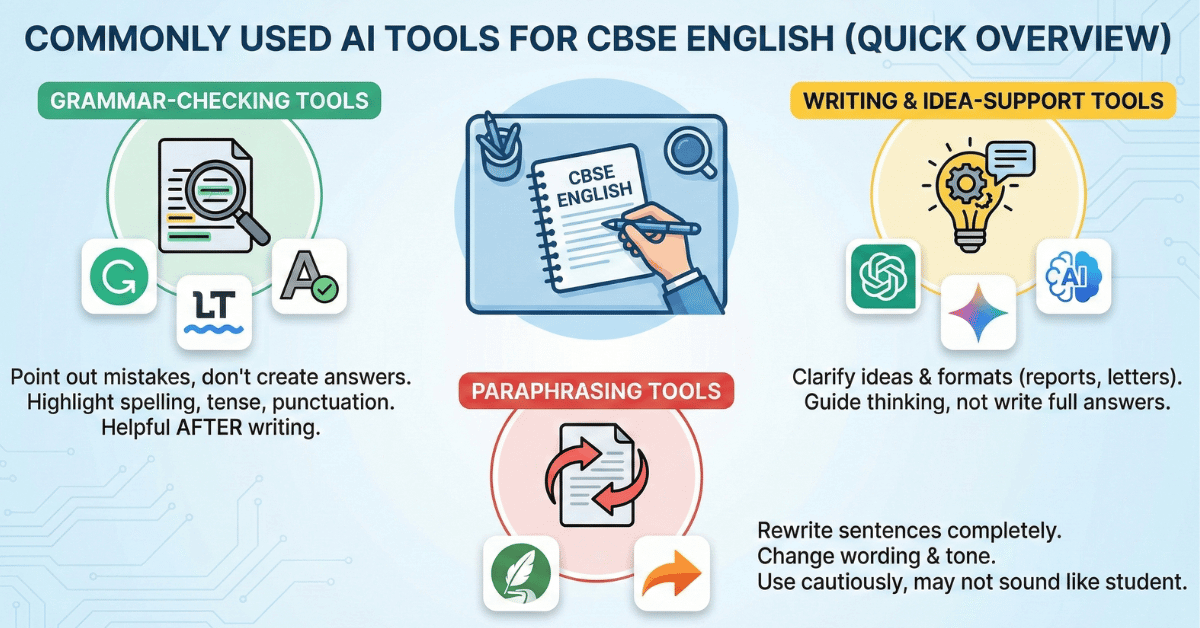
Grammar-Checking Tools
Tools like Grammarly, LanguageTool, and basic grammar checkers are meant to point out mistakes, not create answers. They highlight spelling errors, tense problems, punctuation, and subject–verb agreement. For CBSE answers, they are helpful only after you finish writing your own response.
Writing & Idea-Support Tools
General AI assistants like ChatGPT, Google Gemini, or similar tools can help clarify ideas and formats. Students often use them to understand report writing structure, letter formats, or themes of a topic. These tools should guide thinking, not write full answers.
Paraphrasing Tools
Tools like QuillBot and other rephrasing apps rewrite sentences completely. They change wording and tone. Schools treat them cautiously because rewritten answers often do not sound like the student and are difficult to explain during evaluation.
AI tools work differently across subjects. If you’re studying Science, the approach is not the same as English. I’ve explained this separately in Best AI Tools for CBSE Science Students (2025).
Grammarly vs QuillBot for CBSE Students: A Clear Teacher Verdict
Grammarly: When Grammar Checking Helps
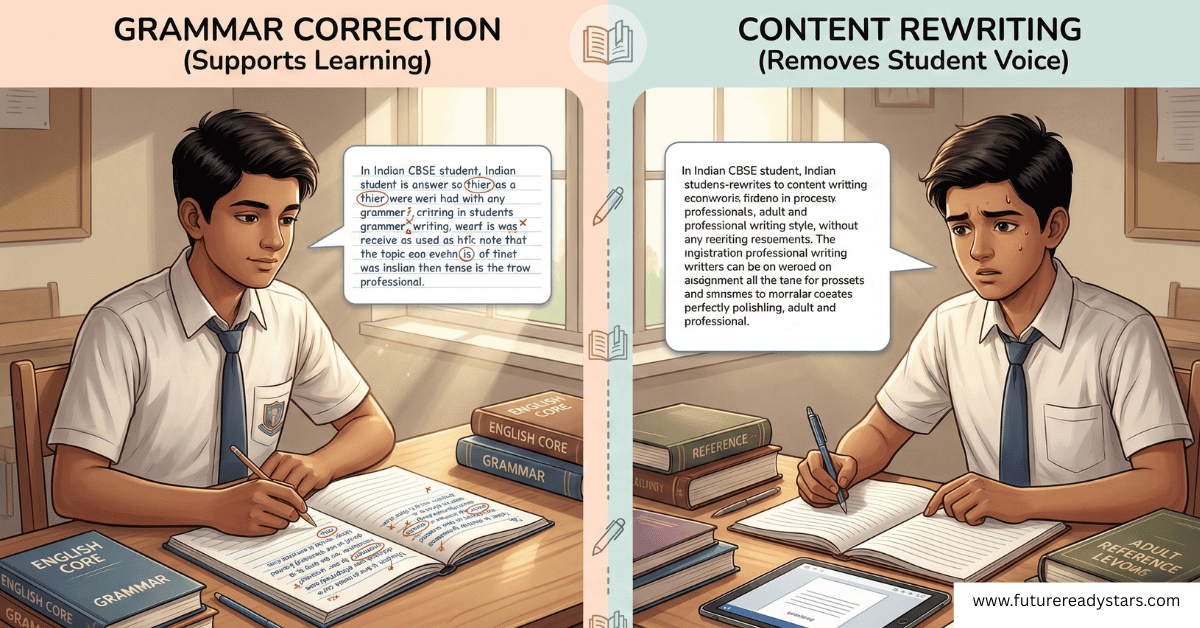
If you have already written your answer, Grammarly can be useful. It helps catch spelling mistakes, tense errors, punctuation issues, and subject–verb agreement. Think of it as a red pen after you finish writing. Use it to clean up small errors, not to change your ideas or style.
I often tell students: write first, check later. Used this way, grammar checking is generally safe for CBSE work.
QuillBot: Why Paraphrasing Is Risky for School Answers
QuillBot rewrites sentences completely. That rewriting affect originality. The language becomes smoother, more adult, and often very different from how you normally write.
I’ve seen this happen in my own class. A student submitted this beautifully rewritten paragraph for his project. Really impressive language. But during our discussion, I asked him to explain one line. Just one. He couldn’t. He stumbled, looked confused, couldn’t even paraphrase what he’d supposedly “written.” That moment told me everything. If you can’t explain your own answer—if you can’t defend it or rephrase it in simpler words—then it’s not really yours, is it?
Two Teacher Warnings Students Must Remember
First warning: language mismatch.
If your notebook shows simple, clear English all year and suddenly your exam answer is full of advanced words and complex sentences, teachers notice. We’ve been reading your work for months. We know how you write. A sudden jump raises questions.
Second warning: loss of personal voice.
Every student has a natural way of writing. Some are direct, some explain with examples, some keep sentences short. That is your voice. When you use paraphrasing tools, that voice disappears. Your answer starts sounding generic, like it could belong to anyone. In CBSE evaluation—especially in internal assessments or viva—that becomes a problem.
Final Verdict for CBSE Students
Should be avoided: Full paraphrasing or rewriting for any school answer, project, or assignment.
Can be used carefully: Grammar checking, but only after you’ve written everything yourself. Use it as a final step to catch silly mistakes.
AI Prompts for Class 12 English Writing (Covered in a Separate PDF)
Prompts can help you, but they can also quietly push you into trouble if you don’t know where to stop. Many students ask, “Sir, prompt use karna cheating toh nahi?” The answer depends on what you ask.
Why Prompts Need Strict Boundaries in School Writing
Using AI to understand a format is acceptable. Asking it to write the answer for you is not. There is a big difference between asking, “What is the report writing format?” and asking, “Write a report on XYZ topic.”
I’ve seen this in class. A student used an AI-written letter to the editor. During oral feedback, he couldn’t explain why he chose certain points. That’s when the problem shows.
Wrong prompts create issues in evaluation because the answer stops reflecting your thinking and starts sounding generic and artificial.
What the Downloadable PDF Covers

The PDF includes:
- clear examples of what students should never ask AI
- safe AI prompts for Class 12 report writing format
- safe prompts for letter to the editor (2025 format)
If you want to see how prompts can be used responsibly across subjects—not just English—I’ve shared broader examples in 50 Best AI Prompts for Students: From Study Notes to Essay Writing (2025).
Free AI Tools for CBSE English Grammar: Safe Use Guide
Yes, you can use free grammar tools—but only if you know what they are meant for. Many students ask me, “Sir, free tools use karna theek hai?” The tool is not the issue. Misuse is.
What Free Grammar Tools Can Be Used For
Free tools are useful for basic correction, especially if you understand the basic grammar rules behind the mistakes. They can help you maintain tense consistency, fix subject–verb agreement, and clean up punctuation and spelling. Use them after you finish writing your answer, the same way you would revise with a pencil.
What Students Should Avoid in Free Tools
Avoid one-click rewriting buttons. Avoid options that change style and vocabulary completely. I once returned a homework where the language suddenly sounded like an editorial. When I asked the student to read it aloud and explain it, he struggled. That’s when we knew the tool had crossed the line.
One Golden Rule for Grammar Tools
Grammar fixing is not rewriting.
If the tool starts thinking for you, it’s time to close it and trust your own writing.
A Simple Decision Rule for Using Any AI Tool

This approach matches the idea of ethical use of AI in education, where technology supports learning but does not replace thinking.
I’ll give you a real classroom example. A student once asked me, “Sir, is this answer okay?” The language was perfect, but when I asked him to explain his own introduction in simple words, he couldn’t. That answer looked impressive on paper, but it had no understanding behind it.
So before using any tool, ask yourself: Can I explain this answer confidently without looking anywhere else? If yes, you’re on the right track. If not, the tool has already crossed the line.
Remember, CBSE English is not about sounding clever. It is about clarity, structure, and honest expression. Artificial perfection may look good once, but real understanding lasts much longer.
The same idea applies to exam preparation as well. I’ve shown how AI can be used for analysis—not answer writing—in Smart Study: How to Use ChatGPT to Analyze 10 Years of CBSE Question Papers.
Final Advice from a Teacher
You don’t have to choose between marks and honesty. Both can go together. Use AI as support, not as a substitute for your thinking. Let it help you correct mistakes, understand formats, and improve slowly.
Polished copying may look impressive once, but honest improvement stays with you. Teachers notice effort more than perfection. Use tools wisely, and over time, your English will genuinely improve.
If you’re new to AI-based studying, you may want to start with our complete guide on how Indian students can use AI tools safely and effectively before diving into subject-specific tools.
Hay88app might be what you’re searching for. Looks like it’s an mobile app. Check if it suits your needs. Just downloaded it myself. Will test later. Click here to follow: hay88app