
Last Updated on July 15, 2026 by Asheesh Kumar
You’ve probably already done this: opened ChatGPT or Gemini at 11 PM, pasted in a question you didn’t understand in class, and gotten an answer in four seconds. It felt like magic. And then, a week later, the same topic showed up in a test — and you blanked.
That gap between “AI gave me the answer” and “I actually know this” is where almost every student gets stuck. It’s also the one thing most AI-for-students articles never talk about. They’ll hand you a list of ten apps and call it a day.
That’s exactly what this guide aims to fix. It’s built from three things: what students are actually saying on Reddit and YouTube, what’s genuinely new in AI tools as of 2026, andwhat I’ve observed while working with students every day at Akshaya Digital Library, where many of them already use ChatGPT, Gemini, and other AI tools for studying. Some of what follows will contradict the “just use AI for everything” advice you’ve read elsewhere. That’s intentional.
The numbers show this isn’t just a trend. A national study of Indian households found that among students already using edtech, 69% who’ve adopted generative AI are using it daily — mostly to clear doubts (73%) and practice lessons. The demand is real. The question is whether it’s working for you or just making you feel productive.
Also Read: Best AI Tutors for CBSE Students (2026): 7 Smart Tools for Smarter Learning
Here are 25 ways to ensure AI actually builds your brain, rather than replacing it.
Build Real Understanding, Not Just Get Answers
Every AI tool will explain a concept to you. Almost none of them will check whether you actually got it — unless you set it up right.
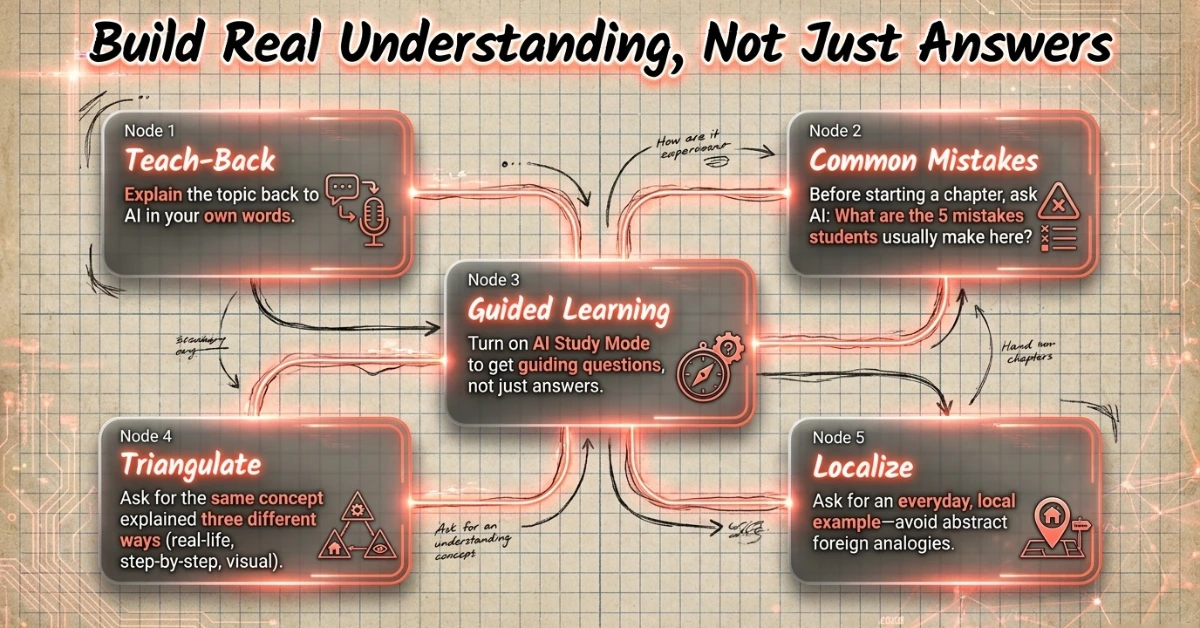
1. Explain the topic back to AI, in your own words
Don’t just read the AI’s explanation and move on. After it explains something, try explaining it back — as if you’re teaching a younger student. If you get stuck explaining any part, that’s exactly the part you don’t understand yet. This one habit teaches you more than reading the same page five times.
Example Prompt: “I’m going to explain the human digestive system to you like you’re a curious 12-year-old. Stop me and ask ‘why’ whenever I use a term I haven’t defined or my logic skips a step. Don’t summarize for me — just question me until I can explain it cleanly.”
Also Read: Fear of Mathematics? How Indian Students Can Use AI to Understand Difficult Math Concepts
2. Before starting a new chapter, ask what mistakes students usually make in it.
Before diving into a new chapter, ask: “What are the 5 mistakes students usually make when they first learn [topic]?” This single question does more than a full re-read, because it tells you exactly where the traps are before you fall into them — a trick almost nobody outside a handful of Reddit study threads is talking about yet.
3. Turn on Guided Learning — don’t just chat normally.
ChatGPT’s Study Mode, Gemini’s Guided Learning, and Claude’s Learning Mode are recent additions (all free, on the free tier) that most students still don’t know exist. Instead of handing you the answer, they ask guiding questions first — closer to a real tutor than a search engine. Turn this on specifically for topics you’re learning for the first time, and switch it off for quick fact-checks where you genuinely just need a definition.
4. Ask for the same concept explained three different ways.
One explanation doesn’t work for everyone. Ask AI to explain a concept once with a real-life example, once step by step, and once as something you could draw as a picture or diagram. Whichever one makes it click for you — that’s how you learn best.
5. Ask for an Indian, everyday example — not a foreign one.
AI often gives examples from American life that don’t make sense to us. Just add: “Give me an example from Indian daily life, not from abroad.” A topic like probability or economics becomes far easier with an example from a train ticket line or a local market instead of Wall Street.
Also Read: Google NotebookLM + Notion AI: A Complete AI Study System for Students (Build Your Second Brain)
Get Doubts Cleared Without Waiting for Class
This is the single biggest reason students reach for AI, according to national survey data — not cheating, doubt-clearing. Here’s how to do it properly.
6. Voice-note your doubt instead of typing it.
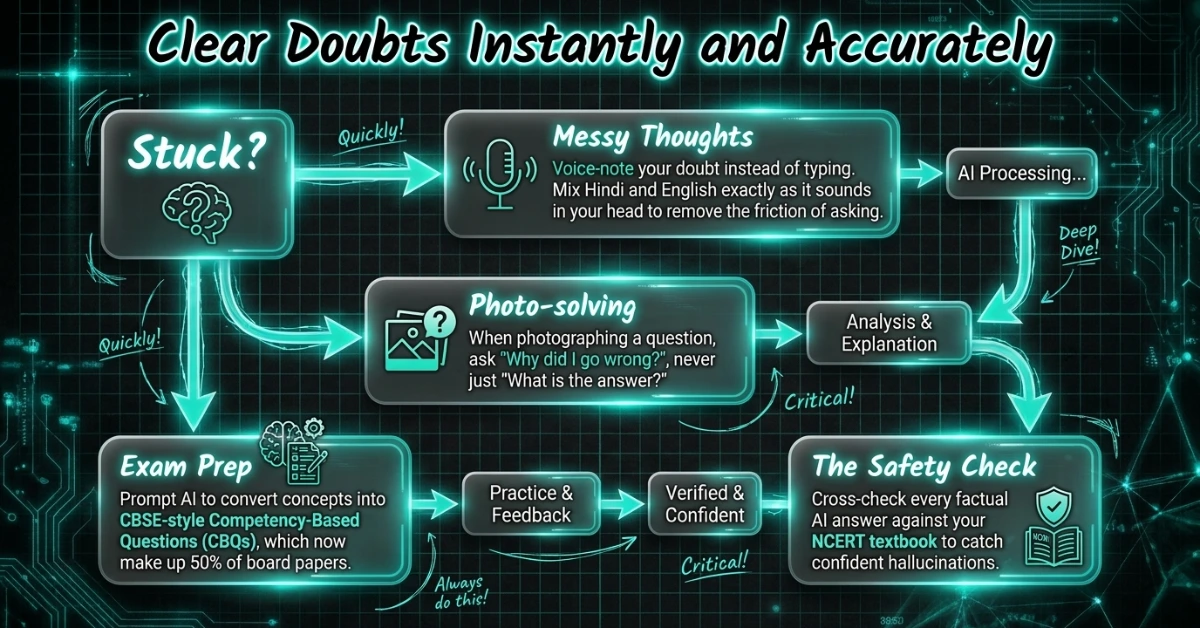
If your doubt is messy — half in Hindi, half in English, and you’re not sure how to phrase it — just talk. Use the voice input on ChatGPT, Gemini, or Meta AI and explain your confusion exactly as it sounds in your head. You’ll get a much more useful answer than a stiff, over-typed query, and it removes the friction that stops most students from asking at all.
7. When you photograph a question, always ask “why,” not just “what.
Snapping a photo of a textbook question is old news. The mistake most students make is stopping at the final answer. Add this every time: “Don’t just give me the answer — show me the exact step where a student is most likely to go wrong.” That one line turns a copy-paste habit into an actual learning moment.
8. Practice Competency-Based Questions (CBQs) specifically.
For CBSE students in 2026, this is critical. CBQs now make up 50% of the Class 10 and 12 board papers. Most AI tools default to basic Q&A. Try: “Convert this NCERT concept into a CBSE-style competency-based question with a real-world scenario, the way it would appear in a 2026 board paper.”
9. Cross-check every AI answer against your own textbook — always.
General-purpose AI models are not trained specifically on NCERT or your state board’s textbook, and they will occasionally give a technically-correct-but-wrong-for-your-syllabus answer, or simply hallucinate a fact with total confidence. Build this habit: ask the AI, “Which NCERT chapter and concept does this match?” If it can’t answer clearly, verify manually before you write it in an answer sheet. This single habit will save you more marks than any tool subscription.
Make What You Learn Actually Stick
Understanding a concept once and remembering it in March are two different problems. This is where most students waste the most time.
10. Ask AI to build you a simple revision plan that brings topics back again and again
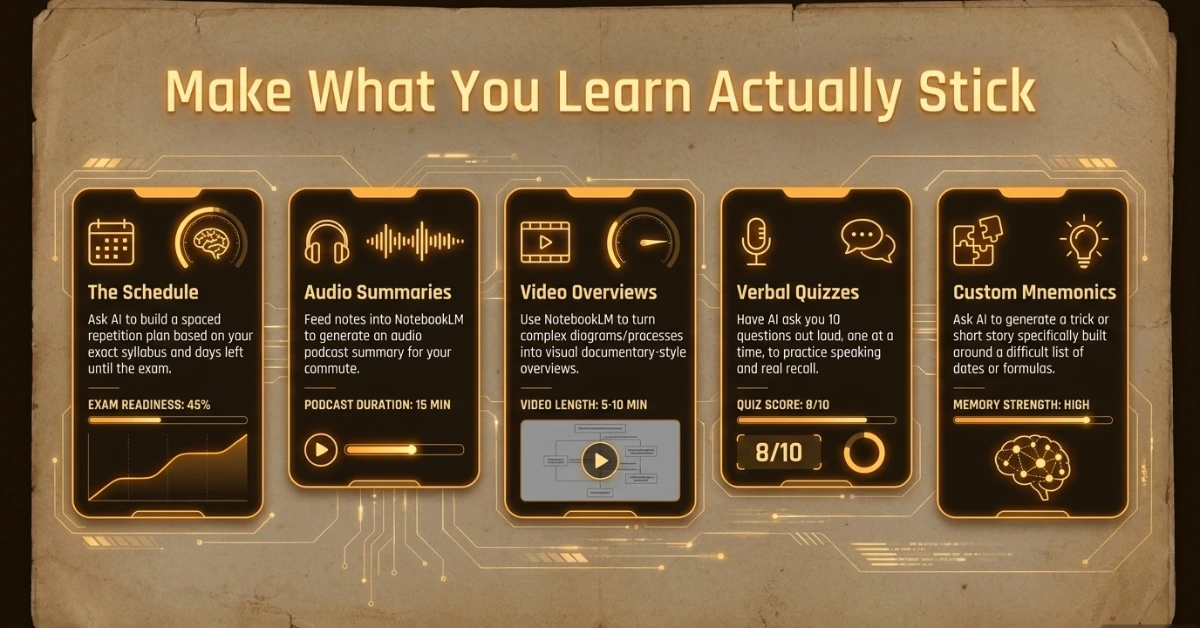
Give AI your full syllabus and let it space your revisions out properly, instead of cramming everything into the final week. Say: “I’ve studied these 5 chapters. My exam is in 30 days. Make me a revision plan that brings each chapter back for a quick revision a few times before the exam, so I don’t forget it.”
Also Read: How to Use AI to Remember Social Science Dates and Historical Events Easily (CBSE Guide)
11. Turn your notes into an audio summary using NotebookLM, and listen to it on the go.
Upload your chapter or notes into NotebookLM, and it can create a short audio summary — almost like a podcast — that explains your material out loud. Play it during your commute, while doing chores, or before sleeping. A simple way to revise without sitting with a book.
12. Turn a tough chapter into a video overview.
NotebookLM can also turn your notes into a short video-style overview with visuals, which is very useful for chapters you find hard to picture in your head — diagrams in Biology, processes in Chemistry, timelines in History.
Read Also: NotebookLM Cinematic Video Overview: Turn Your Notes Into a Mini Documentary (Student Guide)
13. Get quizzed out loud before an exam.
Say: “Ask me 10 questions on Chapter 3 out loud, one at a time, mix of easy and hard. Don’t tell me the next question until I’ve answered.” Answering questions verbally, in full sentences, does two things at once — it tests what you actually know, and it’s quietly one of the best ways to get more comfortable speaking in English before a viva or an interview. Do this a day or two before every test.
14. Get a simple trick or short story made up to remember lists, dates, or formulas.
Get a simple trick or short story made up to remember lists, dates, or formulas For anything hard to memorise — a list of dates, a formula, the steps of a process, articles of the Constitution — ask AI to turn it into a short story, rhyme, or easy trick built specifically around that list. Try: “Make me a fun, easy-to-remember story that helps me recall these 5 dates in order.” A memory trick built for your exact list works far better than a generic one you find online.
Study Smarter, Not Longer
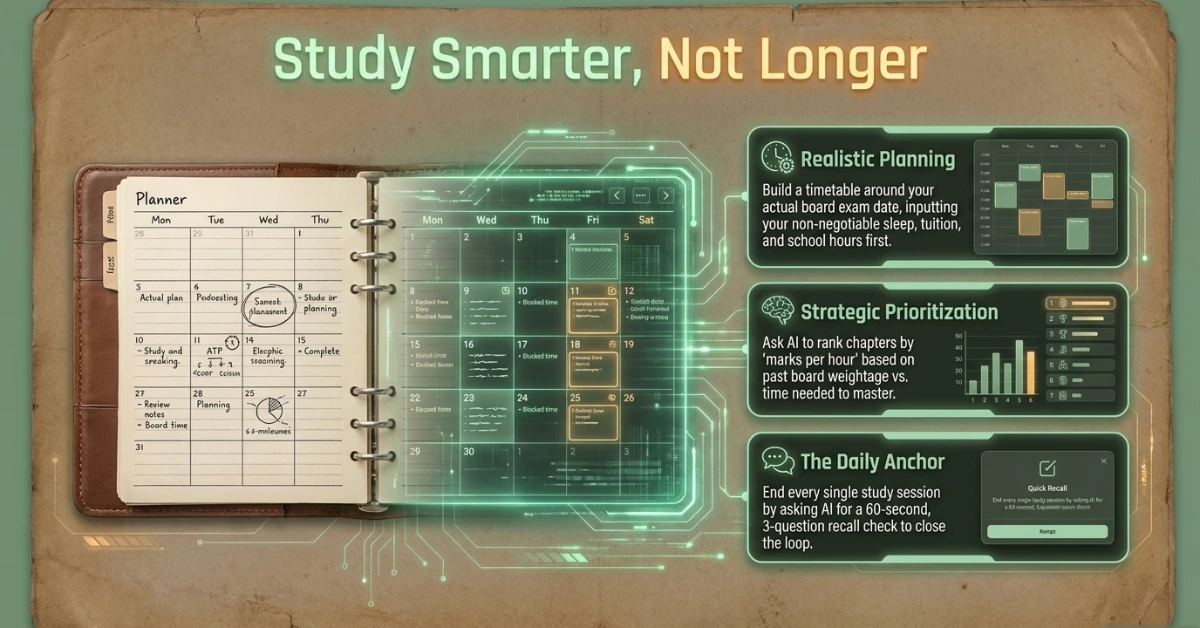
15.Build a timetable around your actual board exam date
Give AI your full subject list, your board exam date, and your other commitments (tuition, school hours, sleep). Ask for a realistic weekly timetable, not an idealised one that assumes you have 10 free hours a day.
16. Ask AI to rank chapters by “marks per hour.”
This is a trick almost nobody uses: feed AI the chapter-wise weightage from the last 2–3 years of your board’s previous papers, and ask it to rank chapters by expected marks versus time needed to master them. This turns revision from “study everything equally” into “study what actually moves your score.”
17. End every study session with a 60-second recall check.
Before you close your books, tell AI what you covered and ask for three quick questions on it — nothing elaborate, just a closing-the-loop habit. Students who do this consistently report far better retention than students who simply stop studying and move on.
Write and Research Without Losing Your Own Voice
This is where the line between “using AI” and “getting flagged for AI” gets blurry — and where most guides give dangerously vague advice.
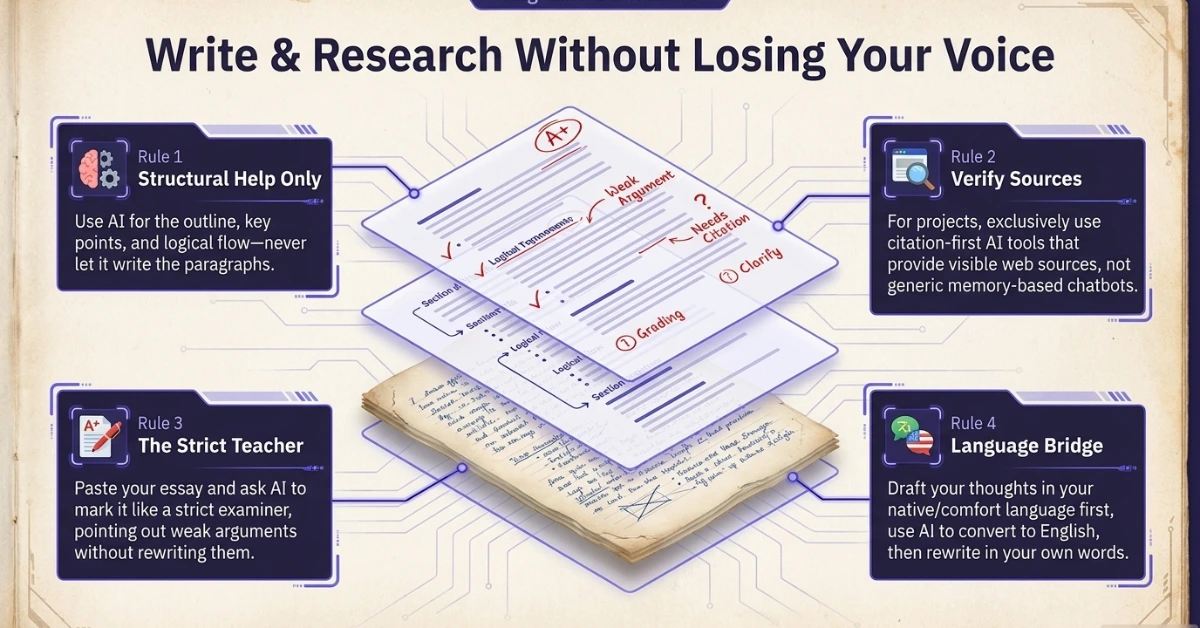
18. Use AI for the outline, never the paragraphs.
Ask for a structure — key points, a logical flow, what to include in your introduction and conclusion — and then write every sentence yourself. This keeps the thinking yours, which is both the actual point of an assignment and your best protection against being wrongly accused of using AI to write it (a real and rising concern — false-accusation stories are now one of the most common AI-in-education discussions online).
19. For projects, use a citation-first AI tool.
Tools built around real-time search with visible sources (rather than a general chatbot working purely off memory) are far better for project work, because you can actually verify and credit where information came from — which matters for both academic honesty and marks.
20. Ask AI to check your writing like a strict teacher — not to rewrite it for you
Paste your own essay and ask: “Mark this like a CBSE examiner would. Point out weak arguments, unclear sentences, and anything that wouldn’t earn full marks — but don’t rewrite it for me.” You keep authorship; you just get sharper feedback than “looks good.”
21. Draft in your comfort language first.
Draft in your comfort language first Write your first draft in whatever language your thoughts come naturally in. Then ask AI to help convert it into clean English, and rewrite the AI’s version once more in your own words. This keeps your actual reasoning intact, instead of replacing it with borrowed phrasing that won’t sound like you when you’re writing under exam pressure.
Use AI Without Losing Your Own Brain
This last section might be the most important — and it’s the part almost no “top AI tools” article bothers to include.
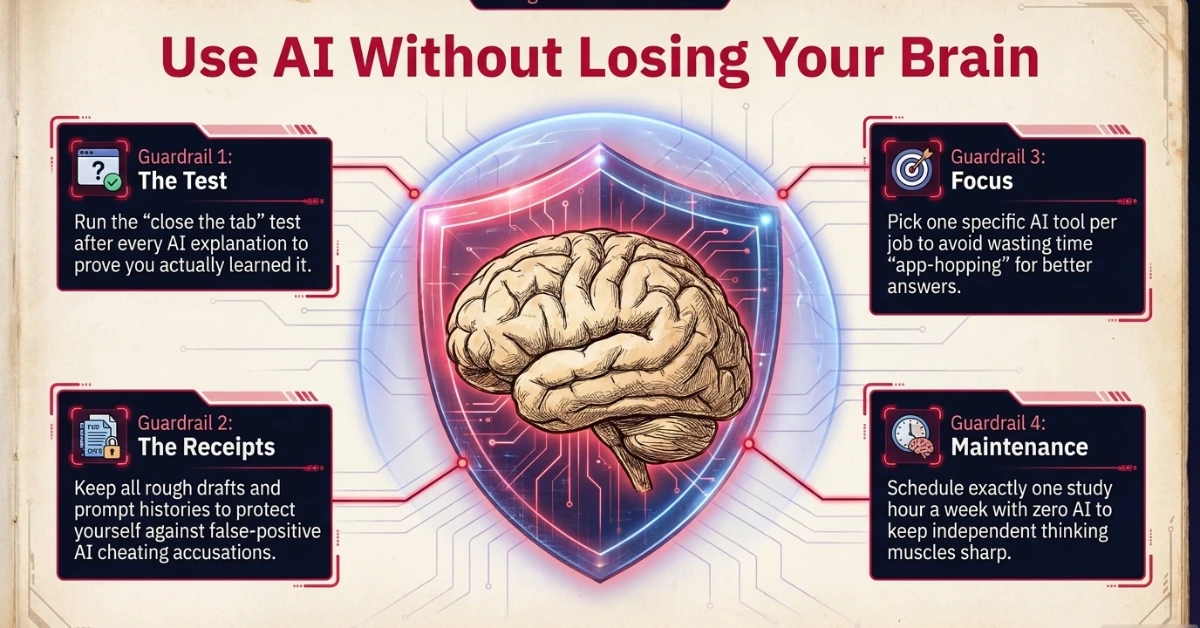
22. Run the “close the tab” test after every explanation.
Run the “close the tab” test after every explanation Once AI explains something, close it and try explaining the concept out loud, unaided. If you can’t, you don’t actually know it yet — you just recognised it while reading. This ten-second habit is the real difference between actually knowing something and just feeling like you do, which AI is very good at making you feel.
23. Keep your own drafts and prompt history.
AI-detection tools regularly flag genuine, human-written work as AI-generated, and students who’ve done nothing wrong end up having to prove it. Keep rough notes, earlier drafts, or your own outline saved somewhere, especially for anything you’ll submit. It’s not paranoia; it’s the same reason you keep a rough sheet in an exam.
24. Pick one tool per job.
A lot of students juggle ChatGPT, Gemini, and two other apps for the same homework question, hoping one gives a “better” answer. This wastes more time than it saves. Decide in advance: one tool for understanding a concept, one for planning your schedule, one for revision audio — and stick to it per task.
25.Schedule one study hour a week with zero AI
Pick one chapter and study it the traditional way — book, pen, your own notes, no tool open. This isn’t nostalgia; it’s maintenance. National survey data already shows a meaningful share of students and teachers worry that constant AI reliance is quietly weakening independent thinking. A single no-AI hour a week keeps that muscle from going soft, and it’s often when you’ll notice most clearly how much you’ve actually learned versus how much you were leaning on the tool.
Frequently Asked Questions
Is it cheating to use AI to study?
Using AI to understand a concept, plan revision, or quiz yourself isn’t cheating — it’s having a 24/7 tutor. It becomes a problem the moment AI-generated text goes into your submitted work. The line isn’t the tool; it’s whether the final thinking is genuinely yours.
Which AI is best for CBSE students in 2026?
None are built purely around NCERT, so verify everything. ChatGPT tends to be stronger for step-by-step math; Gemini handles live web reading and Google Docs well; Claude is excellent for long-form writing and document analysis.
Can I trust AI answers for NCERT-based questions?
Not blindly. General AI models can state something confidently while being wrong for your specific syllabus. Always ask which chapter it’s matching to, and verify.
Will using AI too much make me dependent?
Yes, if you only ever ask for answers. The dependency risk isn’t in the tool — it’s in passive use. The strategies in this guide (teach-it-back, close-the-tab test, weekly no-AI hour) exist to keep you doing the thinking.

My name is Asheesh Kumar i am a dedicated educator and have a deep understanding of artificial intelligence, I aim to transform traditional learning methods by integrating cutting-edge technology and AI-driven tools into education. As a teacher and personal tutor, I have the privilege of working with many students and understanding their individual strengths and weaknesses. With this insight, I know how to help each student overcome their challenges and improve their skills. Understanding each student’s unique learning style and needs allows me to tailor lessons that maximize their potential. This holistic approach not only boosts academic performance but also builds confidence and a lifelong love for learning.
5 thoughts on “The Complete Guide to Studying With AI: 25 Practical Ways for Students (2026)”