
Last Updated on March 23, 2026 by Asheesh Kumar
Your eight-year-old just asked Alexa to help with their math homework. Your teenager is using ChatGPT to brainstorm essay ideas. Your fifth-grader wants to know if AI will take over the world.
Welcome to parenting in 2026, where artificial intelligence isn’t some distant future concept—it’s sitting at your dinner table, living in your kids’ pockets, and shaping how they learn, play, and think.
But here’s the thing most parents won’t tell you: teaching AI literacy at home doesn’t require a computer science degree or fancy tech skills. It just requires curiosity, honesty, and a willingness to learn alongside your kids.
I’ve spent the last three years working with families who’ve successfully integrated AI education into their homes, and I’m going to share exactly what works, what doesn’t, and how you can start today—even if you barely understand AI yourself.
Why AI Literacy Matters More Than Coding
AI literacy isn’t teaching kids to build algorithms.
It’s understanding how AI “thinks,” where it fails, and how to use it responsibly. It’s critical thinking in a world where machines write, draw, and answer confidently—even when wrong.
Research from Stanford shows that kids are “racing ahead in their grasp of the technology, and schools are scrambling to catch up.” Teachers are understandably worried—about misinformation, academic integrity, and the fact that most of them received zero training on this
Your grandparents didn’t know how TV signals worked, but they knew not to believe everything on TV. That’s the level we’re aiming for.
Also Read: AI Literacy 101: How to Teach AI to Students (A Practical Classroom Guide for 2026)
The Three Pillars of Home AI Education
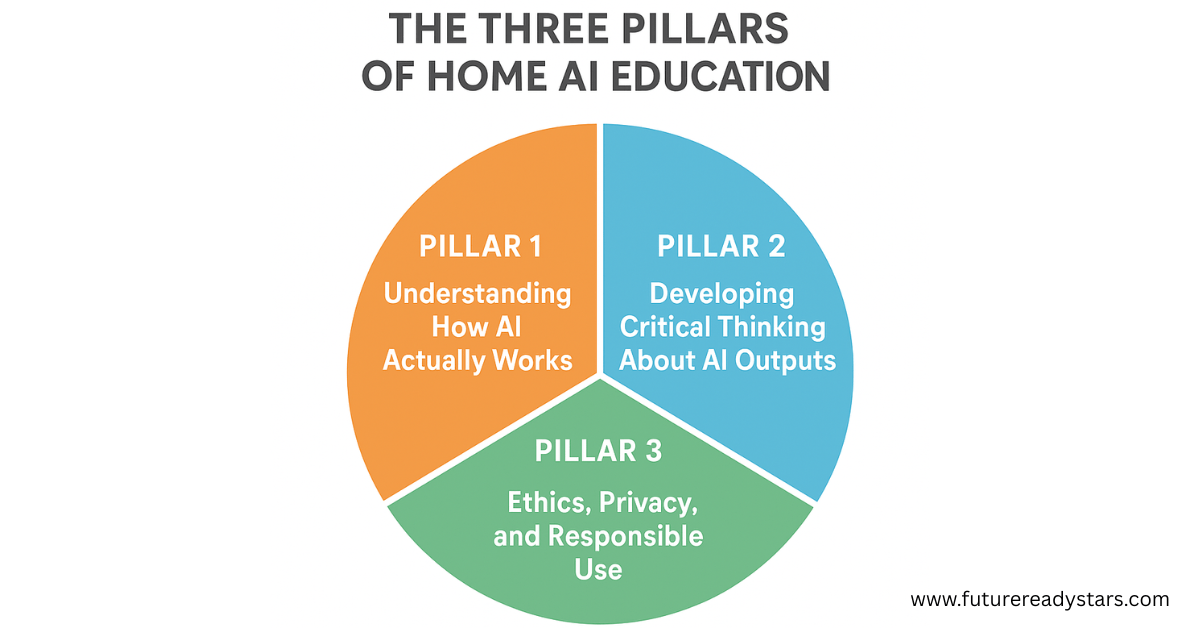
Pillar 1: Understanding How AI Actually Works
Start with the magic trick reveal. Kids love magic. They love it even more when they learn the secret.
The Cookie Sorting Game (Ages 5-8)
Spread out 20 pictures of different cookies on your kitchen table—chocolate chip, oatmeal raisin, sugar cookies, some burnt, some perfect. Ask your child to sort them into “yummy” and “not yummy” piles.
Now tell them: “Congratulations, you just taught an AI how to recognize good cookies!” Explain that AI learns exactly like they just did—by looking at lots of examples and finding patterns.
The follow-up question writes itself: “What if I had only shown you burnt cookies? Would you think all cookies are burnt?” Boom. You’ve just taught bias in training data.
The Pattern Detective (Ages 9-12)
Play 20 questions, but with a twist. You think of an animal, and your child asks yes/no questions to guess it. After they guess correctly (or give up), explain that this is essentially how AI works—it asks itself thousands of questions about patterns in data.
Then flip it: “What if I told you I was thinking of an animal, but I’d only ever seen animals in a zoo? Would I know about animals in the ocean?” This introduces the concept of limited training data.
One parent’s ten-year-old suddenly got why AI struggles with rare diseases— “It hasn’t seen enough examples. Like my three zoo animals.”
Also Read: Tablet vs Laptop for Students 2025: Tutor’s Guide for Parents – futureReadyStars
Pillar 2: Developing Critical Thinking About AI Outputs
This is where rubber meets road. Your kids are already using AI tools. They need to know when to trust them and when to raise an eyebrow.
The Fact-Checking Challenge (Ages 8-15)
Pick a topic your child knows well—their favorite sport, a book series they love, their hometown. Ask an AI assistant (ChatGPT, Claude, or any chatbot) a question about it. Then, together, verify whether the answer is correct.
When I did this with my neighbor’s daughter using questions about her gymnastics competitions, the AI confidently stated that a certain scoring rule existed—but she knew it was outdated by three years. Her face lit up: “It doesn’t know everything!”
Make it a weekly game. The goal isn’t to trash AI—it’s to build healthy skepticism. Kids learn that AI is a tool that needs verification, just like Wikipedia or a stranger’s advice.
The Creative Collaboration Exercise (Ages 10-16)
Have your child write a 3‑sentence story opening. Ask AI to continue it. Read together. Discuss:
- What did the AI get right about your story’s tone?
- What felt “off” or generic?
- What would you change to make it more “you”?
This teaches AI as collaborator, not replacement. A middle-schooler said, “It gave me ideas, but they weren’t as good until I mixed them with mine.” That’s the insight we want.
Pillar 3: Ethics, Privacy, and Responsible Use
This is the “vegetables” part of AI literacy—not always fun, but absolutely essential.
The Digital Footprint Mapping (Ages 9-15)
Sit down with a large piece of paper and markers. Draw your child in the center. Then map out every piece of information about them that exists online or in databases: school records, social media posts, photos, search history, apps they use, smart home devices.
Then explain: “Using AI feeds it info. Some companies keep and train on it.” Ask: “What would you share? What stays private?”
Ask: “If you could control what information AI companies know about you, what would you share and what would you keep private?”
This isn’t fear. It’s empowerment. Kids who understand privacy make smarter choices.
The Bias Detector Game (Ages 11-16)
Show your child AI-generated images of “a doctor,” “a nurse,” “a CEO,” and “a teacher.” Many image generators still default to stereotypical gender and racial representations.
Discuss what they notice. Why might AI show these patterns? (Answer: because it learned from millions of internet images that reflected society’s biases.)
Then ask the powerful question: “If AI learns from us, and AI is making decisions about jobs, loans, and opportunities, what should we do?”
Let them wrestle with it. Some say diversify training data. Others say add human oversight. All start thinking like ethical designers.
Age-Appropriate Activities That Actually Work

For Elementary School (Ages 5-10)
AI or Human? Game
Show pairs of images, poems, or short stories. Some human-made. Some AI‑generated. Can they tell?
The point isn’t to be right. It’s to ask what feels “human.” A second-grader said, “The AI picture is too perfect. Real artists make happy mistakes.”
Teachable Machine Project
Use Google’s Teachable Machine to train a simple classifier on toy photos. Celebrate mistakes. Ask: “Why did it think your red car was a fire truck?” Because both are red. That’s how AI gets confused.
Also read: AI in Early Childhood Education: Screen Time or Smart Time? – futureReadyStars
For Middle School (Ages 11-14)
AI Journalism Assignment
Pick a current event. Have your child ask three different AI tools to summarize it. Compare the responses:
- What facts appear in all three?
- Where do they differ?
- What language feels biased or neutral?
Then find three actual news articles on the same topic and compare those to the AI summaries. This teaches media literacy and AI literacy simultaneously.
Build an AI Assistant
Not through coding, but through imagination. Have your child design an AI assistant for a specific purpose: helping elderly people remember medications, helping kids with homework anxiety, helping rescue shelters match pets with families.
What would it need to know? What mistakes could it make? What ethical rules should it follow?
One thirteen-year-old designed a tutor that only gives hints. Ethics, built-in.
For High School (Ages 15-18)
The Deepfake Discussion
Watch appropriate deepfake examples. Discuss tech, harms, and detection limits.
Ask: “If you can make a convincing video of anyone, what’s your responsibility?” Let them craft their ethical stance.
Stanford research shows teens who engage these scenarios early make better choices under pressure.
AI Career Exploration
Pick three careers your teen likes. Investigate:
- How AI is used now
- What tasks might be automated
- Which human skills gain value
A teen exploring nursing learned diagnostics may improve, but empathy and communication matter more. That’s reassuring and motivating.
Common Mistakes Parents Make (And How to Avoid Them)

Mistake 1: AI as Savior or Villain
Extreme rhetoric makes kids anxious or tuned out. Frame AI as powerful and imperfect. Helpful and problematic. Like many inventions.
Mistake 2: Banning AI Entirely
Prohibition rarely works. Kids will use it elsewhere. Then they learn without guidance. Set clear guidelines instead. For example: “Use ChatGPT to brainstorm. Final essay must be your voice.”
Mistake 3: Expecting to Know More Than Your Kids
Your teen may know tools better. That’s okay. Make it collaborative. “Teach me how that works” models intellectual humility—and builds trust.
Resources You Can Actually Use
Free Tools and Websites:
- AI for K-12 Initiative: Free lesson plans designed by teachers
- Teachable Machine by Google: Build simple AI models without coding
- Quick, Draw!: Game that shows kids how AI learns to recognize drawings
- Moral Machine: MIT project exploring ethical decisions in AI
Family-Friendly AI Tools for Exploration:
- ChatGPT (with parental supervision and settings adjusted)
- Google’s “Talk to Books”: Search engine that answers questions conversationally
- Seeing AI: Microsoft’s app that describes the world for visually impaired users—great for showing kids how AI “sees”
Also Read: Top 15 Banned AI Tools Students Love (Why Schools Can’t Stop Them)
Books by Age
- Picture books on robots for younger kids
- Sci‑fi with AI themes for tweens
- Nonfiction on tech ethics and society for teens
Your First Week: A Simple Start
You don’t need a master plan. You need to start. Here’s a week-by-week beginning:
| Day 1 | Have the “AI in Our House” conversation — list every AI tool your family uses (smartphone assistant, school apps, games, chatbots). |
| Day 2 | Pick one tool you listed. Explore it together for 20 mins. Ask weird or funny questions. Laugh at mistakes. |
| Day 3 | Play Cookie Sorting or Pattern Detective (depending on child’s age). Then debrief: “What pattern did AI see? What patterns did we miss?” |
| Day 4 | Try the Fact-Checking Challenge: pick a topic your child knows well; ask AI + then verify using a book, website, or personal knowledge. |
| Day 5 | Creative Collaboration: let them start a short story or drawing prompt. Give AI a shot at continuing. Then remix together. |
| Day 6 | Do a mini “Digital Footprint Mapping”: on paper, draw your child in center; around the edges, list all digital/data touchpoints (apps, social media, school portals, smart devices). Ask: “What data do we want to share? What should stay private?” |
| Day 7 | Family reflection: talk about what felt useful, weird, surprising. Ask your child: “If you could ask AI to learn anything — what would it be?” Use answers to plan future learning. |
The Real Goal: Preparing Kids for an AI-Integrated Future
Here’s what we’re really after: kids who can leverage AI as a powerful tool while maintaining their creativity, critical thinking, and ethical compass.
We want teens who say, “This AI-generated essay is good, but it’s not mine—let me use it as a starting point and make it better.”
We want ten-year-olds who ask, “How does this app know what to show me? What information is it collecting?”
We want kids of all ages who understand that humans still make the final decisions—humans create AI, train it, deploy it, and are responsible for its impact.
The parents who succeed at this aren’t the most tech-savvy. They’re the most consistent. They bring up AI in casual conversation. They show genuine curiosity. They admit what they don’t know. They make it normal to discuss AI, question it, and experiment with it.
Because the best time to teach AI literacy was five years ago. The second-best time is now—before dinner, during homework, in those small moments when your kid asks a question you don’t know how to answer.

My name is Asheesh Kumar i am a dedicated educator and have a deep understanding of artificial intelligence, I aim to transform traditional learning methods by integrating cutting-edge technology and AI-driven tools into education. As a teacher and personal tutor, I have the privilege of working with many students and understanding their individual strengths and weaknesses. With this insight, I know how to help each student overcome their challenges and improve their skills. Understanding each student’s unique learning style and needs allows me to tailor lessons that maximize their potential. This holistic approach not only boosts academic performance but also builds confidence and a lifelong love for learning.
3 thoughts on “AI Literacy for Kids in 2026: Parents’ Guide to Teach AI at Home”