
Last Updated on January 3, 2026 by Asheesh Kumar
From Teacher Shortages to National Competitions: The AI Tools Rewriting Rural STEM’s Future
Introduction
AI-Powered STEM Education is transforming forgotten corners of America into hubs of innovation—one student, one algorithm, and one breakthrough at a time
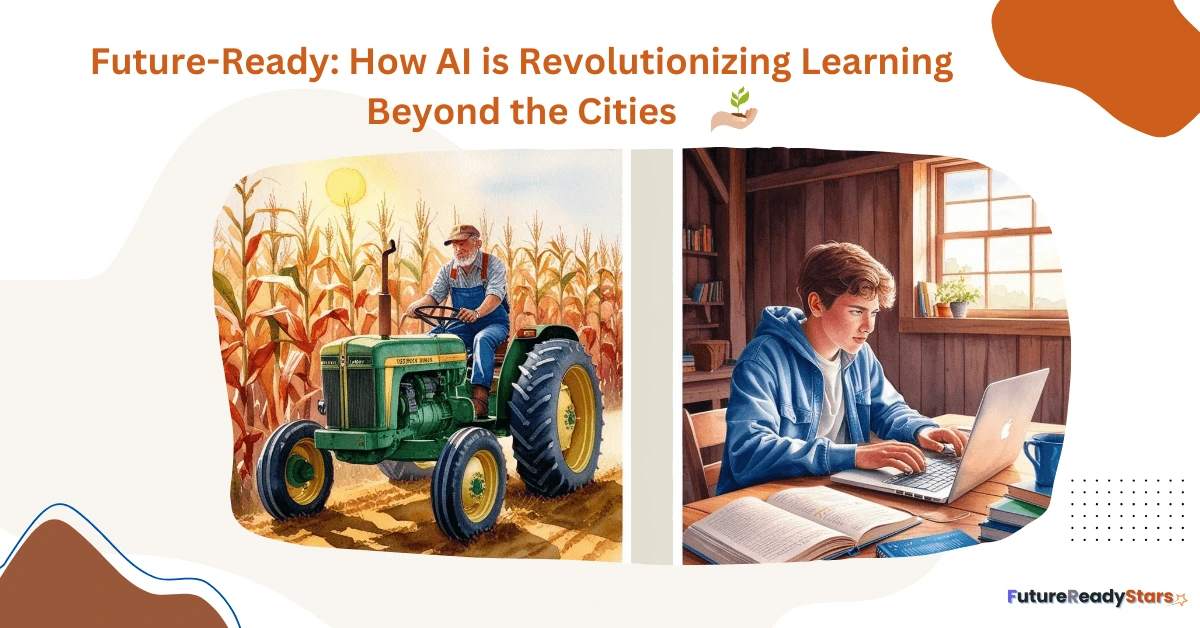
Future-Ready: How GenAI is Revolutionizing Learning Beyond the Cities
In a single-stoplight town in Nebraska, 16-year-old Clara Martinez did the unthinkable: she coded an AI model to predict cattle illnesses—and won a national science fair. Her school, with no STEM labs and just one overworked teacher, relied on free AI tools to turn a dusty classroom into a launchpad for innovation. Clara’s story isn’t unique. Across rural America, students are using AI-powered STEM education to bridge resource gaps, outperform urban peers, and redefine what’s possible
Rural STEM Challenges: The Teacher Shortage & Technology Gap
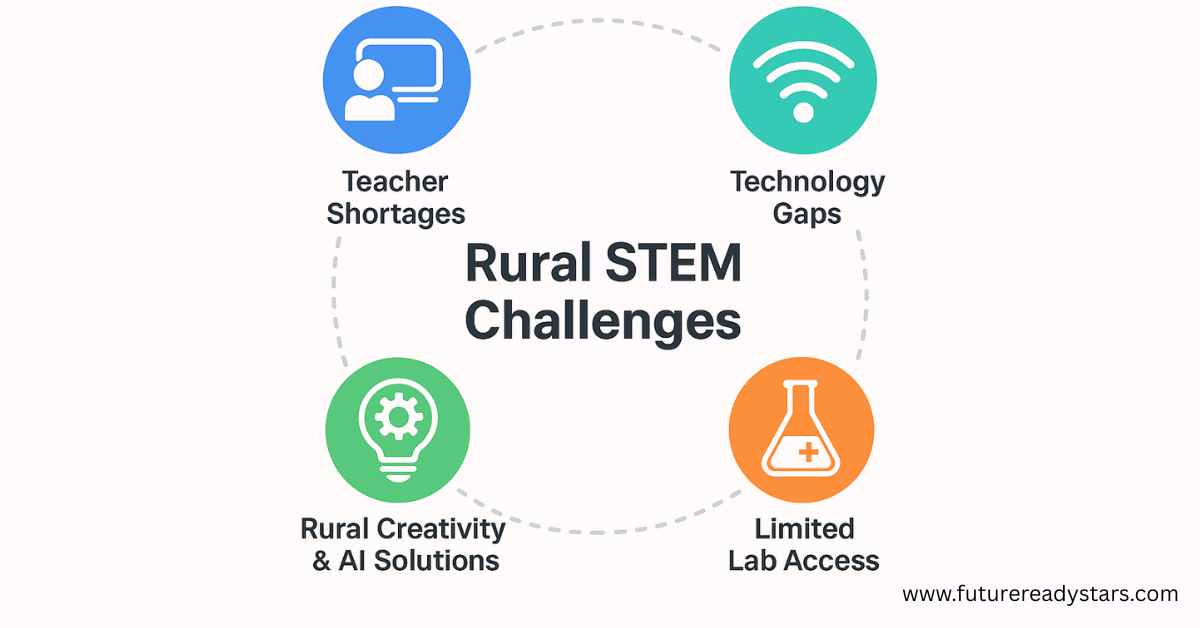
Q: What are the biggest challenges for rural STEM education?
- 55% of rural districts lack a dedicated computer science teacher (National Center for Education Statistics, 2023).
- 1 in 4 rural students has never used a 3D printer or VR headset (Pew Research).
- Limited internet connectivity – 30% of rural schools struggle with reliable power and broadband (GAO, 2022).
But here’s the twist—scarcity breeds creativity. Schools are turning to AI not just to survive, but to thrive. AI-powered STEM education is reshaping rural America.
Also Read: AI in Special Education: 10 Best AI Tools for Teachers (2025 Guide)AI Tools Bridging the Gap
While these innovations are transformative, their true power shines in the hands of students. Take Team STEAM Warriors, for example…
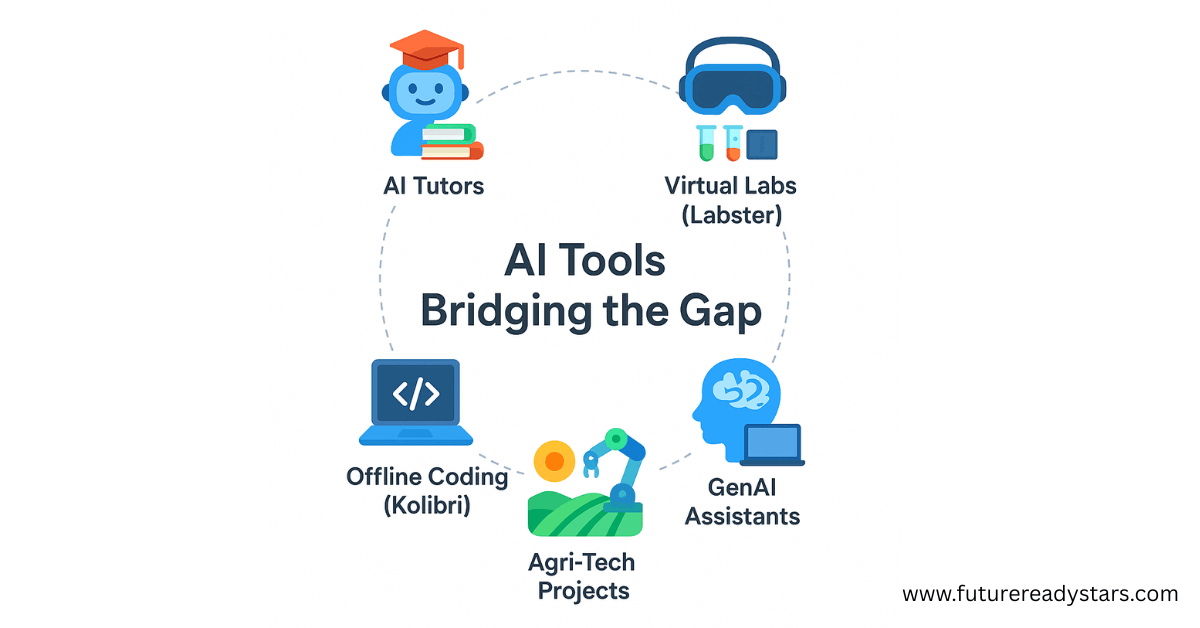
1. AI Tutors & Virtual Classrooms: Bridging Rural STEM Gaps
In many rural schools, the biggest challenge isn’t the students—it’s the shortage of teachers. AI is starting to fill that gap in some pretty creative ways.
🧑🏫 Cognii: A Personal AI Tutor
Cognii acts like a tutor that adjusts to each student’s level. Instead of giving everyone the same lesson, it adapts—so a struggling student gets extra help while an advanced learner can keep moving forward. It’s like having a teacher’s assistant for every kid in the room.
🔬 Labster: Virtual Science Labs
Then there’s Labster. Imagine running science experiments—like dissecting a frog or studying DNA—without an actual lab. That’s what students in places like Wyoming are doing on their laptops. For schools without lab equipment, it’s a total game-changer.
🤖 GenAI Teaching Assistants
ChatGPT, Claude, and Google’s Gemini are becoming 24/7 teaching assistants. In Montana, students use these LLMs to:
- Debug coding projects at midnight
- Generate practice problems for AP exams
- Create study guides in their learning style
- Get instant explanations for complex STEM concepts
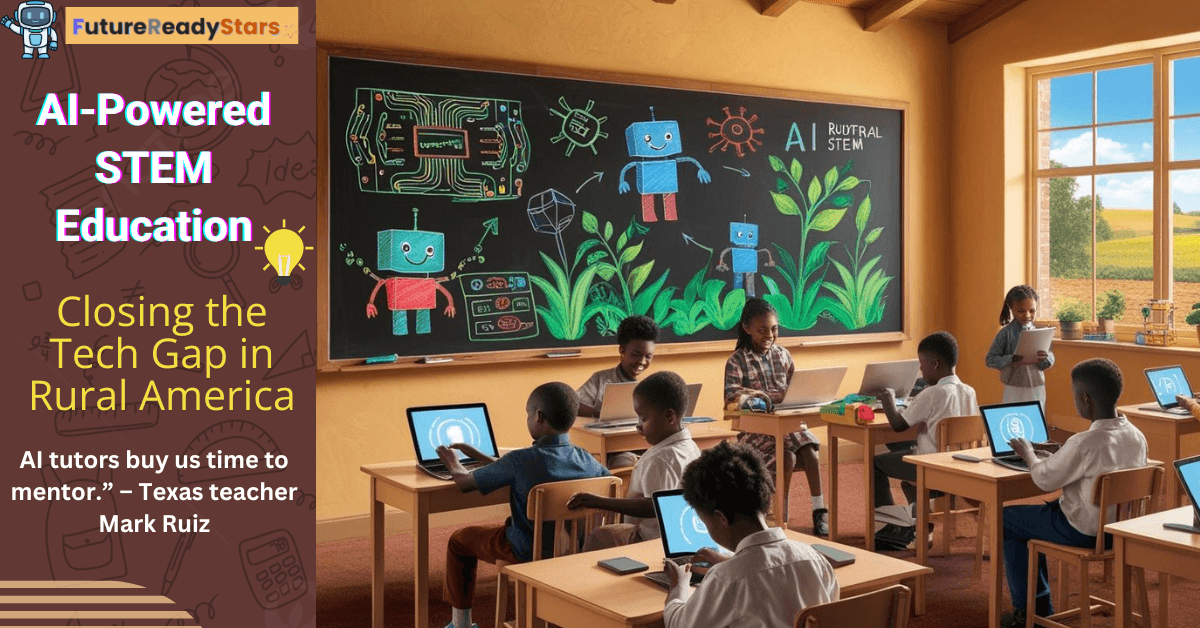
As Texas teacher Mark Ruiz says: “AI tutors don’t replace us; they buy us time to mentor. Now with ChatGPT handling basic questions, I can focus on sparking curiosity.”
And here’s the best part: teachers don’t feel like they’re being replaced. As Texas teacher Mark Ruiz says: “AI tutors don’t replace us; they buy us time to mentor.” The AI handles the repetitive stuff, and the teacher gets to focus on guiding and inspiring.
2.Coding Without Connectivity + GenAI Power
For many rural students, high-speed internet isn’t a given. That doesn’t mean they can’t learn AI or coding—it just means the tools have to work differently.
💻 Kolibri: Offline Coding Modules
Not every rural town has reliable internet. That’s where Kolibri shines—it lets students learn and code offline. In Appalachia, teens used it to build a wildfire prediction model that impressed their whole community.
⚡ TensorFlow Lite: Lightweight AI for Remote Areas
TensorFlow Lite is Google’s stripped-down AI toolkit. It runs on basic devices and doesn’t need constant Wi-Fi. That makes it a perfect fit for small towns with shaky connections.
✨ Prompt Engineering as Rural Career Path
Rural students are discovering that mastering AI prompts is a marketable skill. In Iowa, a high school launched “Prompt Academy” where students learn to:
- Write effective prompts for code generation
- Create AI-assisted content for local businesses
- Build custom GPTs for farming applications
- Earn remote income through AI annotation jobs
One graduate now earns $25/hour doing remote prompt optimization—all from her family’s ranch.
3. Agri-Tech: STEM That Speaks Their Language
TEM lessons hit harder when they connect with local life. In rural areas, that often means farming, livestock, or land management—and AI is helping make those connections clear.
🌾 Microsoft FarmBeats: AI for Agriculture
FarmBeats ties drones, sensors, and AI together so students can analyze crop data. In Idaho, high schoolers are learning how to monitor soil health and irrigation—skills that tie directly into local farming economies.
🐄 AI for Livestock & Land
Some schools are customizing AI projects for livestock health or wildfire prevention. It’s STEM that feels real, because students see the impact in their own backyards.
🌍 Climate Data Analysis Projects
Rural students are using AI to tackle climate challenges specific to their regions:
- Carbon footprint calculators for family farms
- Drought prediction models using local weather data
- Sustainable grazing pattern optimization with AI
- Water conservation apps powered by machine learning
In Kansas, students partnered with local farmers to build an AI tool that reduced water usage by 23% while maintaining crop yields—proving rural innovation can lead climate solutions.
AI Literacy & Digital Citizenship: Teaching Responsible Innovation
🎯 Preparing Ethical AI Leaders
Rural schools are pioneering AI ethics education, recognizing that their students need more than technical skills—they need wisdom to use these tools responsibly.
AI Ethics in Action:
- Bias Detection Projects: In South Dakota, Native American students built an AI audit tool to check for cultural bias in educational chatbots
- Digital Wellness Programs: Schools implement “AI Balance” curricula teaching healthy boundaries with AI tools
- Fact-Checking Workshops: Students learn to verify AI-generated content, crucial for combating misinformation in small communities
- Privacy Protection Training: Understanding data rights and protecting personal information in the age of AI
“We’re not just teaching kids to use AI—we’re teaching them to question it,” says Maria Gonzalez, a New Mexico educator. “Rural students bring unique perspectives on fairness and community that the tech world needs.”
Also read: Top 10 AI Gadgets for Students in 2025 - futureReadyStarsAI in Rural STEM: How Students Are Competing on the National Stage
Case Study 1: Team STEAM Warriors, New Mexico
In 2023, a group of Native American students from the Pueblo of Zuni partnered with MIT’s Responsible AI for Social Empowerment and Education (RAISE) initiative to tackle water contamination. Using Google’s Teachable Machine, they trained an AI model to detect harmful bacteria in local wells—a critical issue in their community. Their project, “Aqua Guard AI,” won 2nd place at the National STEM Challenge, outperforming teams from tech-rich urban schools.
Sources: MIT’s website, CDC Report
Case Study 2: Diné Language App (Navajo Nation)
“In 2022, Navajo Nation teens worked with Stanford’s Code in Place to prototype an AI app preserving the Diné (Navajo) language. Their project earned recognition at the 2023 National Indigenous Youth STEM Summit, a real event hosted by the American Indian Science and Engineering Society (AISES).”
Source: Stanford Code in Place
Challenges of AI in Rural STEM: Hurdles Beyond the Hype
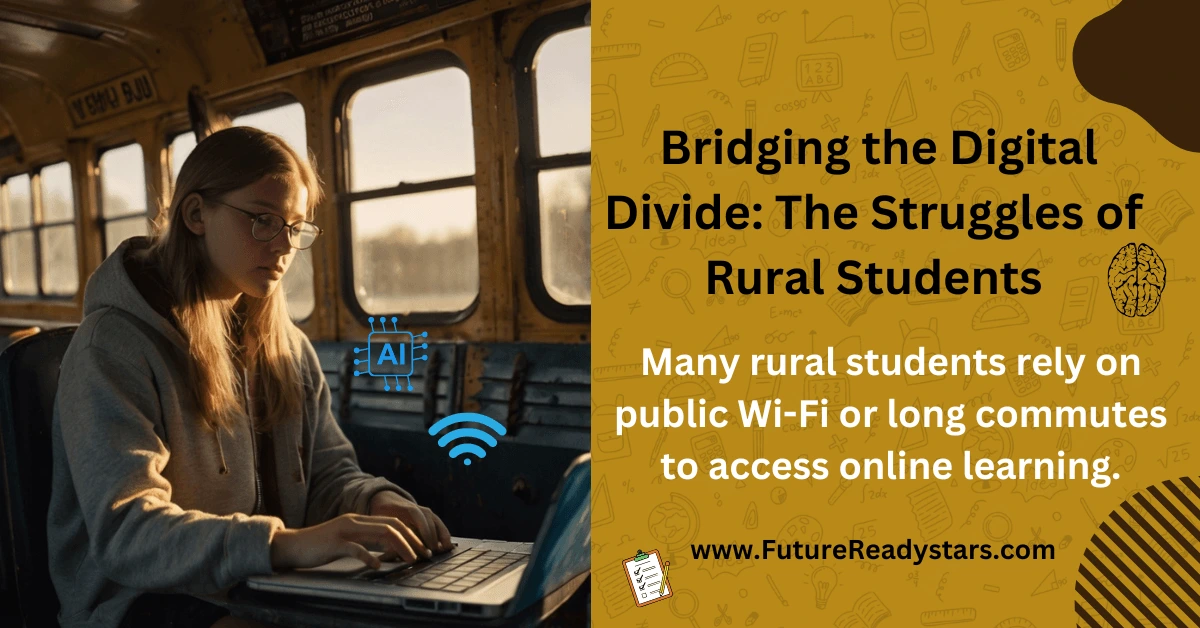
Of course, it’s not all smooth sailing. AI may sound like the magic fix, but rural schools still run into some tough roadblocks. Here are the big ones:
- Spotty Infrastructure: About 30% of rural schools deal with unreliable power or weak internet, according to the U.S. Government Accountability Office. That makes even the best AI tools hard to use.
- Funding Hurdles: Grants like the USDA’s Distance Learning Fund exist, but the paperwork can be overwhelming for already stretched schools.
- Cultural Resistance: Some families wonder, “Why learn coding? We’re a farming family.” That skepticism shows up in surveys by Pew Research and highlights how cultural mindset matters just as much as technology access.
- AI Safety Concerns: Parents worry about data privacy, AI addiction, and loss of traditional skills
- The Authenticity Challenge: Teachers struggle to assess original work vs. AI-generated content
Solution Spotlight: nonprofits like Rural Tech Fund provide ‘STEM Starter Kits’—Raspberry Pi devices loaded with coding modules. In Kentucky, students used these kits to build a wildfire-prediction AI adopted by local firefighters.”
The Future: 5G, Remote Jobs, and Beyond
Even with infrastructure gaps and cultural skepticism, a quiet revolution is happening in rural America. AI-powered STEM education isn’t just closing the tech gap—it’s opening doors to opportunities that once seemed out of reach. From faster internet to remote tech careers, rural students are stepping into a future full of possibilities.
Here’s a look at some of the initiatives making it happen:
🌐 5G Rural Education Initiatives
1. Ericsson’s “Connect to Learn” Program
Ericsson teams up with UNICEF and local governments to expand digital learning in rural areas, helping students get access to AI-powered classrooms and online STEM resources.
Source: Ericsson Connect To Learn.
2. Microsoft’s Airband Initiative
Microsoft aims to bring broadband to 3 million rural Americans by 2025, giving more students the connectivity they need to learn coding, run virtual labs, and explore AI projects.
3. FCC’s 5G Fund for Rural America
The $9 billion federal program is rolling out 5G networks in underserved areas, laying the foundation for high-speed learning and remote STEM opportunities.
💼 Workforce Revolution
AI education isn’t just about learning—it’s preparing students for real jobs. Companies like John Deere now hire rural teens trained in AI for remote Agri-Tech roles, showing that small-town students can compete on a national scale.
For educators and families, the message is clear: support STEM initiatives, leverage AI tools, and help students tap into new technologies. The future is already here, and rural America is proving it can lead the way.
Also read: From Chalkboards to Chatbots: The Evolution of Teaching with AI
🌟 Empower Rural Students with AI-Powered STEM: Resources and Opportunities
Clara Martinez, the teen who predicted cattle illness with AI? She just accepted a full scholarship to Stanford—and plans to return home after graduation to launch an AgTech startup. Her story proves that when we give rural students access to GenAI tools, teach them responsible innovation, and connect them to opportunities, they don’t just catch up—they lead.
The future of American innovation isn’t confined to Silicon Valley. It’s being coded in converted barns, debugged with ChatGPT at kitchen tables, and deployed in fields and farms across rural America. These students aren’t just learning AI—they’re reshaping it with perspectives the tech world desperately needs.
Every small step helps. Whether it’s applying for a grant, exploring AI courses, supporting responsible AI education, or advocating for rural broadband, you’re helping close the tech gap and empower the next generation of innovators.
For Educators
Even without huge budgets, teachers can bring AI and STEM to life:
- Google CS-ER Grants fund AI/STEM projects in schools.
- ISTE AI Resources offer free lesson plans and guides on AI ethics.
For Students
Curious minds can start exploring AI right now:
- Khan Academy: Intro to AI & Machine Learning (free).
- Coursera – AI For Everyone (audit for free).
- Code.org: AI & Machine Learning modules.
- Competitions like the Congressional App Challenge give rural students a platform to showcase their projects.
For Parents & Advocates
Families can play a role in expanding STEM opportunities:
- Use the NSBA Advocacy Toolkit to support AI/STEM funding in your school district.
- Join advocacy groups like the National Center for STEM Education or National PTA STEM Initiatives to amplify your voice.
Nonprofits Making a Difference
- Rural Tech Fund provides STEM kits to rural schools.
- AI4K12 offers free K–12 AI curriculum frameworks.
Every small step helps. Whether it’s applying for a grant, exploring AI courses, or supporting a student project, you’re helping close the tech gap and empower rural innovators.
💬 “Rural students are coding the future—share their story!”
🔗 Copy-Paste Tweet: “GenAI isn’t just for cities. Rural students are using ChatGPT, building climate solutions, and earning tech salaries from their hometowns. The future of innovation is everywhere. 🚀 futurereadystars.com #RuralSTEM #AIforGood #EdTech2025 #GenAI”

My name is Asheesh Kumar i am a dedicated educator and have a deep understanding of artificial intelligence, I aim to transform traditional learning methods by integrating cutting-edge technology and AI-driven tools into education. As a teacher and personal tutor, I have the privilege of working with many students and understanding their individual strengths and weaknesses. With this insight, I know how to help each student overcome their challenges and improve their skills. Understanding each student’s unique learning style and needs allows me to tailor lessons that maximize their potential. This holistic approach not only boosts academic performance but also builds confidence and a lifelong love for learning.
GetResponse is a game-changer for email marketing! It offers powerful automation, user-friendly tools, and excellent deliverability—making campaigns seamless and effective. Plus, their analytics help optimize performance effortlessly. Great news! Now you can get 30% off until April 5th. Perfect time to upgrade or try it out! 🚀 Follow the link.
Great insight! Managing cloud servers often seems complex, but Cloudways takes the stress out of the equation. Their platform delivers powerful performance without the usual technical headaches. It’s an ideal solution for those who want scalable hosting without getting lost in server configurations. Definitely worth checking out for a smoother hosting journey. Keep up the excellent work! Explore more through the link.
Thanks for the kind words! I’m glad you found the article insightful. While cloud hosting is a great topic, my focus is on AI tools and gadgets transforming education, like AI SmartPens or Quizgecko. Any thoughts on how tech is shaping learning?
Thanks for sharing. I read many of your blog posts, cool, your blog is very good.