
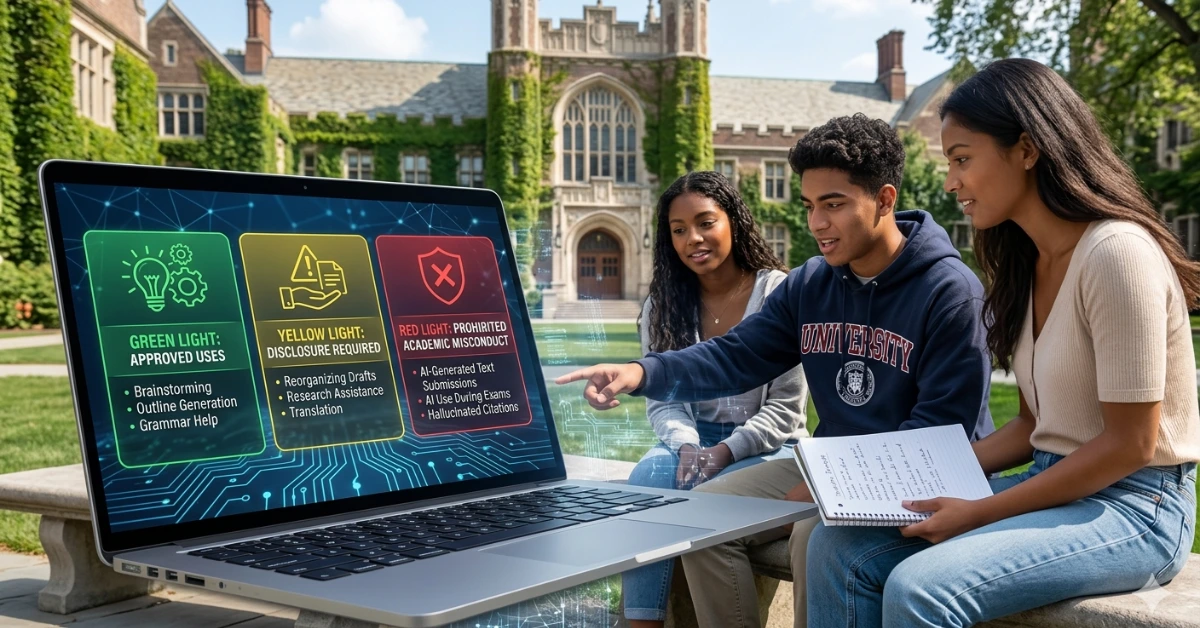
If you feel like your college syllabus looks a little different this semester, you’re not imagining it. After two years of “wait and see,” US universities have officially entered the era of the Great AI Rewrite.
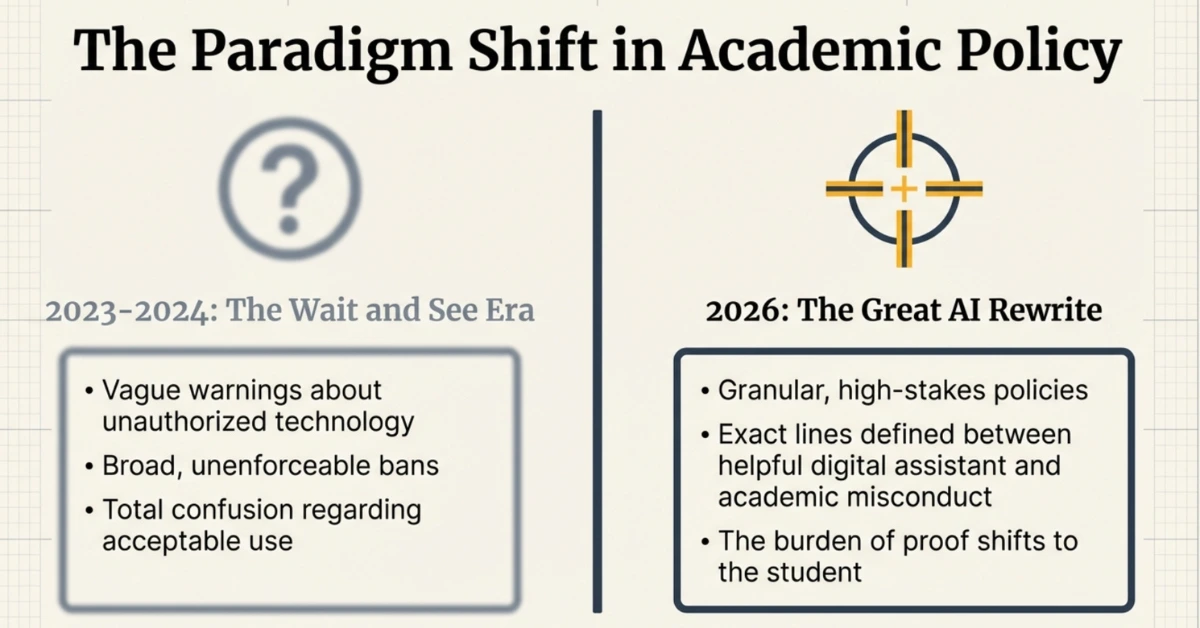
The days of vague warnings about “unauthorized technology” are over. In 2026, institutions from the Ivy League to local community colleges are rolling out granular, high-stakes policies that define exactly where the line is between a “helpful digital assistant” and “academic misconduct.”
Here is the breakdown of the new landscape: what’s officially on the “green light” list, what will land you in the dean’s office, and how to protect yourself in an era of unpredictable AI detectors.
Also Read: NotebookLM Cinematic Video Overview: Turn Your Notes Into a Mini Documentary (Student Guide)
🚦The Stoplight System: Green, Yellow, and Red
The most useful thing to know is that the “ban everything” era is largely over. Instead, most updated policies in 2026 have quietly adopted a three-zone framework. Think of it as a traffic light — and your syllabus is the signal.
🟢 Green Light — AI Fully Encouraged
- Brainstorming thesis ideas or generating outlines
- Using AI as a “personal tutor” — ask it to explain concepts
- Grammar, punctuation & style cleanup for non-native speakers
- Summarizing research papers to orient yourself before diving in
- Generating practice problems for coding or math exams
🟡 Yellow Light — Allowed, But You Must Disclose
- Drafting emails or non-graded professional communications
- Using AI to reorganize or tighten your draft’s structure
- Translation support for multilingual assignments
- Getting AI feedback on your argument’s logical flow
- Research assistance with proper citation of original sources
🔴 Red Light — These Will Land You in Trouble
- Submitting AI-generated text as your own — even if you “edited” it
- Having AI fully rewrite your essay for tone, style, or flow
- AI-generated citations (hallucinated sources = data falsification)
- Any AI use during exams, quizzes, or oral defenses
- Using AI without a Disclosure Statement when one is required
Also Read: Best AI Subscription Plans for Students 2025: ChatGPT, Claude, Gemini, Perplexity & Grok Compared Pro tip: When you open a new syllabus, Ctrl+F for “AI,” “artificial intelligence,” or “generative.” If you find nothing — assume Yellow Light rules apply and disclose anything you use.
What the Big Schools Are Actually Doing
Policies vary wildly, but here’s what some of the most-watched institutions have landed on:
Harvard University
No single university-wide rule — faculty set their own policies per course. Permitted uses include brainstorming, concept clarification, and scenario generation. But for any permitted use, students must submit a Disclosure Statement: what tools they used, what prompts they typed, and how the output shaped the final work. At Harvard, submitting AI-generated work as your own is treated the same as asking someone else to do your assignment.
MIT
Heavy focus on data security. Students are forbidden from entering unpublished research, interview transcripts, proprietary data, or personally identifiable information into any public AI tool. Graduate researchers, take note — this one’s for you. At MIT, transparency is key — students are expected to clearly disclose when AI tools are used in academic work.
Columbia University
Openly describes its policy as a “work in progress as the technology, the law, and community usage evolves.” A working group is actively drafting formal guidelines. Until then: explore responsibly, always disclose.
67%
Of 174 US universities analyzed in a February 2026 study, 117 had no explicit AI policy, no disclosure requirement, and no enforcement mechanism — at all. But “no rule” doesn’t mean “anything goes.” Undisclosed AI use can still constitute academic misconduct.
Your Draft History Is Your Best Friend
Here’s the shift that most students are missing: AI detection software is no longer the main tool schools are using. After high-profile false-positive scandals — where legitimate essays by non-native English writers were flagged as AI-generated — most major schools, including Harvard and the entire UC system, now treat detectors as indicators, not proof.
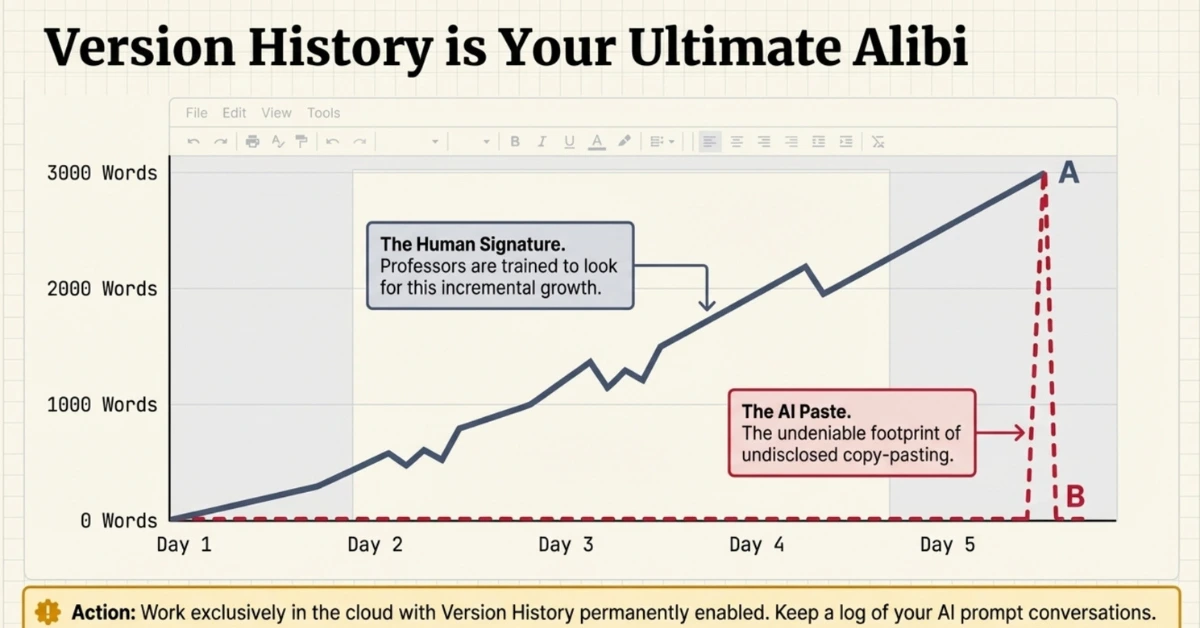
The burden of proof has moved to your process. And that changes everything.
- Work in the cloud. Use Google Docs or Microsoft 365 with Version History turned on. A document showing incremental development over days looks very different from one that appeared fully-formed in 20 minutes. Professors are specifically trained to notice this now.
- Save your prompts. If you used AI for brainstorming, keep a log of the conversation. Showing exactly how you used the tool to think — not to replace thinking — is your strongest defense if anyone questions your work.
- Request an oral follow-up. Many 2026 policies now give students the right to “viva” their submitted work. A 5–15 minute conversation where you explain your argument structure, your source choices, and your revision logic will clear almost any AI-related accusation. Students who genuinely wrote their work can explain it. Students who didn’t — can’t.
- Never paste sensitive research data into public AI tools. Unpublished results, interview transcripts, clinical data, or any third-party confidential material should never go into ChatGPT or any public LLM. This applies even at schools with relaxed AI policies.
Also Read: From Chalkboards to Chatbots: The Evolution of Teaching with AI💡The Bigger Picture: Why Universities Are Changing Now
Here’s the thing most policy documents won’t say out loud: universities are realizing that when you graduate, your employer will probably expect you to know how to use AI. The goal of these new rules isn’t to keep you in the dark ages — it’s to make sure you don’t lose the ability to think for yourself while using the tools of the future.
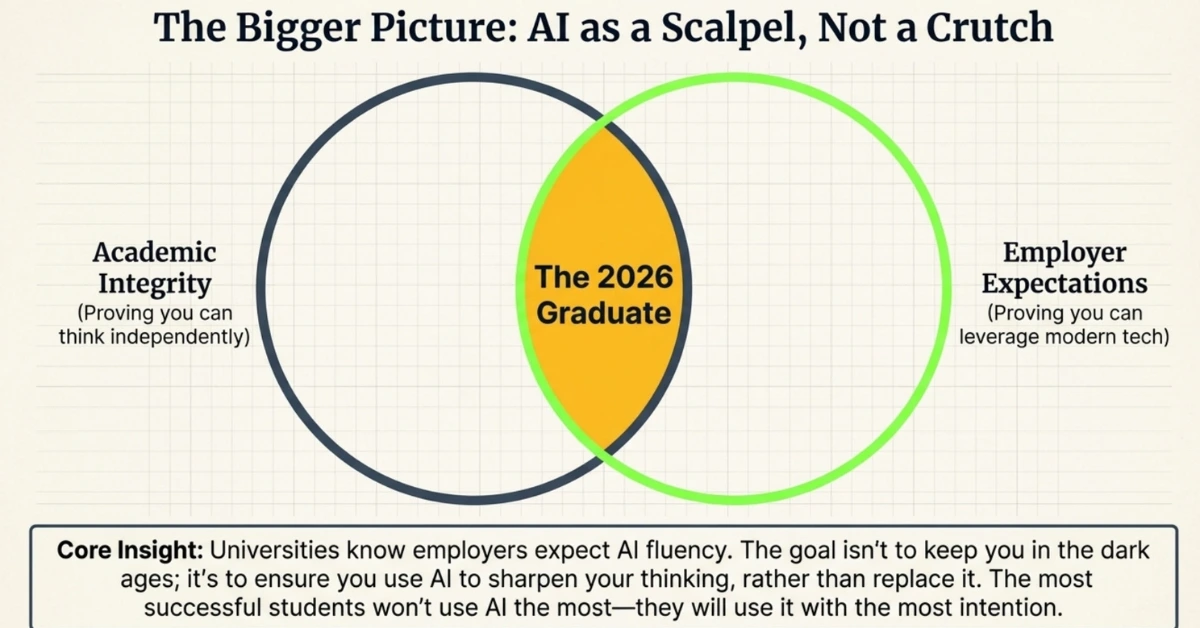
The students who navigate this era best won’t be the ones who use AI the most. They’ll be the ones who understand why the rules exist — and use AI to sharpen their thinking rather than replace it.
Disclosure is now the baseline expectation across almost every updated policy. Failing to disclose AI assistance can now constitute a standalone integrity violation — even if the content itself is perfectly original and factually accurate. The crime, in 2026, is stealth.
⭐ The 2026 Golden Rule
When in doubt — disclose. A footnote explaining that you used AI to help organize your thoughts will almost never get you in trouble. Pretending you did it all alone just might. The policies are changing. The stakes are real. But the principle is simple: be honest about your process.