
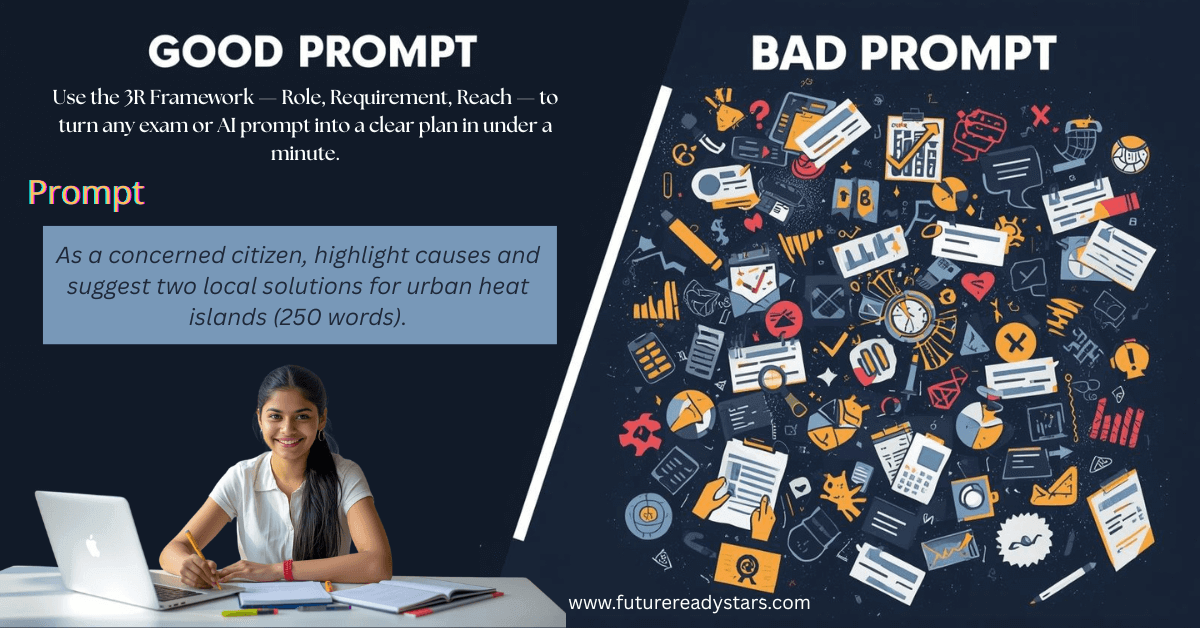
If you’ve ever stared at a blank page, unsure where to start, you’re not alone. In 2025, “prompt writing for students” is more than just responding to a question in an exam. It’s a life skill that helps students analyze tasks, ask better questions, and produce clear, insightful writing—whether you’re in a CBSE classroom in India, crafting an essay for a global curriculum like IGCSE orIB, or preparing content for college applications.
This guide breaks down what prompt writing really is, how to decode any prompt with confidence, and how to respond with structure, style, and voice. Along the way, you’ll find CBSE-aligned examples and global scenarios so you can apply these strategies anywhere.
If you’re curious how AI is shaping exam prep, check out our guide on Top AI Tools for CBSE Exam Question Prediction (2025)
What Is Prompt Writing for Students, really?
At its core, prompt writing is the skill of understanding a task and shaping a targeted, relevant response. A prompt might be an exam question, a writing task, a case study scenario, a debate topic, or even a creative cue in a design thinking project. Strong prompt writing involves three steps:
- Decode the demand: Identify what the prompt is asking you to do.
- Design the response: Plan structure, evidence, and examples before writing.
- Deliver with voice: Write clearly and persuasively, while staying focused on the task.
In CBSE contexts, prompts often come as direct questions or situational tasks in English, Social Science, and Applied Science assessments. Globally, prompts may include data-driven tasks, source-based questions, or multi-step inquiries. The good news: the decoding skills you learn here work across all formats.
How to Decode Any Prompt in 60 Seconds (3R Framework)
Use the 3R Framework — Role, Requirement, Reach — to turn any exam or AI prompt into a clear plan in under a minute.
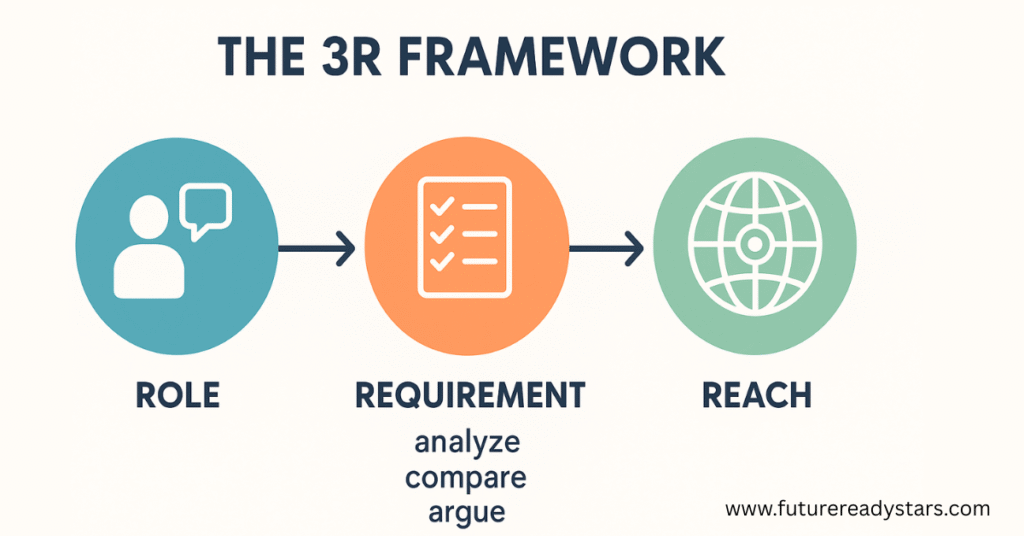
1. Role (Who?) — Identify your voice: student, scientist, concerned citizen, reporter, etc. The role determines tone and what evidence is appropriate.
2. Requirement (Do what?) — Circle the action verbs: analyze, compare, argue, describe, propose. These tell you the structure (e.g., analysis = claim + evidence; compare = similarities & differences).
3. Reach (How far?) — Define the scope: local, national, global, or specific timeframe. Note constraints: word count, required sources, or time limits.
One-line exam template (for quick use):
[Role] + [Action verb(s)] + [Scope/Constraints]
Example: “As a concerned citizen, highlight causes and suggest two local solutions for urban heat islands (250 words).”
CBSE example
Prompt: “Write a letter to the editor highlighting the increase in urban heat islands in your city, suggesting solutions.”
- Role: Concerned citizen
- Requirement: Highlight causes + suggest solutions
- Reach: City-specific, actionable; follow letter format and word limit
IGCSE/Global example
Prompt: “Compare the effectiveness of two renewable energy strategies in reducing carbon emissions in developing countries.”
- Role: Analytical student writer
- Requirement: Compare effectiveness (criteria-based)
- Reach: Developing countries, evidence-based (use examples)
Extra subject examples
- Science (CBSE lab report prompt): Role = lab intern; Requirement = describe method, present results, draw conclusion; Reach = specified experiment, include safety notes.
- History (IB style): Role = historian/analyst; Requirement = evaluate causes vs. consequences; Reach = specific event(s) and time period.
Quick tips (30–60 seconds):
- Underline all verbs and constraints immediately.
- If prompt has multiple verbs, plan a short section for each.
- Turn the action verb into your paragraph headings: Claim, Evidence, Analysis, Conclusion.
- If unsure about role/tone, default to “analytical student” and ask for rubric keywords.
Drop this short exercise into class warm-ups: give students 3 prompts, 60 seconds each to decode using 3R, then compare plans. It trains speed and clarity — the exact skill needed for exams and AI prompts alike.
For math-specific support, see our breakdown of Best AI Tools for CBSE Students to Solve Math Problems (2025): Free & Paid Options
Choosing the Right Structure: 6 Proven Templates
NCERT textbooks, CBSE question banks, and global exams like IGCSE or IB often expect specific structures. Below are six student-friendly templates with examples:
- Argument — Evidence — Impact (for “argue,” “persuade”)
- How: Claim → Evidence → Explain → Impact (why it matters)
- CBSE example: Claim: “Urban heat islands can be mitigated through tree canopies and cool roofs, but only if municipal bylaws prioritize heat-resilient zoning.”
- AI prompt (paste): “Act as a CBSE English examiner. Write a 200–250 word persuasive paragraph: claim, two pieces of evidence, explanation, and a 1-line impact, on why tree canopies and cool roofs reduce urban heat islands.”
- Suggested length: 180–250 words (one strong paragraph + short conclusion)
- Point — Proof — Explain — Link (PPEL) (for “analyze,” “evaluate”)
- How: Point → Proof (quote/data) → Explain meaning → Link to question
- CBSE example: Point: The Green Revolution improved yields; Proof: yield stats; Explain: link to food security; Link: short evaluation of sustainability.
- AI prompt: “You are a CBSE history teacher. Produce a 150–200 word analysis paragraph using PPEL on the Green Revolution’s impact on yields and sustainability, with one statistic and one evaluative sentence.”
- Suggested length: 150–200 words (one paragraph per point)
- Compare — Contrast — Conclude (for “compare,” “contrast”)
- How: Compare A vs B by the same criteria → Highlight differences/similarities → Conclude with judgment
- CBSE example: Compare two irrigation methods (drip vs flood) on water use, cost, yield.
- AI prompt: “Act as an agriculture science tutor. Produce a 220–300 word compare-contrast answer for CBSE: compare drip and flood irrigation on water efficiency, cost, and crop yield; finish with a concise conclusion.”
- Suggested length: 220–300 words (2–3 short paragraphs)
- Problem — Cause — Effect — Solution (PCES) (for “suggest,” “propose,” “recommend”)
- How: Define problem → Root causes → Effects → Prioritized solutions (feasibility notes)
- CBSE example: Problem: rising urban heat; Causes: loss of trees, concrete expansion; Effects: health/stress; Solutions: tree-planting, cool roofs, policy changes.
- AI prompt: “You are a CBSE geography teacher. Write a 250–300 word PCES response that defines urban heat islands, lists 3 causes, two stakeholder effects, and proposes 3 prioritized solutions with feasibility comments.”
- Suggested length: 250–300 words (structured sections or numbered points)
- Source-Based Synthesis (for “evaluate the sources,” “discuss with reference to…”)
- How: Summarize sources → Assess credibility → Compare evidence → Synthesize a position
- CBSE example: Compare two news sources on an environmental policy—summarize claims, check data sources, weigh credibility, form conclusion.
- AI prompt: “Act as an IB/CBSE examiner. Provide a 300–350 word synthesis comparing two given sources on [topic], briefly summarize each, evaluate credibility (authority, evidence), and give a reasoned conclusion.”
- Suggested length: 300–350 words (two mini-summaries + synthesis)
- Narrative–Expository Hybrid (for creative/reflective prompts)
- How: Hook with a brief anecdote → Analytical transition → Return to anecdote + reflective insight
- CBSE example: Start with a short scene showing climate anxiety, then analyze causes and end reflecting on student responsibility.
- AI prompt: “You’re a CBSE English teacher. Write a 250–300 word narrative-expository piece: 2–3 sentence personal hook, 3 short analysis sentences, and a reflective close linking to the prompt theme.”
- Suggested length: 250–300 words (intro hook, 2 analytic paragraphs, reflective close)
We tested this planning idea with AI in our deep-dive: ChatGPT-5 Study Mode vs Claude Learning Mode: I Tested Both for 30 Days (Honest Results)
Writing with Voice: Professional yet Relatable
Students often ask, “How do I sound like myself without being too casual?” Aim for a voice that’s clear, informed, and approachable.
- Use active voice and mostly short sentences to keep momentum.
- Vary sentence length for rhythm: pair a longer analytical sentence with a short takeaway.
- Prefer precise words: replace good with effective, bad with harmful or inequitable.
- Ground claims with local examples — school experiments, neighborhood facts, or recent news — and show how they matter.
- Signal structure with signposts: “First,” “In contrast,” “A final consideration.”
Tone benchmarks:
- Edutopia-like: classroom-friendly, practical, research-aware.
- The Learning Network-like: inquiry-driven, example-rich, student-focused.
For more practice, visit Purdue OWL Writing Lab — a trusted guide for students worldwide.
Evidence That Works: CBSE + Global Examples
Relevance beats volume. Choose evidence that directly answers the prompt.
- CBSE-friendly sources: NCERT chapters, MoE/CPCB reports, school surveys, local newspapers, classroom data.
- Global sources: UN/WHO reports, peer-reviewed papers, Our World in Data, reputable media.
From Prompt to Paragraphs: A Guided Walkthrough
Prompt: “Write a 150–200 word analytical paragraph on the rise of e-waste in urban India and propose two realistic school-level interventions.”
Use UNEP’s Global E-Waste Monitor for real-world data when writing.
Plan (30–60 sec): Problem → Causes → Effects → Solutions.
Draft (example):
E-waste is accelerating in Indian cities as students upgrade devices frequently and households discard older electronics without safe channels. Limited awareness of disposal protocols and a fading repair culture funnel broken gadgets into landfills, where toxic metals leach into soil and water. The consequences are unequal: informal workers face direct exposure, while neighborhoods near dumps absorb environmental costs. Two school-level interventions are both practical and scalable. First, monthly “Repair Fridays,” where student tech clubs and local technicians fix common issues—keyboards, screens, charging ports—can extend device life and lower costs. Second, audited collection drives each term, partnered with certified recyclers, would create a trustworthy pipeline for disposal. When students see their school endorse repair and responsible recycling, behavior shifts from convenience to accountability.
(Use this model flow in timed practice: plan → write → revise.)
For practical AI resources to access evidence faster, don’t miss Google AI Pro Free for Students 2025: Get $240 Worth of AI Tools
Common Pitfalls & Fixes (Quick Checklist)
- Writing before decoding: Pause 30–60 seconds to label Role / Requirement / Reach.
- Drifting off-prompt: Re-read the action verbs after every paragraph.
- Overloading with facts: Use one strong, explained stat per paragraph.
- Vague conclusions: End with a clear judgment or next step.
- Monotone tone: Vary sentence length; add a grounded example.
Pre-submit checklist: clear thesis, paragraph focus, attributed evidence, transitional signposts, and a “so what?” closing line.
Want to know which AI subscriptions are worth it for students? We compared them in Best AI Subscription Plans for Students 2025: ChatGPT, Claude, Gemini, Perplexity & Grok Compared
FAQs
A1: The 3R framework stands for Role, Requirement, Reach. It’s a quick decoding method — identify who you’re writing as, what action the prompt asks you to take, and the scope/constraints. With practice you can use it in 30–60 seconds before planning an answer.
A2: Yes. Students who plan with the prompt’s verbs and structure typically write more focused answers that match the rubric. Two minutes of planning often prevents losing marks for off-topic or incomplete responses.
A3: AI is a tool for scaffolding and feedback. Use it to generate model answers, practice variations, or get quick revisions — but write final exam practice under timed, unaided conditions and always cite/acknowledge substantial AI help per school policy.
A4: Use rubrics that score (1) prompt decoding (Role/Requirement/Reach), (2) structure use (template alignment), (3) evidence & attribution, and (4) clarity of voice. Quick in-class warm-ups (3 prompts × 60 seconds) make assessment fast.
Bottom line
Prompt writing is more than an exam tactic — it’s a practical thinking skill that helps students interpret tasks, structure responses, and show original thought. Whether you’re working within CBSE’s structured formats or tackling IB/IGCSE source-based questions, the same habits serve you: decode quickly (Role, Requirement, Reach), pick a structure that matches the verb, and deliver with a clear, evidence-backed voice. Start small: use the 3R framework as a 60-second warm-up before every practice question, and keep a personal prompt portfolio to track what works. Teach the skill once and students will use it for exams, project work, and real-life problem solving. If you’d like, download the one-page prompt cheat sheet below — it makes a great handout for classrooms and revision sessions.
of course like your website but you have to check the spelling on several of your posts A number of them are rife with spelling issues and I in finding it very troublesome to inform the reality on the other hand I will certainly come back again
Your writing is like a breath of fresh air in the often stale world of online content. Your unique perspective and engaging style set you apart from the crowd. Thank you for sharing your talents with us.
Your writing is a true testament to your expertise and dedication to your craft. I’m continually impressed by the depth of your knowledge and the clarity of your explanations. Keep up the phenomenal work!
Your blog is a breath of fresh air in the crowded online space. I appreciate the unique perspective you bring to every topic you cover. Keep up the fantastic work!
Your article helped me a lot, is there any more related content? Thanks!
Hello .!
I came across a 151 awesome page that I think you should check out.
This platform is packed with a lot of useful information that you might find interesting.
It has everything you could possibly need, so be sure to give it a visit!
https://soundsandcolours.com/subjects/travel/rare-animal-species-in-latin-america-77941/
And remember not to overlook, everyone, that a person always are able to within this article find responses to your the absolute complicated inquiries. The authors made an effort to lay out all of the content using the most easy-to-grasp manner.
Thanks for sharing. I read many of your blog posts, cool, your blog is very good.