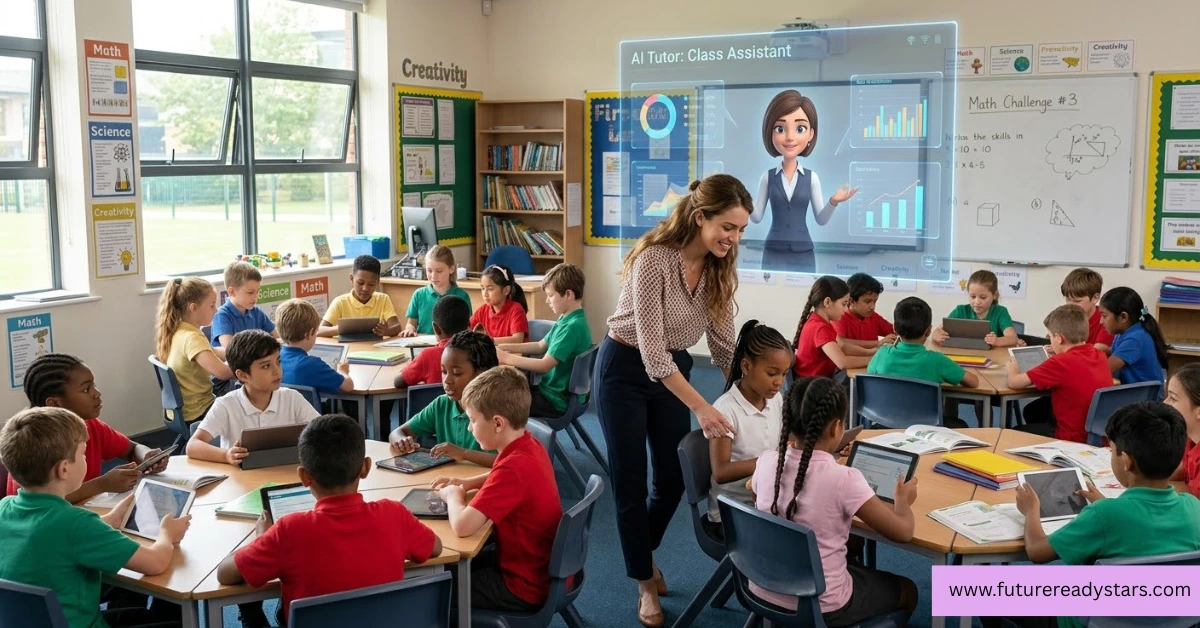
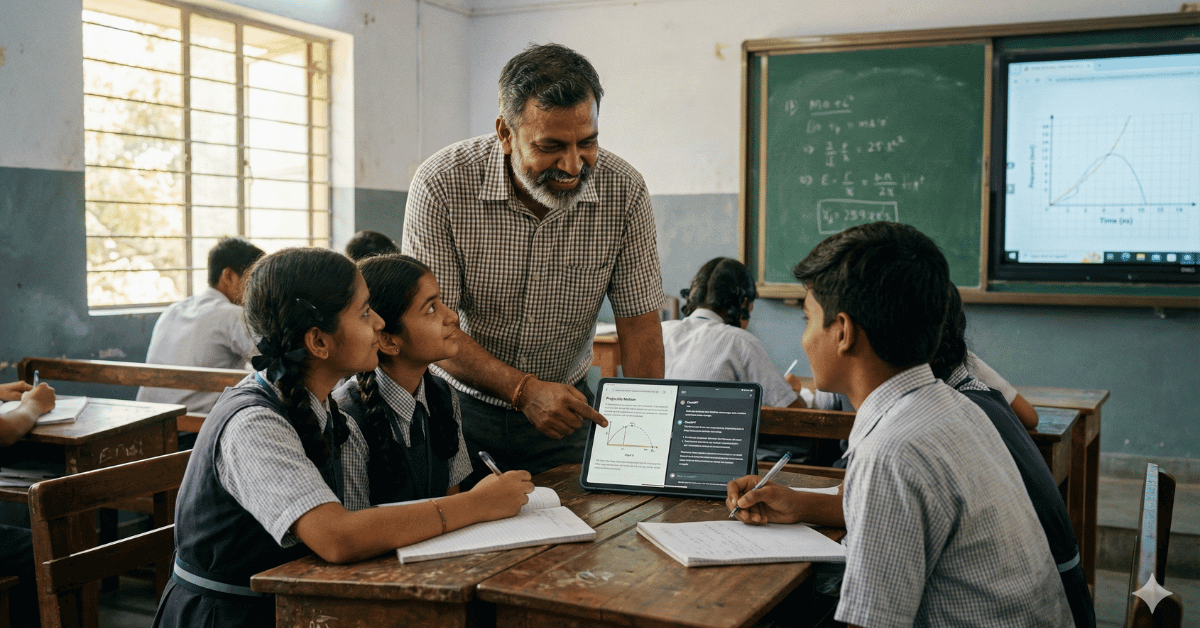
A state that educates millions of kids in Kannada is now betting that artificial intelligence can do what decades of teacher shortages couldn’t. Here’s what’s actually happening — and why it might matter far beyond one state. “Picture a child in a government school in Kalaburagi — no private tutor, no internet at home, one teacher handling five subjects — suddenly having something that answers every question, in Kannada, without getting tired.” That sounds like science fiction. But Karnataka’s government has quietly set the wheels in motion on exactly this kind of experiment. And whether you’re skeptical or hopeful, the sheer ambition of what they’re attempting deserves more attention than it’s been getting. This isn’t about fancy tablets for elite schools. This is about deploying AI-powered learning tools across government schools — the schools that educate kids from the most under-resourced families in the state. Let that sit for a second. Also Read: CBSE Is Teaching AI to 8-Year-Olds From 2026 — Here’s Exactly What Your Child Will Learn Grade by Grade So What Are They Actually Doing? Karnataka’s Department of School Education and Literacy has been piloting an AI-assisted learning program in select government schools — part of a broader push that’s been building since the state’s NEP 2020 implementation began. The idea is to bring in AI tutoring tools that can interact with students in their native language, adapt to their learning pace, and fill the gap that exists when a teacher simply cannot give every child individual attention. The tools being looked at aren’t just digital textbooks dressed up with a chatbot. Think more along the lines of adaptive learning engines — platforms that track where a student is struggling, adjust the difficulty in real time, explain concepts differently when the first explanation doesn’t land, and quiz students in ways that feel less like tests and more like a conversation. The goal is personalisation at scale — something human teachers, stretched thin across thirty-plus students and multiple subjects, genuinely can’t pull off alone. 43K+ Government schools in Karnataka — the potential scale of this rollout ~60% Of Karnataka’s school-going children enrolled in government institutions 1:35 Average student-to-teacher ratio in many government schools 12+ Languages spoken across Karnataka — localisation is the hard part What Does a “Digital AI Tutor” Actually Look Like? When people hear “AI teacher,” the brain immediately conjures a robot standing at a chalkboard. The reality is far more practical — and honestly, far more interesting than that. Think of it less as a replacement teacher and more as a 24/7 co-teacher who never loses patience. Here’s the problem it’s solving: in a traditional classroom, if a student misses the logic behind an algebra equation on Tuesday, the class moves to the next chapter on Wednesday. That gap doesn’t close — it compounds. Week after week, the child falls a little further behind, and nobody has the bandwidth to go back and fix the root cause. The AI tutor is designed to interrupt exactly that pattern. It sits alongside the regular curriculum — not replacing it, running parallel to it. A student who struggles with fractions but breezes through geometry gets a different experience than the student who’s the opposite. The tool adjusts, not because someone programmed in a rigid set of rules, but because it’s tracking in real time what’s landing and what isn’t. It doesn’t move on until the child is ready to move on. That’s not a small thing. That’s actually the thing most children in large classrooms never experience. Also Read: ChatGPT Just Dropped 70+ Interactive Math & Science Visualizations — Here’s Every Topic Covered & How to Use It Before Your Exam Real Talk for Educators: And it’s worth being honest with educators here, because this part matters: the hardest thing about teaching forty-plus kids in one room isn’t knowing the subject. It’s the relentless, energy-draining reality of fifty different learning speeds moving in fifty different directions at once. The AI takes over the exhausting repetitive work — the drills, the basic doubt-clearing, the same explanation for the fourteenth time — so the teacher can do what only a human can do. The quiet kid in the back row gets the same quality of explanation as the loudest kid at the front. No favouritism, no fatigue, no moving on just because the clock says to. The Obvious Question: Will AI Replace the Human Teacher? Nobody who’s thought about this carefully believes AI tutors replace teachers. That’s not the pitch, and it would be a terrible pitch. What’s actually being argued is something subtler: AI can handle the repetitive, individual-paced, drill-and-practice work that teachers currently have no time for — which frees the teacher to do the things AI genuinely can’t do. Motivating a disengaged kid. Noticing when something is wrong at home. Building the kind of trust that makes a student show up even when they don’t want to. The worry, though, is real and worth naming. In under-resourced schools, technology initiatives have a history of looking great on paper and then quietly dying in practice. Devices that never get charged. Platforms in English when the kids speak Tulu. Software that requires internet, in schools where connectivity is a pipe dream. The graveyard of well-intentioned EdTech initiatives in India is long and sobering. The Kannada Problem — And Why It’s Actually the Most Interesting Part Here’s something that doesn’t get enough attention: building AI tutors for English-medium, urban students is relatively solved. There are fifty companies doing it. The hard, interesting, meaningful problem is building one that works for a first-generation learner in Raichur whose home language is a dialect of Kannada mixed with Urdu, who’s never seen a device before, and who learns at a different pace than the curriculum assumes. Karnataka is genuinely wrestling with this. The state has pushed vendors on Kannada-medium content, on local-language voice interfaces, on making sure the tool doesn’t assume prior familiarity with technology. It’s not perfect — it can’t be yet — but the fact that this is being treated as … Read more