
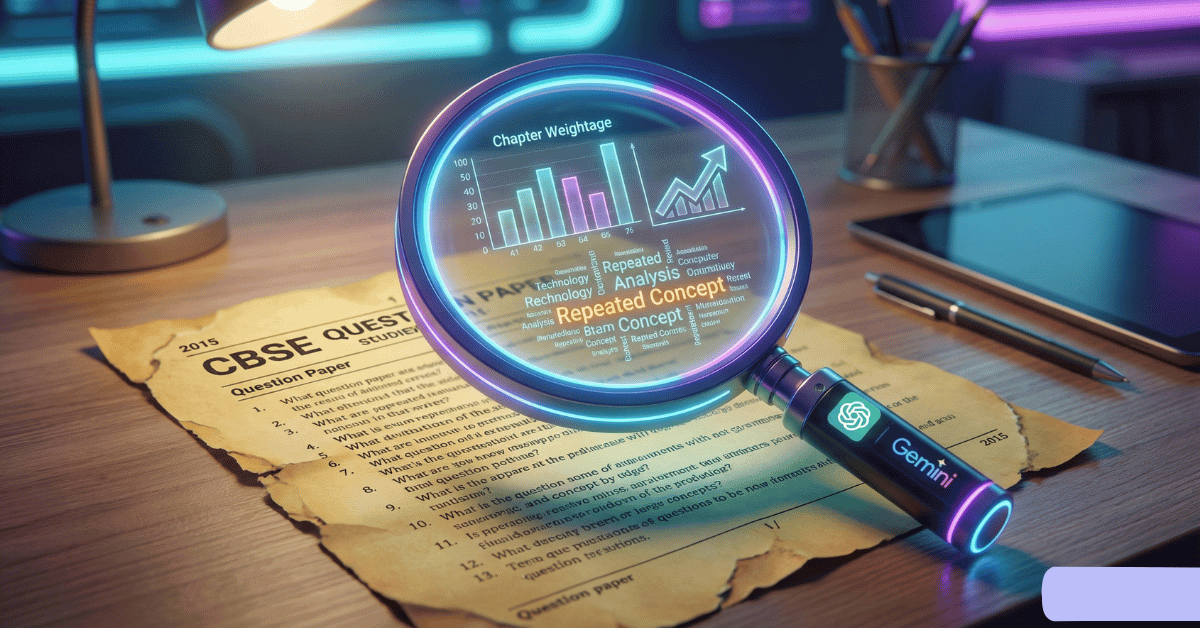
The Problem Every Board Student Faces
Exam season is here, and you know what teachers keep saying: “Solve 10 years of Previous Year Questions!” Sounds great, right? But here’s the reality – sitting with a pile of old question papers and manually counting which chapter appeared how many times? That’s going to take you 2-3 days minimum. By the time you figure out the pattern, half your revision time is gone.
What if I told you there’s a smart hack that does this analysis in just 10 minutes? No, I’m not joking. AI tools like ChatGPT and Google Gemini can scan those papers faster than your favorite topper Bhaiya ever could.
Don’t just do hard work, do smart work.
Once you identify important chapters using this method, you can easily turn it into a complete 90-day CBSE study plan using AI.
What You Need (Super Simple Setup)
Before we start, get these two things ready:
1. Digital PDFs of CBSE Question Papers
- Go to the official CBSE website (cbseacademic.nic.in) and download last 10 years’ papers for your subject
- Or use any reliable educational website that provides authentic CBSE papers
- Keep them saved in one folder on your phone or laptop
2. An AI Tool (Free Options Available!)
- Google Gemini – This is my favorite for students because you can upload PDF files directly (and it’s completely free!)
- ChatGPT – Works great too, but the free version doesn’t read PDFs, so you’ll need to copy-paste the text
- Both work on mobile and computer, so tension mat lo
Both work on mobile and computer, so tension mat lo. That’s it. No fancy software, no technical knowledge needed.
If you’re studying Science subjects, you can also explore how different tools work in real situations in our guide on the best AI tools for CBSE Science students.
Step-by-Step Guide: Become a PYQ Analysis Expert
Step 1: Upload Your Question Papers
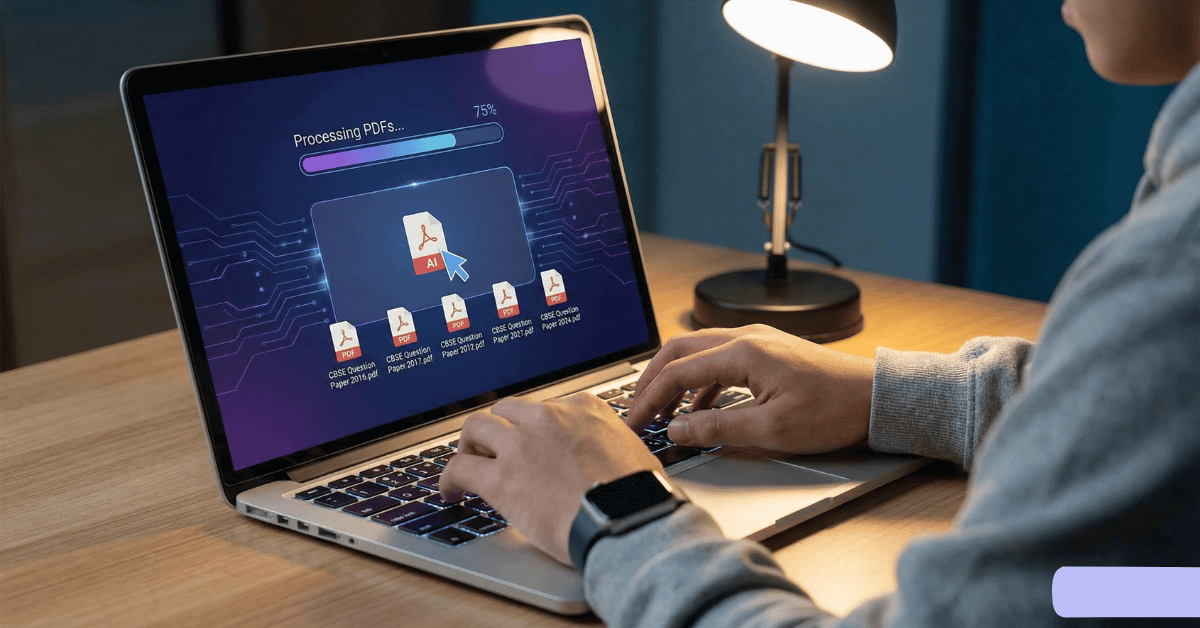
If you’re using Google Gemini:
- Open Gemini (gemini.google.com)
- Click on the attachment icon (paperclip symbol)
- Upload all your PDF files at once (you can upload multiple papers together!)
- Wait for it to process – usually takes 10-20 seconds
If you’re using ChatGPT:
- Copy the text from your PDF (select all, copy)
- Paste it into the ChatGPT chat box
- Do this for 2-3 papers at a time (don’t overload it)
Pro tip: Start with just 5 years of papers if you’re short on time. Quality analysis beats quantity always.
Step 2: The 3 Magic Prompts (Copy-Paste These!)
This is where the real magic happens. I’m giving you three ready-made prompts that you can copy and paste directly. These prompts are tested and actually work.
Prompt 1: The Weightage Finder
Analyze these CBSE Class [10/12] [Subject Name] question papers and create a table showing 'Chapter Name' vs 'Total Marks Asked' across all the papers I've uploaded. Sort the table from Highest to Lowest marks. This will help me identify high-weightage chapters.Repeated concepts become much easier to handle when you combine this analysis with the 3R method CBSE toppers use to decode questions quickly.
Why this works: You’ll instantly see which chapters are “VIP” for your exam. If “Electricity” has 35 marks across 10 years and “Magnetic Effects” has only 12 marks, you know where to focus your energy.
Prompt 2: The Repeated Concepts Hunter
Identify the top 5 most repeatedly asked concepts or topics in these [Subject Name] papers. Don't just list question numbers – tell me the specific concept or theory (for example: "Ohm's Law applications" or "Photosynthesis mechanism") that appears frequently across different years.Why this is powerful: Some topics come EVERY SINGLE YEAR in different forms. Once AI tells you this, you can master those 5 concepts and guarantee yourself easy marks.
Prompt 3: The Trend Spotter
Compare the question paper patterns from the last 3 years (2022-2024) with the older papers (2015-2021). Tell me: Are case-study based questions increasing? Is the difficulty level changing? Are there any new types of questions appearing? Give me specific observations.Why you need this: “CBSE keeps changing its pattern slightly… compare with the latest Sample Question Papers.” This prompt helps you prepare for what’s coming, not just what’s gone.
Step 3: Let AI Do the Heavy Lifting
After you paste any of these prompts, just sit back for 30 seconds. The AI will scan through everything and give you a detailed breakdown.
You’ll get tables, lists, and insights that would’ve taken you hours to compile manually. Save this analysis in your notes – it’s gold for your revision strategy.
Common Mistakes Students Make While Analyzing PYQs with AI
Most students mess this up the first time. Learn from these mistakes so you don’t waste time:
- Uploading everything at once: Don’t dump 10 years of papers together and expect clean results. Start with 5 years, then expand.
- Trusting AI blindly: If AI says a chapter has high weightage, quickly verify it with 1–2 papers yourself.
- Ignoring question types: Marks alone don’t matter. Notice how questions are asked — numericals, case studies, diagrams.
- Using AI for answers: This method is for analysis, not for writing answers. Writing practice must still be yours.
Real-Life Example: My Class 10 Biology Experiment
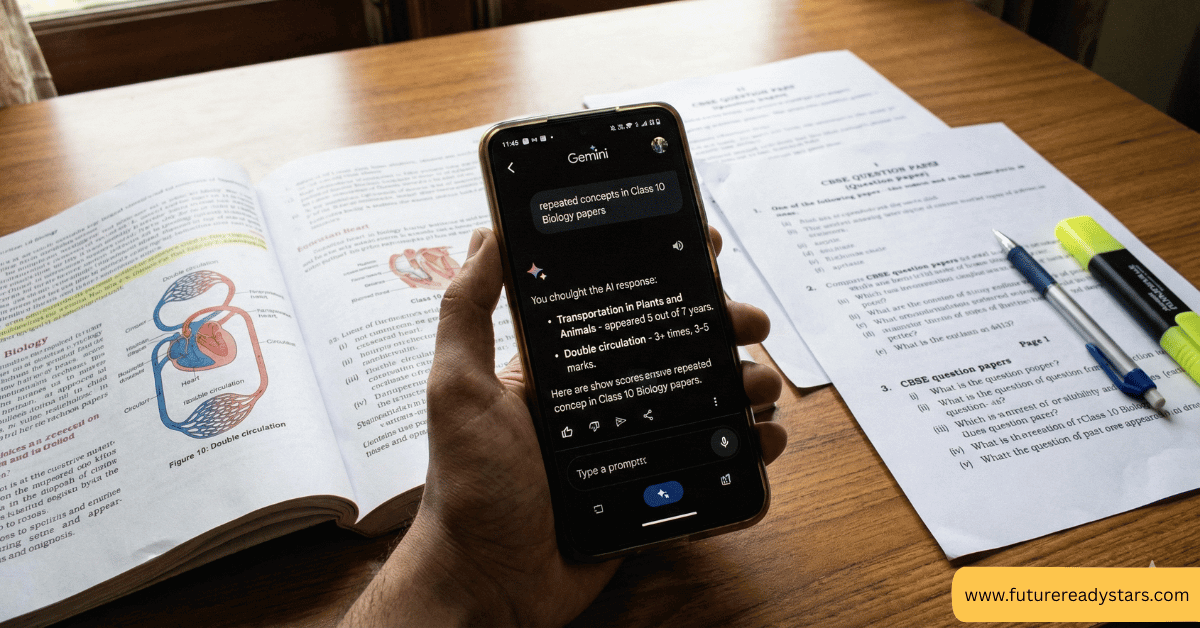
Let me share what happened when I tried this hack for Class 10 Biology:
I uploaded 7 years of papers into Gemini and used Prompt 2 (the repeated concepts one). Within 45 seconds, it told me that:
- Transportation in Plants and Animals” appeared in some form in 5 out of 7 papers.
- The concept of double circulation specifically came at least 3 times with 3-5 marks each time.
Now imagine if a student knows this before their exam. They can give extra attention to double circulation diagrams and explanations. That’s practically free marks sitting on the table!
Similarly, for Class 12 Physics, a student found out that “Ray Optics and Numerical Problems” had the highest weightage – 8 marks every year without fail. Knowing this helps you prioritize better than any coaching institute ever could.
Apart from ChatGPT and Gemini, there are several other tools students use daily—here’s a curated list of the best AI apps that make CBSE studying easier.
Important Warning: Teacher’s Honest Advice

Listen carefully because this is important: AI is super smart, but it’s not perfect.
Sometimes ChatGPT or Gemini might make mistakes. This is called “hallucination” in AI terms – basically, it confidently tells you something that’s wrong. For example, it might count a chapter’s marks incorrectly or miss a question while analyzing.
What you should do:
- Use AI for finding patterns and saving time
- But always cross-check the final analysis with your own eyes
- Look at 2-3 papers yourself to verify what AI is saying
- Never use AI to solve numerical problems or write answers for you – use it only for analysis and strategy
Think of AI as your study buddy who helps you work faster, not as someone who’ll do your homework. Ratta marne ki zarurat nahi hai, “…but samajhna toh padega na? Always keep your NCERT Textbooks handy for final verification.”?
(Also, avoid uploading papers with your personal school details written on them. Stay safe online.)
This balanced approach is explained in detail in our pillar guide on AI for Indian students, where we talk about safety, discipline, and responsible AI use.
How to Convert AI Analysis into a 7-Day Study Plan
Finding patterns is useless unless you act on them. Here’s how to use the AI output properly:
- High-weightage chapters → revise first, multiple times
- Repeated concepts → practice diagrams, numericals, and definitions
- Low-weightage chapters → quick reading, don’t overinvest time
- Recent pattern changes → focus on case studies and application-based questions
Simple rule:
Spend 60% time on high-frequency topics, 30% on medium ones, and 10% on the rest.
This alone can improve your score by 10–15 marks.
Your Action Plan: Start Today!
Enough reading. Time for action. Here’s what you’re going to do RIGHT NOW:
- Tonight: Download 5 years of PYQs for your weakest subject (we all have that one subject, don’t lie!).
- Open Gemini or ChatGPT : Upload those papers on your phone.
- Use Prompt 1: Find the high-weightage chapters and write them in your notebook.
- Tomorrow: Use Prompt 2 to make a “Must Revise” list of top 5 concepts.
Remember, boards are not about studying everything equally. They’re about being strategic. The toppers you see? They’re not necessarily studying 16 hours a day. They’re studying the RIGHT things in the right way.
Final Thoughts: Smart Study Beats Hard Study
This AI hack gives you the same advantage those toppers have – knowing what matters most.
Your Class 10th or 12th boards will come only once. Don’t waste time on low-weightage chapters when you could be mastering the topics that appear every single year.
Stop overthinking. Open Gemini or ChatGPT. Upload your first paper. And see the magic happen.
If you’re new to AI-based studying, you may want to start with our complete guide on how Indian students can use AI tools safely and effectively before diving into subject-specific tools.
All the best for your boards! You’ve got this!
Really great read — I appreciate how clearly you explained the importance of local online presence for businesses today. It’s a topic many companies overlook, i find it very interesting and very important topic. can i ask you a question? also we are recently checking out this newbies in the webdesign industry., you can take a look . waiting to ask my question if allowed. Thank you