
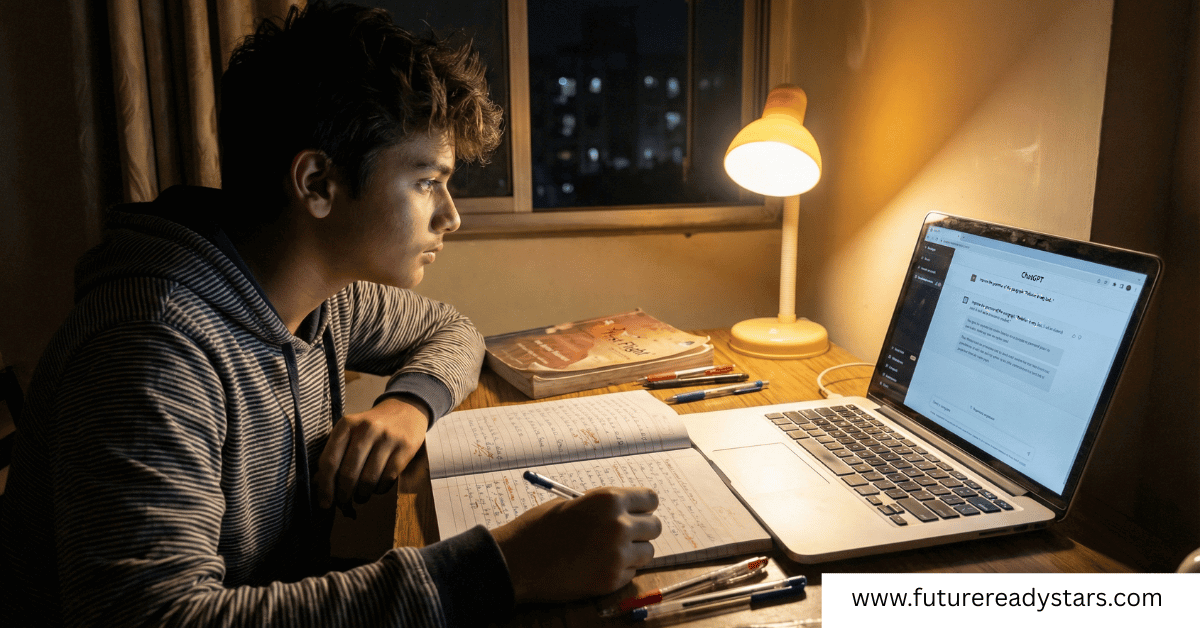
Why CBSE Students Are Confused About Using AI for English
Let’s be honest. Many of you are scared to even open ChatGPT or other AI tools. You keep thinking, ‘Is this cheating? What if the teacher finds out? What if my Internal Assessment marks go down?
But here’s the thing. The real confusion isn’t whether you should use it. It’s how you’re using it.
I see this in my classes almost every week. Just last week, actually, one Class 10 student submitted this article on Environmental Pollution. Perfect grammar. Big fancy words—”multifaceted,” “tapestry”—all that. So I asked him, “beta, what does multifaceted mean?” And what did he do? Just looked down at his shoes. Completely silent.
This is exactly the problem. You think AI is some magic button—click, homework done, you relax. Wrong. If you’re using it to write your entire essay? That’s cheating, plain and simple. And trust me,CBSE examiners can recognise a robotic answer very quickly.
But using it to fix your grammar? To suggest a better title? That’s actually being smart.
The problem is that nobody has taught you where the line is. So, remember this one thing: AI can improve your answer. It cannot replace your thinking.
What Counts as Cheating in CBSE English (Clear Boundaries)
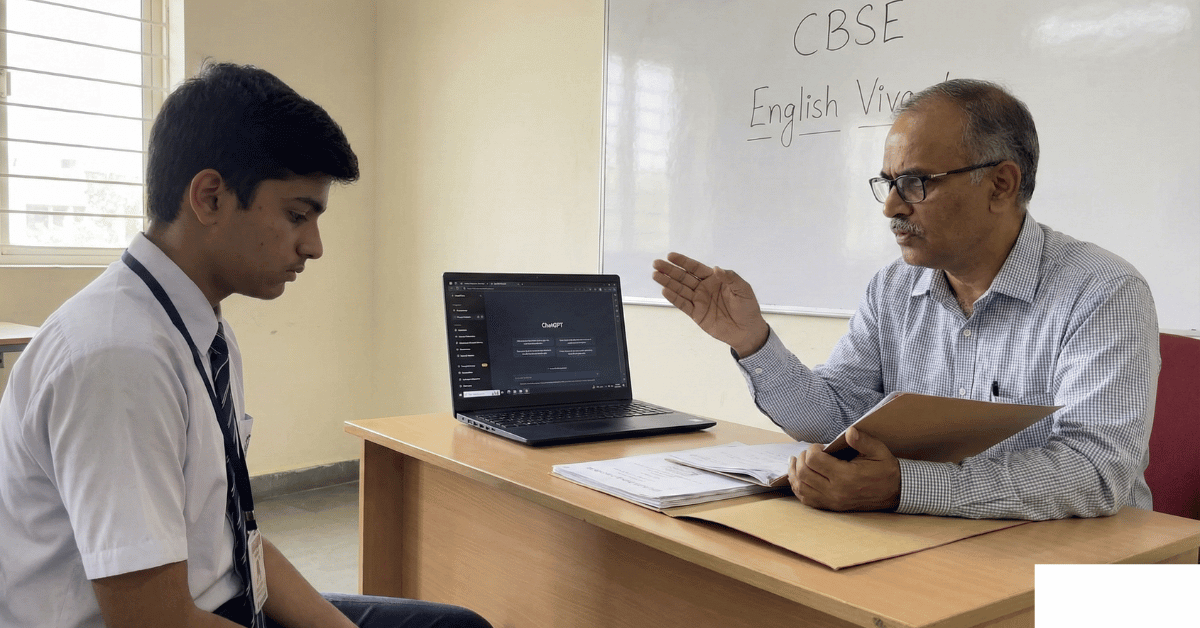
Okay, let’s clear this up once and for all. The main rule? Simple. The work has to be yours. In CBSE, we’re checking if you can express your own thoughts, not if you know how to use some tool. If AI is doing all the thinking and you’re just submitting the output, that’s cheating. And it’s not even about getting caught. It’s that you’ve stopped learning, basically.
What You Should NOT Do with AI
Don’t submit AI-written essays as your own. Don’t just type ‘Write an article on Discipline’ and copy-paste the whole thing. If you submit some robotic essay with words, you can’t even explain, who are you fooling? Only yourself. Teachers know how you write. A sudden change? Very suspicious.
Never use AI for exam answers or project work. Because what happens during viva? External examiner asks one cross-question, and you’ll just sit there blank. Why? Because you never actually wrote that answer yourself.
Stop asking AI for “fancy introductions” to memorize. They sound fake, honestly. A simple sentence that YOU wrote. Always better than some complicated machine sentence.
How AI Can Help You Improve Creative Writing (The Right Way)
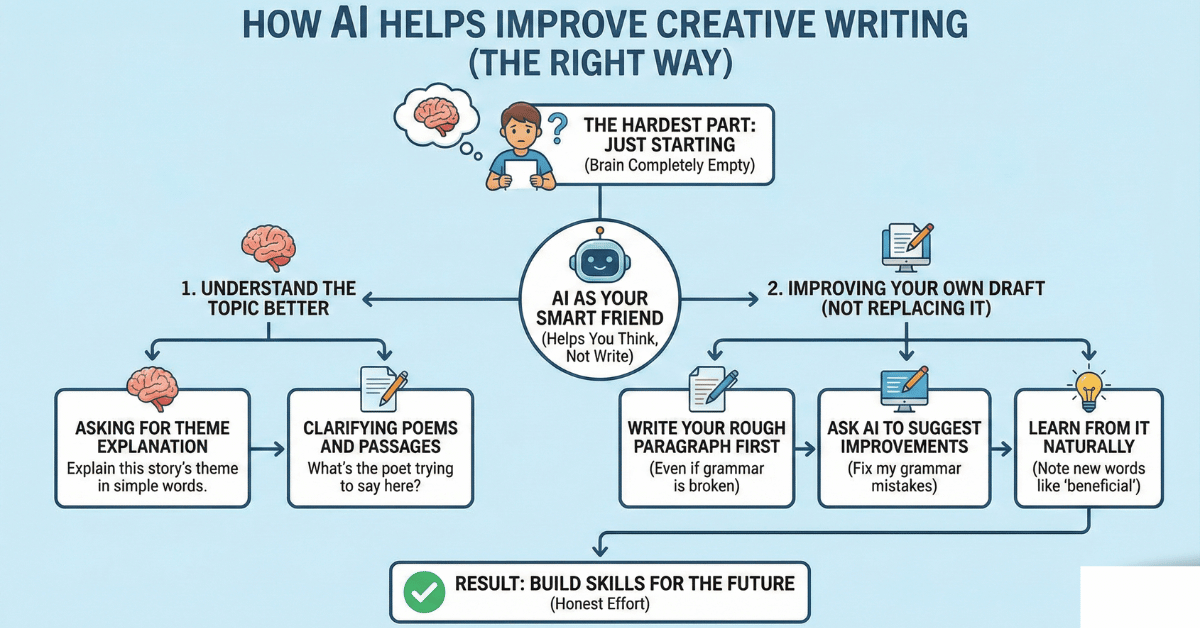
You know what’s the hardest part? Just starting. You sit there staring at that blank paper and… nothing. Brain completely empty. This is where AI can be like that smart friend sitting next to you in the library. It’s there to help you think, not to do the actual writing for you.
1. Using AI to Understand the Topic Better
- Asking for theme explanation: Sometimes the exam question itself is confusing, no? You can ask AI, “Explain this story’s theme in simple words.” It helps you understand what the examiner actually wants. So you don’t end up writing something completely off-topic.
- Clarifying poems and passages: Stuck on some difficult line in a poem or Unseen Passage? Just type it in. Ask, “What’s the poet trying to say here?” It gives you that clarity so you can form your own answer.
2. Improving Your Own Draft (Not Replacing It)
Learn from it naturally: Look at what AI changed. Did it replace “good” with “beneficial”? Note it down. This way you’re actually learning new words and sentence structure for next time.
Write your rough paragraph first: Always write your first draft yourself. Even if the grammar is broken, doesn’t matter. Put your raw thoughts down. That’s the most important step, actually.
Ask AI to suggest improvements: Then paste your paragraph and ask, “How can I make this better?” or “Fix my grammar mistakes.”
Using AI to Fix Grammar Without Losing Your Writing Style
Grammar is the biggest reason students lose marks in the writing section. You often know the answer, but the sentence structure comes out wrong. AI is excellent for fixing this, but you must be careful. You want to correct your English, not sound like a completely different person.
1. Sentence-Level Grammar Checking
- Checking one paragraph at a time: Do not paste your entire project at once. Take one small paragraph and put it in the tool. This keeps you in control and stops the AI from rewriting your whole story.
- Understanding why a correction was made: If the AI changes “he go” to “he goes,” stop and look at it. Ask yourself why that change happened. If you just copy the correction without understanding the rule, you will make the exact same mistake in your board exam when the AI is not there.
2. Common CBSE Grammar Mistakes AI Can Help Catch
Articles, prepositions, and punctuation: Where to put a comma, or when to use “an” instead of “a”—these small mistakes add up. Use the tool to clean up these basics so your teacher can focus on your ideas, not your red marks.
Tense errors: Many of you start a story in the past tense and suddenly switch to the present tense halfway through. AI spots this inconsistency instantly and helps you keep the flow smooth.
Subject–verb agreement: This is a classic error. Students often write “The group of boys are playing” instead of “is playing.” The tool will highlight these slip-ups.
How to Practice CBSE English Answers Using AI

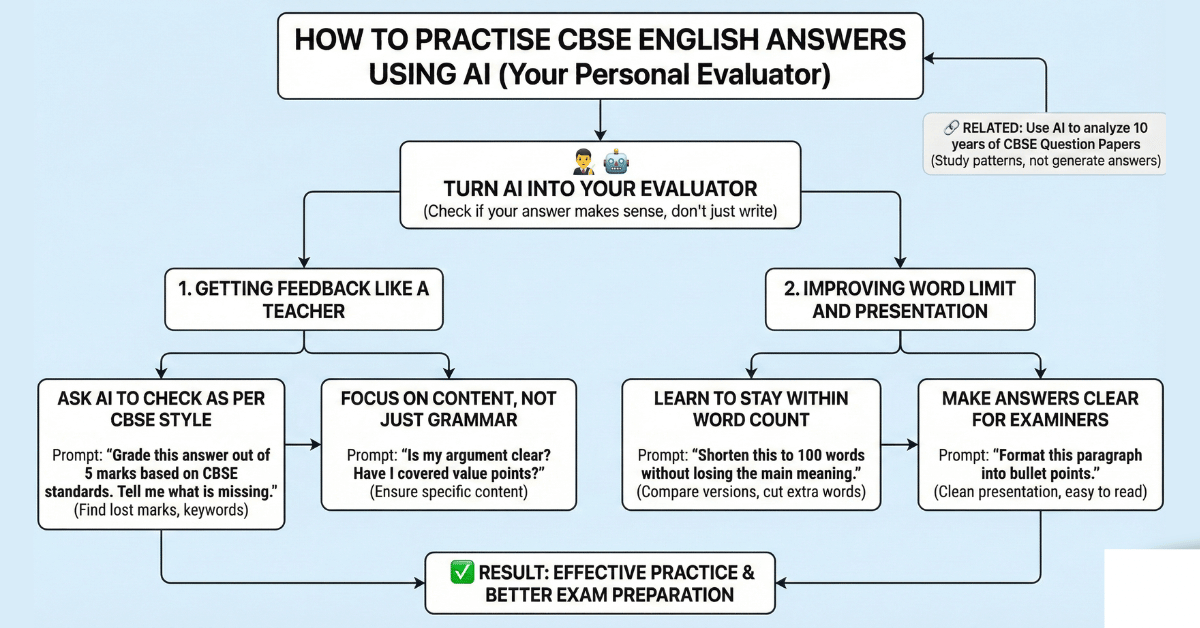
When you are studying alone at home, there is no teacher to check your notebook This is the best way to use AI—turn it into your personal evaluator. You don’t need it to write the answer; you need it to tell you if your answer makes sense.
1.Getting Feedback Like a Teacher
Asking AI to check as per CBSE style: After you write a practice answer, type this into the AI:
"I am a Class 10 student. Grade this answer out of 5 marks based on CBSE standards. Tell me what is missing." It will often tell you exactly where you lost marks—maybe you missed a keyword, or your conclusion was weak.Focusing on content, not just grammar: Don’t just ask “Is this correct?” Ask
"Is my argument clear?" Ensure you have covered the value points required for the specific chapter. If the AI says your answer is "vague," you know you need to be more specific next time.2. Improving Word Limit and Presentation
- Learning to stay within word count: This is a major struggle. You write 200 words for a 120-word question, and then you run out of time in the exam. Paste your long answer into the AI and say, “Shorten this to 100 words without losing the main meaning.” Compare the two versions to see which extra words you can cut.
- Making answers clear for examiners: Board examiners check hundreds of copies. They hate huge blocks of text. Ask the AI, “Format this paragraph into bullet points.” Seeing how a messy paragraph turns into clean points helps you learn how to present your answers neatly in the actual exam.
In fact, the same approach can be used for exam preparation. I’ve explained this step-by-step in Smart Study: How to Use ChatGPT to Analyze 10 Years of CBSE Question Papers, where AI is used to study patterns—not generate answers.
How Teachers Can Easily Detect Misuse (Reality Check)
Don’t think we won’t notice. We’ve been reading student copies for years now. We know exactly how a Class 10 or 12 student writes, and honestly? In most cases, we can recognise AI-written answers very easily
Why honesty is safer: Look, if you get caught, you lose your teacher’s trust instantly. Better to submit an answer with two grammar mistakes and get decent marks than submit a perfect AI copy, get caught. We respect honest effort, not copy-paste.
Language mismatch: If you usually make small grammar mistakes in class, and suddenly your homework has university-level words? It’s obvious, beta. When I see words like “meticulous,” “tapestry,” or “delve” from a student who struggles with basic tenses… I know immediately. You didn’t write this.
Too perfect answers: AI writes answers that are TOO perfect. Zero spelling errors, super smooth sentences. But real student writing? It has bumps. It has your personality. A completely flawless answer just looks robotic and fake to us.
No personal voice: Your writing has a voice—the way YOU express things. AI has no voice. It just assembles data. So when you submit an AI answer, it feels cold, you know? It lacks that natural flow, those small human touches that show you actually tried.
A Simple Rule for Safe AI Use in CBSE English
If you are confused by all the advice and just want one clear rule to follow, this is it: If you didn’t write the first draft yourself, don’t submit it.
Marks matter, but skills matter more: We all stress about board marks. But think about next year. In college or a job interview, you will not have an AI tool to whisper answers in your ear. If you let the machine do the writing now, you will struggle later when you have to stand on your own feet. Build the skill now; the marks will follow naturally.
The Golden Rule: Your brain must do the hard work first. If you stare at a blank screen and ask the AI to start writing, you are cheating yourself. You must write your own raw thoughts first—even if the grammar is broken. Only then should you open the AI tools.
Use AI to learn, not to submit: Treat the AI like a tuition teacher sitting next to you. Ask it to check your mistakes or explain a hard word. But never, ever copy a paragraph directly from the screen to your notebook. If you cannot explain the meaning of a sentence to your teacher, you should not be using it.
Once you understand how to use AI properly, you can even use it to plan your studies smartly. I’ve shown how students can create a realistic timetable in this guide: CBSE 90-Day Study Plan: Build Yours in 5 Minutes with AI (2025).
Final Advice from a Teacher
So, final question: Should you use AI or just avoid it completely?
AI is not your enemy. Don’t think you have to delete these apps to be a “good student.” That’s old-fashioned thinking. Technology is here to help, just like a dictionary or calculator helps. No need to be scared of it.
Of course, different subjects need different tools. If you’re a Science student, you’ll need AI support in a very different way, which I’ve covered separately in Best AI Tools for CBSE Science Students (2025).
Blind copying is the real problem. The danger isn’t the tool—it’s your laziness. If you’re just copy-pasting without even reading? You’re hurting your own future. Training yourself to be dependent. That’s what worries us teachers.
Use it wisely and your English will actually improve. Use AI to check grammar, understand difficult words, brainstorm ideas—that’s smart work. Use it to improve yourself, not to depend on it. Be honest with yourself. Your marks will follow.
If you’re new to AI-based studying, you may want to start with our complete guide on how Indian students can use AI tools safely and effectively before diving into subject-specific tools.
2 thoughts on “How Indian Students Can Use AI to Improve CBSE English Writing Without Cheating”