

Why English Writing Feels Harder Than Reading for Indian Children
“Sir, padhna toh theek ho gaya hai, par likhne mein bahut problem hoti hai.”
I hear this from parents very often. And honestly, it makes sense.
Reading is recognising words. Writing is creating them. Writing needs spelling, sentence order, and confidence — all at the same time. That’s why many children who read reasonably well still avoid writing.
The moment writing starts, fear also starts. Fear of spelling mistakes. Fear of messy handwriting. Fear of red marks. Slowly, children stop trying. Not because they can’t write — but because writing feels stressful.
Our job as parents and teachers is simple: make writing feel safe before making it perfect.
Also Read: Help Your Child Read English: 5 Useful Educational Gadgets for Indian Students
Digital Writing Tablets for Daily Writing Practice Without Paper Waste
“Roz likhwaana mushkil ho jaata hai” – because notebooks finish, pencils break, and erasers make holes in pages.
Digital writing tablets allow children to practice letters and words without wasting paper. They write, erase, and try again — without anyone judging their handwriting.
When Digital Tablets Actually Help
These work beautifully for children in Classes 1 to 4 who need repetitive practice. Writing the same word twenty times in a notebook feels like punishment. On a tablet, it feels like play. The child writes, erases, tries again without anyone seeing their mistakes.
I’ve noticed something interesting. Children write more freely on these tablets because there’s no permanent record of errors. That freedom reduces fear. And less fear means more practice.
When a Simple Notebook Works Better
Once your child can write a full paragraph with decent spelling, the tablet has done its job. For longer compositions and school homework, they need to use regular notebooks anyway. Don’t let the tablet become a distraction or excuse to avoid proper writing.
Which Age Group Benefits Most
LKG to Class 4 students gain the most. After Class 5, children should be comfortable with pen and paper. If they’re still avoiding notebooks by then, the problem is deeper than just practice – it might be fear or learning difficulty that needs proper attention.
Also Read: AI Tools for CBSE English Students: Grammar, Writing, and Safe Use (A Teacher’s Guide)
Talking Dictionaries and Spelling Devices: Why Hearing Spelling Works Better
“Spelling galat ho jaati hai, kitni baar samjhaayein?” – because explaining doesn’t help. Hearing does.
Children learn spelling two ways. Visual memory – seeing the word repeatedly. And auditory memory – hearing how it sounds. Most children rely too much on visual memory alone, which is why similar-looking words confuse them.
How Audio Spelling Support Changes Learning
A talking dictionary or spelling device speaks the word clearly, then spells it letter by letter: “Beautiful. B-E-A-U-T-I-F-U-L. Beautiful.” The child hears the rhythm of the spelling. This rhythm sticks in memory far better than staring at a written list.
I’ve tested this in my own classes. Students who heard spellings aloud while writing them down remembered 60-70% after one week. Students who only read spelling lists? Maybe 30-40%.
Best for Which Students
Classes 2 to 6 benefit most, especially children who constantly mix up words like “their” and “there,” or “principal” and “principle.” For younger children still learning basic three-letter words, this might be too advanced.
Simple Typing Tools for Building Writing Confidence (Optional but Useful)
“Bachcha likhne se bachne ke liye bahane banata hai” – hand pain, tiredness, stomach ache. Every excuse appears when writing time comes.
Here’s an unpopular truth – sometimes the problem is not unwillingness to write, but genuine physical difficulty. Some children have poor pencil grip. Some have weak finger muscles. Forcing them to write pages with a pen creates real frustration.
How Typing Can Temporarily Help
A simple keyboard – even a basic one connected to a tablet – removes the physical barrier. The child can focus purely on thinking and forming sentences without worrying about hand pain or messy letters.
I’ve seen reluctant writers suddenly produce full paragraphs when allowed to type. Why? Because typing removes the shame of bad handwriting. Their ideas finally become visible without embarrassment.
When Typing Becomes the Bridge
Use typing as a temporary bridge, not a permanent replacement. Let your child type their first draft – get the ideas out. Then, ask them to copy it neatly by hand. This two-step process works remarkably well for Classes 4 to 7.
Also Read: How Indian Students Can Use AI to Improve CBSE English Writing Without Cheating
Sentence-Building and Word Games: Why Grammar Books Fail Young Learners
“Sentence banana nahi aata, grammar samajh nahi aata” – and then parents buy thick grammar workbooks that make everything worse.
Young children don’t understand abstract grammar rules. “Subject comes before verb” means nothing to a Class 2 student. They need to feel how sentences work, not memorize rules about them.
How Play-Based Sentence Games Work
Simple word games – physical cards or digital apps – let children arrange words into sentences. They see “the,” “dog,” “barks,” “loudly” and must arrange them correctly. They try, fail, rearrange, succeed. This trial-and-error teaches sentence structure naturally.
Some electronic games speak the sentence aloud after the child arranges it. Hearing “The dog barks loudly” confirms they got it right. Hearing “Dog the loudly barks” immediately shows something is wrong.
Why This Works Better Than Grammar Exercises
Grammar exercises in workbooks feel like tests. Games feel like play. The brain learns faster through play because stress is absent. I’ve watched students who couldn’t complete one grammar worksheet happily play sentence games for twenty minutes straight.
What Parents Should Avoid While Helping with English Writing
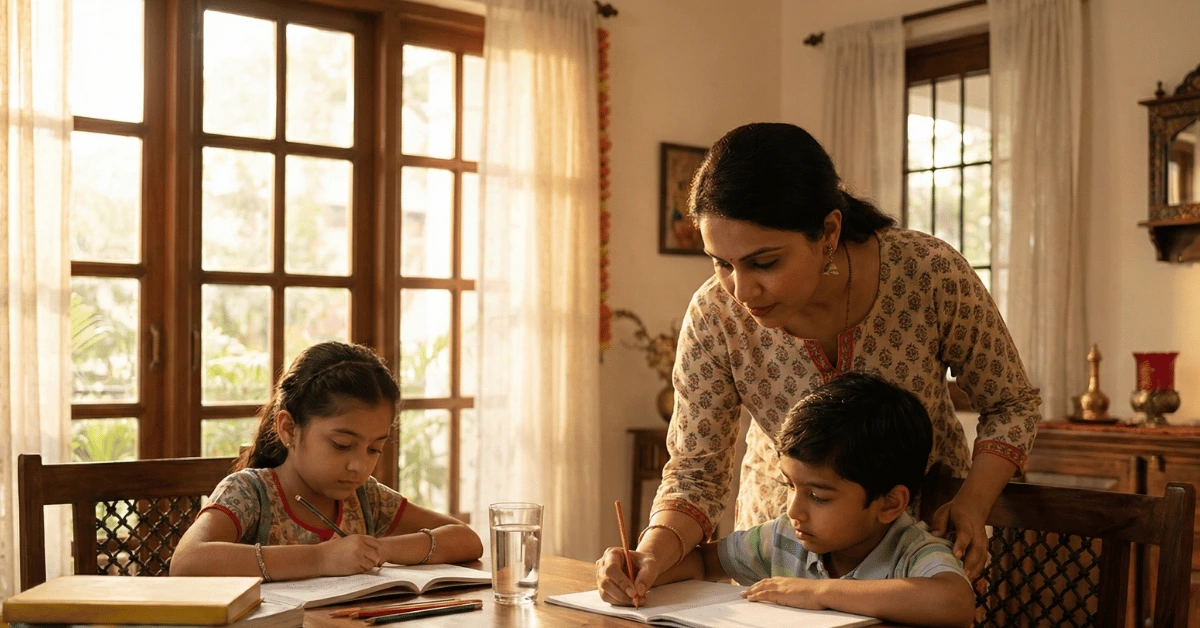
“Improvement kyun nahi dikh raha?” – often because well-meaning parents make these mistakes.
Over-correcting every spelling error. Your child writes a creative sentence with two spelling mistakes. You circle them in red immediately. The child remembers only their failure, not their good idea. Correct spelling, yes – but appreciate the thinking too.
Comparing notebooks with classmates. “Sharma ji ki beti kitna neat likhti hai.” This kills motivation instantly. Every child’s hand develops differently. Some write neatly at seven, others at ten. Both are normal.
Expecting neat handwriting too early. In Classes 1 and 2, focus on getting thoughts on paper, not perfect letters. Neatness comes with muscle development. Pressure makes children write slowly and fearfully.
Forcing long writing sessions. Fifteen minutes daily beats one forced hour on weekends. The brain needs regular, short practice – not exhausting marathons.
Also Read: When Your Kid Catches Deepfakes Faster Than You: A Survival Guide for Indian Parents (2025)
A Teacher’s Final Advice on Building English Writing Skills
Let me say this clearly.
Writing skills grow with time, patience, and safety. Not pressure.
Gadgets can help — but only when they reduce fear, not increase expectations. Sit nearby. Encourage effort. Ignore small mistakes. Celebrate attempts.
If your child writes one honest sentence today without fear, that is progress.
Fluency will come later. Confidence must come first.
If you’re new to AI-based studying, you may want to start with our complete guide on how Indian students can use AI tools safely and effectively before diving into subject-specific tools.
1 thought on “Help Your Child Write Better English: Simple Educational Tools That Actually Work (Teacher’s Guide for Indian Parents)”