

If you’re preparing for CBSE Class 10 or Class 12 board exams in 2025, the next 90 days can transform your results. The challenge isn’t just “studying more.” It’s studying the right things, at the right time, in the right way. In this guide, you’ll learn how to build a practical, personalized, and science-backed 90-day CBSE study plan in just five minutes using AI—then execute it with confidence.
Whether you’re targeting a 95+ score or aiming for steady, stress-free improvement, you’ll learn how to:
- Structure your 90 days effectively
- Use CBSE’s 2025 syllabus and sample papers strategically
- Track your progress and stay consistent
- Apply AI tools to plan, revise, and simulate real exam conditions
You’ll also get weekly and daily templates, subject-specific strategies, and ready-to-use AI prompts.
Also read: The 3R Method: How CBSE Toppers Decode Any Prompt in 60 SecondsWhy 90 Days Is the Sweet Spot for CBSE Success
There’s something almost magical about the three-month timeline for board exam preparation. It’s not too long that you lose momentum, yet substantial enough to cover every chapter, practice thoroughly, and still have time for multiple revisions. Educational psychologists call this the “Goldilocks zone” of exam preparation—not too rushed, not too relaxed, but just right.
Here’s what makes it so effective:
Here’s why it works so well:
- You can move through three clear phases: Learn → Reinforce → Master
- You can complete three full “study → test → feedback → adjust” cycles
- You can attempt two to three full-length sample paper rounds per subject
- You can apply spaced repetition effectively for better long-term memory retention (research shows spaced practice improves retention by 200%)
Think of 90 days as your runway — your goal isn’t just to finish the syllabus, but to master exam patterns, timing, and presentation, since CBSE rewards accuracy, clarity, and structure.
How to Build Your Custom 90-Day Plan in 5 Minutes (Copy-Paste Prompt Inside)
You don’t need to spend hours planning. Use AI like Notion AI, ChatGPT, StudySmarter, or ExamTime to create a first draft, then refine in a minute. Here’s a simple prompt you can paste into any AI tool:
Step 1: Use This Exact Prompt
Copy this prompt:
“I am a CBSE [Class 10/Class 12] student appearing in 2025. My subjects are [list subjects]. I have [school hours/tuition] on these days [days]. I’m strongest in [list] and weakest in [list]. I want a 90-day plan split into three phases: Learn (Day 1–30), Reinforce (Day 31–60), Master (Day 61–90). Please provide:
- Weekly goals per subject
- Daily study schedule (2–3 focused blocks)
- Topic order based on CBSE weightage
- Weekly test plan (chapter tests, PYQs, sample papers)
- Revision schedule using spaced repetition
- Light days for rest and buffer
- Action items for weaker topics.
Format in a simple weekly table with checkboxes.”
Step 2: What AI Will Give You (Real Example)
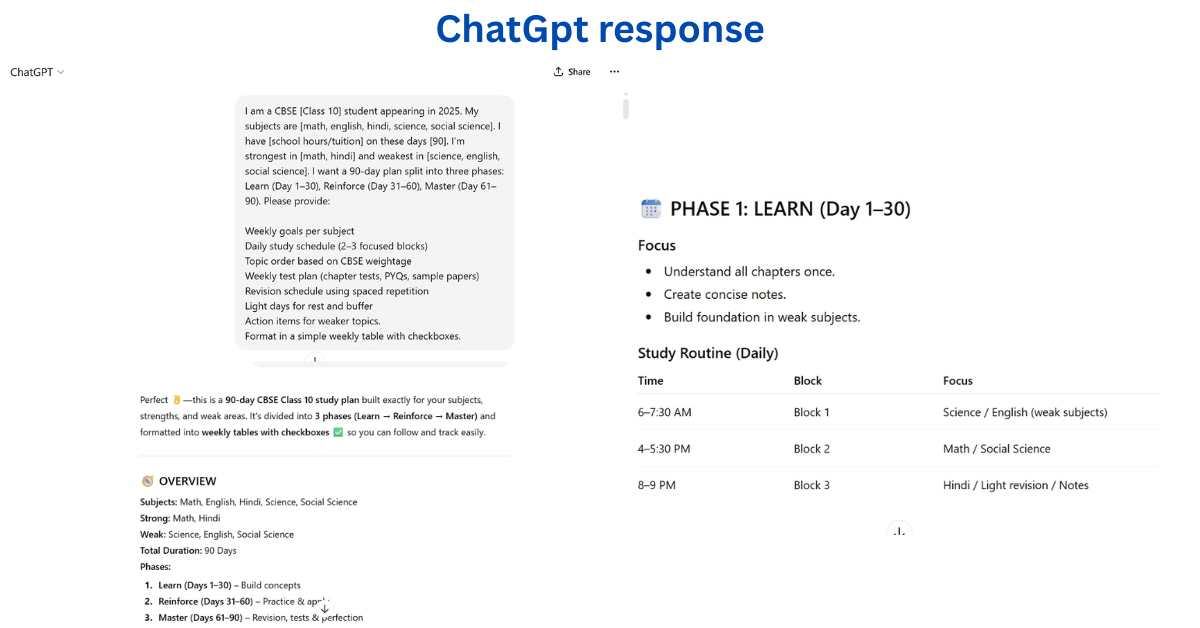
Here’s what a typical AI response looks like (abbreviated):
Week 1 Goals:
- Math: Complete Quadratic Equations + 30 practice problems
- Physics: Kinematics concepts + 15 numericals
- English: 2 reading passages + 1 article writing practice
- Chemistry: Mole concept + balancing equations drill
Daily Structure:
- Morning (6:30-7:30 AM): Math problem-solving
- After school (5:00-6:30 PM): Physics/Chemistry concepts + practice
- Evening (8:00-9:00 PM): English/Social Science + review
Buffer: Sunday afternoon reserved for catch-up.
Step 3: Refine in 60 Seconds
Ask follow-up questions to customize:
- “Rebalance time—I need 40% of study time on Math and Physics, they’re my weak areas”
- “Add a 30-minute daily writing practice slot for presentation marks”
- “Generate memory cues for Biology terms I keep forgetting”
- “My school has tests on Fridays, adjust my mock test days”
AI vs. Manual Planning:
- Manual: 2-3 hours of research, Excel sheets, constant revision → still generic
- AI: 5 minutes to first draft → personalized to your schedule, strengths, exam dates
This is how CBSE toppers are now using AI — not for shortcuts, but for strategy. This gives you a personalized, realistic plan you can start today.
Also read: 15 Best AI Apps That Make CBSE Studying 10× Easier [By Class & Subject]The 90-Day CBSE Roadmap: Learn → Reinforce → Master
Here’s a subject-agnostic template you can adapt with AI in seconds. This framework has been tested with Class 10 and 12 students across streams.
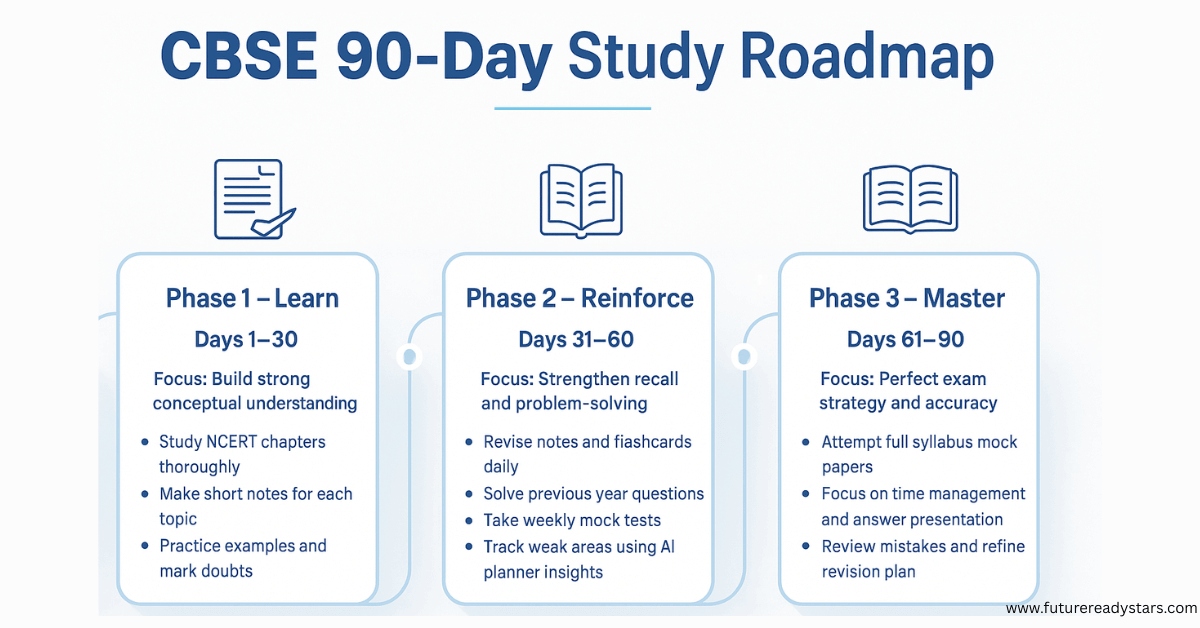
Phase 1: Learn (Days 1–30)
Goal: Finish the full syllabus once, with concept notes.
Structure:
- For Science/Math: Concept → Examples → 20–25 practice questions.
- For Languages: Reading comprehension + grammar drills + daily writing.
- For Social Science: Concept maps + 10-mark answer frameworks + timeline notes.
Daily Blocks
| Block | Duration | Focus |
|---|---|---|
| A | 60–90 mins | Learn new concepts |
| B | 60 mins | Practice questions or short answers |
| C | 30 mins | Review notes + flashcards |
Phase 2: Reinforce (Days 31–60)
Goal: Consolidate learning with PYQs and CBSE sample papers.
Structure:
- Two days per week: Timed question sets from PYQs.
- One day per week: Writing practice for 3–5 long answers per subject.
- One day per week: Formula lists, mind maps, and corrections.
Daily blocks:
| Block | Duration | Focus |
|---|---|---|
| A | 60 mins | Timed topic-wise drills |
| B | 60 mins | Error analysis + redo |
| C | 30 mins | Active recall (teach/flashcards) |
Weekly: 1 sample paper under exam timing for major subjects. Review rigorously.
Phase 3: Master (Days 61–90)
- Goal: Exam conditioning, speed, accuracy, presentation.
- Structure:
- Alternate days: Full-length sample papers.
- In-between days: Deep review, model answers, and diagrams/charts practice.
- Focus on common trap questions and silly mistakes.
- Daily blocks:
| Block | Duration | Focus |
|---|---|---|
| A | 3 hrs | Full paper or mixed-section drill |
| B | 1 hr | Marking scheme comparison + rewrite weak answers |
| C | 20 mins | Formula/date/definition polish |
Weekly: 2–3 full papers per subject over the fortnight, then taper slightly in the final week.
Pro tip: Mark a “Buffer Day” every 10 days. Use it to catch up, rest, or consolidate. Burnout kills recall; a rested mind scores higher.
The Subject-Specific Tactics CBSE Toppers Actually Use
Mathematics (Class 10 and 12)
- What to do:
- Build a formula register. Review daily for 10 minutes.
- Topic order: Algebraic foundations → Coordinate Geometry → Trigonometry → Calculus or Advanced Algebra → Probability/Statistics.
- Solve NCERT fully. Then add PYQs, then sample papers.
- How to use AI:
- Ask for 10 progressively harder problems per topic.
- Request step-by-step scaffolding for stuck problems.
- Generate “error flashcards” from your own mistakes.
Science (Class 10) and Physics/Chemistry/Biology (Class 12)
- Physics:
- Derivations and definitions: write once, teach once, record as voice notes.
- Numericals: Start with NCERT examples, then PYQs.
- Diagrams: Practice clean, labeled drawings.
- Chemistry:
- Physical: Formula sheets + 15-min daily numericals.
- Organic: Reaction patterns + named reactions + exceptions list.
- Inorganic: Periodic trends charts + summary tables + mnemonics.
- Biology:
- Diagrams and flowcharts: practice daily.
- NCERT lines: memorize key phrases. Train answer presentation to match marking scheme.
- How to use AI:
- Generate flashcards for definitions, reactions, diagrams labels.
- Ask for “one-pager” summaries of each chapter for rapid recall.
English/Language
- Reading: Practice one passage every two days under time limits.
- Writing: Maintain a reusable structure for letters, reports, articles. Time yourself.
- Literature: Create character/theme maps. Memorize 8–10 high-utility quotations.
- AI assist:
- Ask for model answers, then compare yours to marking points.
- Request topic-based prompts for 15-minute writing sprints.
Social Science (Class 10) and Humanities Subjects
Ask for comparison tables for similar concepts you keep mixing up.
- History: Build timelines, cause-effect chains, and keyword banks.
- Geography: Map practice twice a week. Data-response drills.
- Political Science: Definition-argument-example structure for 5/8-mark answers.
- Economics: Case studies + graphs. Turn each chapter into 10 “flash Q&A.”
AI assist:
- Generate “exam-style” questions with marking scheme bullets.
- Ask for comparison tables for similar concepts you keep mixing up.
Also read: Best AI Subscription Plans for Students 2025: ChatGPT, Claude, Gemini, Perplexity & Grok Compared📥 Download Your Complete AI Prompts Library
Want all these prompts in one easy-to-access document? I’ve created a comprehensive, printable guide you can keep at your study desk.
What’s inside:
✅ All 15 prompts with real examples
✅ “When to use” guidance for each prompt
✅ Subject-specific bonus prompts
✅ Pro tips for getting better AI responses
✅ Ethical usage guidelines
Download Free PDF: 90-Day AI Prompts Guide (No signup required)
Your Weekly and Daily Routine: A Simple Template That Works
Weekly skeleton
- 5 “study-heavy” days
- 1 “drill-and-review” day
- 1 buffer/rest day
Daily schedule (adapt duration to your timetable)
| Time | Task |
|---|---|
| 10 min | Warm-up: review yesterday’s mistakes |
| 60–90 min | Block 1: New learning/practice |
| 10–15 min | Short break |
| 60 min | Block 2: Timed questions or writing |
| 10–15 min | Short break |
| 30–45 min | Block 3: Active recall & formula drills |
| 10 min | Wind-down: log progress & doubts |
Use a simple “3-Check” at day’s end:
- What will I test tomorrow?
- What did I understand?
- What can I recall without notes?
The “Exam Skills” Most Students Forget—and How to Master Them
Timing and pacing: Practice sectional time budgets. For example, in a 3-hour paper, decide your per-mark time. Set micro-deadlines per section.
Answer structure:
- For 5–8 markers: definition or context, 3–4 clear points with examples, a one-line closing insight.
- Underline keywords. Use bullet points for clarity.
- Diagrams and maps: Draw first, label neatly, then write. It calms the mind and secures easy marks.
- Marking scheme alignment: After practice papers, compare with CBSE’s scheme. Where are you losing marks? Fix that pattern deliberately.
Review loop:
- Identify 3 recurring mistakes each week.
- Turn each into a mini-plan: 20 minutes of targeted drilling + 10 minutes of reflection.
A 7-Day Sample Plan You Can Start This Week
| Day | Subjects | Focus |
|---|---|---|
| 1 | Math (Quadratics, 25 problems) English (Article Writing, timed) Science/Physics (Motion + 10 numericals) | Concept + timed drills |
| 2 | Chemistry (Organic reactions) Social Science (History chapter + 2 long answers) Math (Mixed algebra) | Practice + review |
| 3 | Biology (Diagrams & definitions) English (Literature answers) Physics (Derivations) | Recall + writing |
| 4 | Geography (Map practice) Chemistry (Inorganic summary) Math (Geometry test) | Application |
| 5 | Economics/Business (Case study) English (Reading) Biology (Short answers) | Analysis |
| 6 | Core Subject Mock | Sample paper + review |
| 7 | Buffer/Rest | Light revision only |
Ask AI to tailor this plan by swapping subjects and adding your school/tuition schedule.
Build Better Notes and Memory: Tools You’ll Actually Use
1-page chapter sheets:
- Top formulas, diagrams, dates, or definitions.
- 3–5 likely exam questions.
- “If asked…” cue cards for long answers.
Flashcards:
- Biology definitions, Chemistry reactions, History dates, English literary devices.
- Review in short bursts: morning/evening, bus rides, between classes.
Error journal:
- One page per subject.
- “Question, mistake, reason, fix.”
- Review every Sunday.
Retrieval practice:
- Explain a concept out loud without notes.
- If you hesitated, that’s your next revision target.
You can ask AI to convert your notes into flashcards, generate quick quizzes, or summarize a messy page into clean bullet points.
Also Read: Best AI Tools for CBSE Students to Solve Math Problems (2025): Free & Paid OptionsHow to Stay Consistent When Life Gets Messy (Because It Will)
- Start tiny: If you’re stuck, commit to 15 minutes. Momentum beats perfection.
- Visual trackers: Put simple checkboxes next to each day’s blocks. Ticking boxes is satisfying and keeps you honest.
- Habit anchors: Pair study with existing routines. For example, “After dinner, 30 minutes of writing practice.”
- Study sprints with friends: 50-minute silent sprint + 10-minute debrief. Share one takeaway each.
- Compassion > comparison: Measure against last week’s you, not someone else’s highlight reel.
Quick Checklist: Build Your AI-Powered CBSE 90-Day Plan Today
- Gather your inputs:
- Subjects, strengths, weaknesses, school/tuition timings, exam dates.
- Paste the 5-minute AI prompt and generate your baseline plan.
- Add your weekly and daily structure with 3 focused blocks.
- Slot PYQs and sample papers into Phase 2 and Phase 3.
- Create a formula/definition register and an error journal.
- Schedule buffer days every 10 days.
- Start with today’s Block 1. Keep it simple and finish it.
You don’t need a perfect plan. You need a plan you’ll use. With a clear 90-day structure and a little AI support, you’ll study with intention, revise with precision, and walk into the exam hall prepared and calm. The difference isn’t magic—it’s method.
Your next step? Open ChatGPT right now, paste the prompt from this guide, and generate your Day 1 schedule. Don’t wait for Monday. Don’t wait for the ‘perfect time.’ The students who score 90+ aren’t smarter—they just started today, not tomorrow. Your 90-day countdown begins now.
Your blog is a breath of fresh air in the crowded online space. I appreciate the unique perspective you bring to every topic you cover. Keep up the fantastic work!
Great job on this comprehensive piece! Its informative, engaging, and packed with actionable tips that I can use right away.