

Last Updated on January 3, 2026 by Asheesh Kumar
Last Tuesday started like any other.
Coffee in hand. Red pen ready. Thirty essays on “The Impact of Globalization” waiting to be graded.
The first essay? Brilliant. Sharp vocabulary. Tight structure. I was impressed.
Then I picked up the second one. Same structure. Same examples. Same… everything.
But here’s what gave you all away:
“Color” instead of “Colour.” “Honor” instead of “Honour.”
In a class full of Indian students who’ve been writing British English since Class 1, suddenly thirty of you turned American overnight.
That’s when it hit me. You didn’t write these essays. ChatGPT did.
And most of you didn’t even read them before stapling the pages together.
Also Read: Tablet vs Laptop for Students 2025: Tutor’s Guide for Parents
Let’s Get Real: I’m Not Here to Ban Your Phones

I’ve been teaching for 15 years. I still remember the smell of chalk dust, the sound of wooden desks scraping the floor, and students actually using those thick NCERT textbooks as… well, textbooks (not phone stands).
Today? Everything’s different. And honestly, I’m not interested in confiscating your phones or blocking ChatGPT on the school WiFi.
We’re in 2025. The world has moved on. Even NEP 2020 (National Education Policy) knows rote learning is dead. The future belongs to thinkers, not memorizers.
The problem isn’t that you’re using AI. The problem is AI is using you.
This guide? It’s about taking back control. Let’s talk about AI skills for students, staying safe online, and actually learning something (wild concept, I know).
Part 1: Stop Cheating Yourself (The “Tutor” Mindset)
The Copy-Paste Trap (We All Fall Into It)
You’ve got a tough Physics numerical. Or a History timeline that makes zero sense. The temptation is real: open ChatGPT, paste the question, copy the answer, done.
Quick dopamine hit. Assignment submitted. Problem solved.
Except… in the Board Exams, ChatGPT won’t be sitting next to you.
You will be. Alone. With a pen and a question paper that suddenly looks like it’s written in Ancient Sanskrit.
If you’re just starting out and want access to advanced AI features without paying, this step-by-step guide on ChatGPT Go being free in India explains exactly how students can use it responsibly.
The “AI Sandwich” Rule (Actually Works)
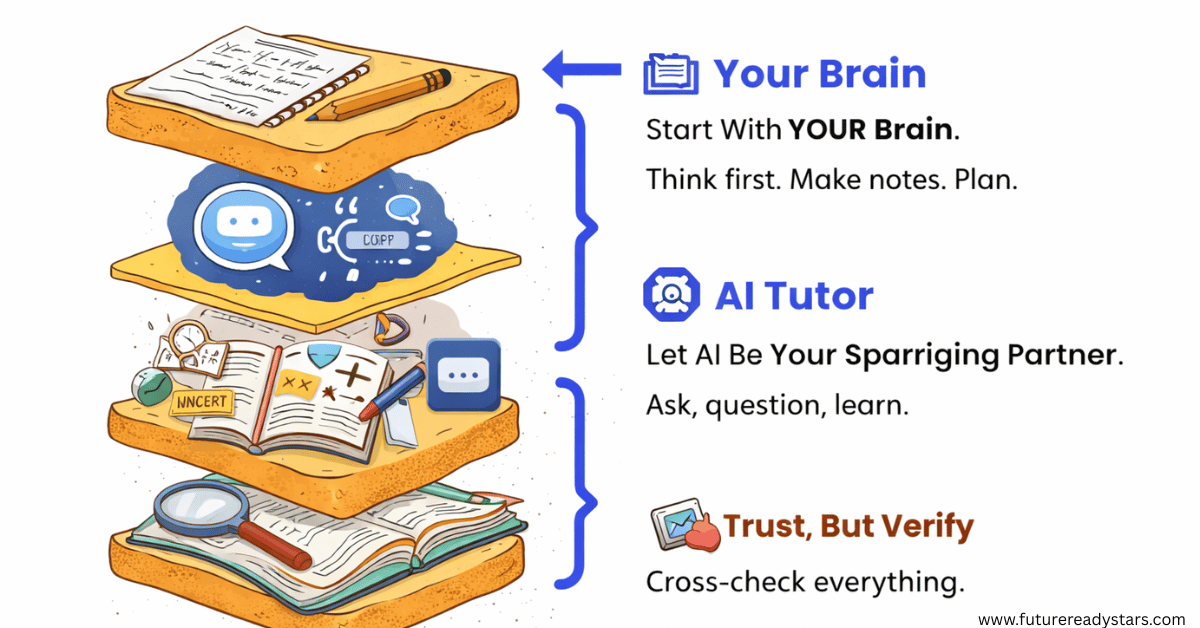
If you want to know how to use ChatGPT for studying without shooting yourself in the foot, try this:
- The Top Slice: Start With YOUR Brain
Before you even think about opening any AI tool, write something down. Anything. Bullet points. A rough formula. The essay structure you think might work.
Never, ever start with a blank screen and AI. That’s how you learn nothing.
- The Filling: Let AI Be Your Sparring Partner
Here’s where AI actually shines. But don’t ask it to do your homework. Ask it to teach you.
Try these prompts:
The “Feynman” Prompt:
"Explain Rotational Inertia like I'm 10 years old. Use a cricket bat as an example." Why it works:
If you can understand it at a child’s level, you actually own the concept.
The “Debate Me” Prompt:
"I wrote these 3 points about the French Revolution. Pretend you're my strict History teacher. Tell me what I missed." See the difference? You're using AI as a tutor, not a servant.Why it works:
You’re forcing AI to critique your thinking, not replace it.
The “Show Your Work” Prompt:
"I solved this quadratic equation and got x = 5. Walk me through the steps to check if I'm right. If I made a mistake, don't just give me the answer—ask me questions so I can figure it out."Why it works:
Board exams test process, not just final answers.
- The Bottom Slice: Trust, But Verify
AI lies. Confidently. With perfect grammar. It’s called “hallucination” (fancy word for “making stuff up”).
Always cross-check with your NCERT textbook, your notes, or Google. Rewrite everything in your own words. Make it sound like you, not like a robot who learned English from corporate emails.
Part 2: Build Skills AI Can’t Replace
“Sir, Why Learn Anything If AI Can Do It?”
I hear this at least twice a week. And I get it. If ChatGPT can code, write, and even make memes, why bother?
As I often tell my students “In the job market of 2030, ‘average’ work will be done by AI. ‘Exceptional’ work will be done by humans using AI.”
Big difference.
The Superpowers You Actually Need
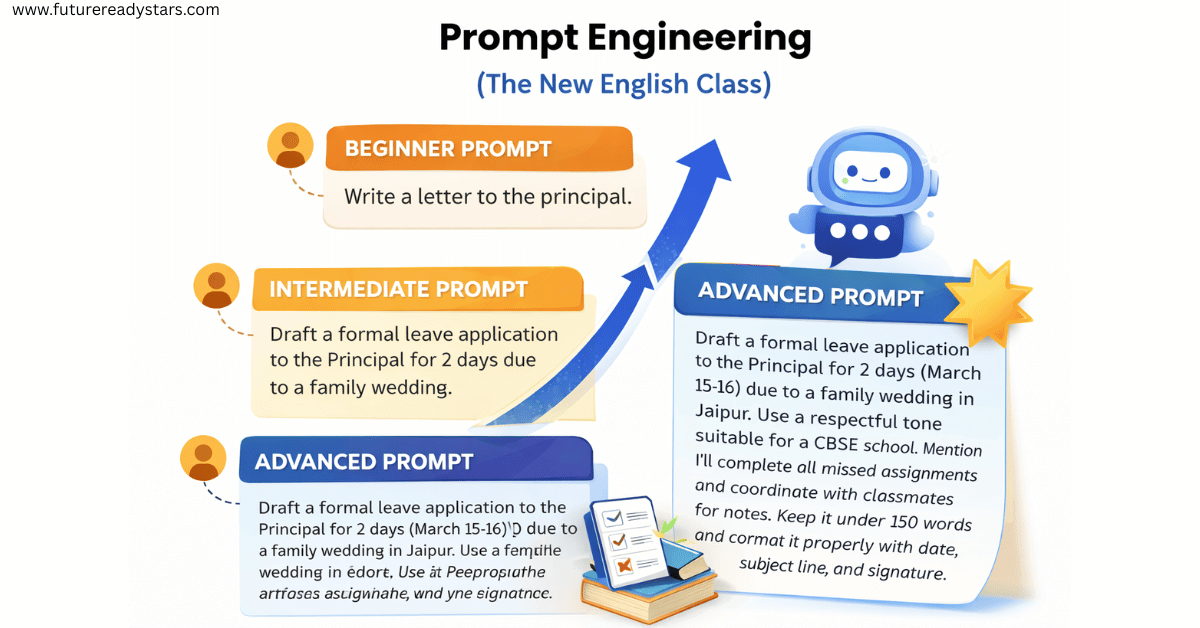
1. Prompt Engineering (The New English Class)
Talking to AI is now a literacy skill. Like knowing how to Google, but deeper. OpenAI’s official guide breaks it down well, but here’s the quick version:
Let me show you the progression:
- Beginner Prompt: “Write a letter to the principal.”
- Intermediate Prompt: “Draft a formal leave application to the Principal for 2 days due to a family wedding. Keep it respectful but short.”
- Advanced Prompt: “Draft a formal leave application to the Principal for 2 days (March 15-16) due to a family wedding in Jaipur. Use a respectful tone suitable for a CBSE school. Mention I’ll complete all missed assignments and coordinate with classmates for notes. Keep it under 150 words and format it properly with date, subject line, and signature.”
The third one? That’s what separates students who use AI from students who master it.
For even richer study prompts and examples you can try, check out 50 Best AI Prompts for Students: From Study Notes to Essay Writing (2025).
2. Critical Thinking (Your Built-In BS Detector)
AI is trained on the internet. And the internet? Full of garbage.
When AI tells you India’s GDP grew by 8%, do you know how to fact-check that? That instinct—that healthy skepticism—is what makes you valuable.
3. Creative Synthesis
AI is great at analyzing the past (it’s all data). Humans are great at imagining the future.
Use AI for the boring stuff (formatting, grammar checks). Save your brain power for the creative stuff (ideas, connections, insights).
Part 3: Stay Safe (Because the Internet is Creepy)
India = Data Goldmine
We’re the data capital of the world. Every app wants your info. Every “free” tool is collecting something.
Here’s what most students don’t realize: when you use free AI tools, you’re not just getting help with homework. You’re potentially sharing your writing style, your academic weaknesses, your daily routine, even your location. That data gets stored, analyzed, and sometimes sold.
AI safety for teenagers isn’t just your parents’ concern anymore. It’s yours. The Indian government is taking this seriously with new cyber safety initiatives focused on youth.
Your Weekly Safety Checklist (Takes 5 Minutes)
1. The “Sunday Permission Check”
Every Sunday, go to your phone settings. Check app permissions.
Does that “AI Avatar Generator” really need access to your Contacts? Your Microphone? Your Camera?
No. It doesn’t. Revoke that permission right now.
2. The “Nickname Rule”
Never use your real full name on free AI chatbots.
Why? Because data breaches happen. All the time. If a platform gets hacked, your personal info is out there. Use a nickname. Just your first name. Anything but your full identity.
3. Spot the Deepfakes
You’ve seen them. Shahrukh Khan promoting a betting app. Politicians saying wild stuff they never actually said.
On your family WhatsApp group, be the one who says, “Wait. Check the lip-sync. This looks fake.”
Use your education to stop misinformation before your uncle forwards it to 47 people. Need help? India now has a WhatsApp Deepfake Detection helpline (+91 9999025044) where you can report suspicious videos.
What’s interesting—and honestly a little worrying—is that many students are now spotting deepfakes faster than their parents. If you’re a parent reading this and feel one step behind, I’ve written a practical, no-panic guide on exactly this gap in When Your Kid Catches Deepfakes Faster Than You: A Survival Guide for Indian Parents (2025).
4. AI is Not Your Friend (Sorry)
I know it sounds harsh, but it’s true. I’ve seen students pour their hearts out to chatbots because they’re lonely or stressed.
AI can simulate empathy. But it doesn’t feel anything. It’s just math predicting the next word.
If you’re struggling, talk to a real human. A teacher, a friend, a counselor. We might be old-school, but we actually care. Organizations like CyberPeace India are working to create better digital wellbeing resources for students.
Final Thoughts: You’re the Steering Wheel
Here’s an analogy for you.
Think of AI like a Formula 1 car engine. Incredibly powerful. Insanely fast.
But an engine without a steering wheel? That’s just a disaster waiting to happen.
You are the steering wheel.
You decide where this technology takes you. You decide if it’s a shortcut to cheat on Monday’s assignment (short-term win, long-term loss) or a tool to understand Quantum Physics better than anyone else in your batch (long-term mastery).
AI can accelerate your learning. But only you can accelerate your future.
If you’re new to AI-based studying, you may want to start with our complete guide on how Indian students can use AI tools safely and effectively before diving into subject-specific tools.

My name is Asheesh Kumar i am a dedicated educator and have a deep understanding of artificial intelligence, I aim to transform traditional learning methods by integrating cutting-edge technology and AI-driven tools into education. As a teacher and personal tutor, I have the privilege of working with many students and understanding their individual strengths and weaknesses. With this insight, I know how to help each student overcome their challenges and improve their skills. Understanding each student’s unique learning style and needs allows me to tailor lessons that maximize their potential. This holistic approach not only boosts academic performance but also builds confidence and a lifelong love for learning.
1 thought on “AI for Indian Students: Your Teacher’s Real Talk on Learning Smarter in 2025”