

I’ll be honest with you: when I first started exploring AI tools with my students last year, most of them were copying and pasting their homework questions directly into ChatGPT and calling it a day. The results? Generic responses that sounded like they came from a very polite robot who had read the Wikipedia page but never actually thought about the topic.
The real magic happens when you learn to talk to AI the way you’d talk to the world’s most patient tutor—someone who can help you think deeper, organize better, and actually understand what you’re learning. After working with hundreds of students and testing countless prompts in real classroom situations, I’ve compiled this guide to help you use AI as a genuine learning tool, not a shortcut that leaves you more confused than when you started.
Understanding the Foundation: What Makes a Great AI Prompt?
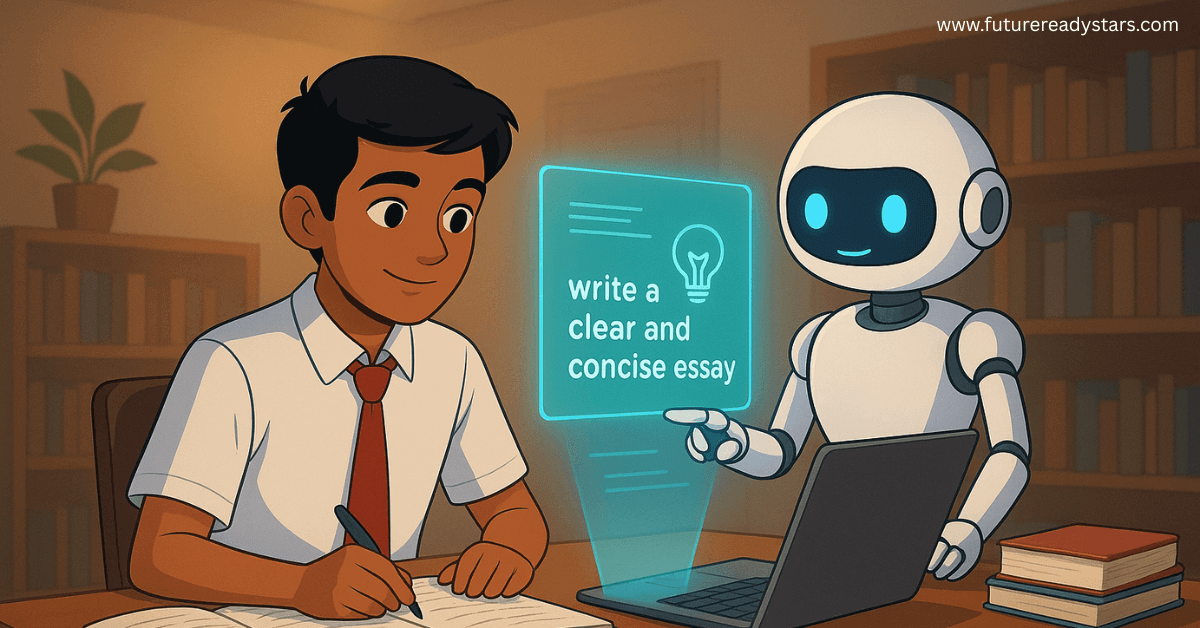
Before we dive into specific prompts, let’s talk about what separates a powerful prompt from one that gives you lukewarm results. The difference usually comes down to three elements: context, specificity, and purpose.
Think of AI as a new teacher who just walked into your classroom mid-semester. If you ask, “Can you help me with math?” they’ll give you something generic. But if you say, “I’m struggling with quadratic equations, specifically understanding why we complete the square instead of just using the formula every time,” now they can actually help you.
The prompts I’m sharing below follow this principle. They’re designed to make AI work harder so your brain can work smarter.
How to Use These Prompts
✔ Copy-paste directly
✔ Add your chapter, topic, grade level, or question
✔ Iterate (“Make it simpler,” “Add examples,” “Try with diagrams,” etc.)
✔ Always fact-check and put answers in your own words
Also Read: The 3R Method: How CBSE Toppers Decode Any Prompt in 60 SecondsSECTION 1: For Better Study Notes & Understanding
1.Turn lecture notes into clear study cards
Prompt: “I’m a [grade/level] student studying [topic]. Convert these lecture notes into 15 concise Q&A flashcards, prioritizing key terms, formulas, and common misconceptions. Keep each answer under 40 words. Notes: [paste notes].”
2. Summarize with “what, why, how”
Prompt: “Summarize this chapter in three sections: What it says, why it matters, and how it connects to earlier topics. Add two practical examples and one visual analogy. Text: [paste excerpt].”
3. Concept map in text
Prompt: “Create a text-based concept map of [topic]. Show nodes (key ideas) and arrows (relationships). Add 3 cross-links between sections students often miss.”
4. Give me 3 levels of explanation: simple, medium, and advanced.
Prompt: “Explain this concept in three levels: (1) like I’m 12, (2) like I’m in high school, and (3) a deeper academic explanation. Then give me a quick analogy I can remember.”
5.“Create a 10-question self-quiz from my notes.”
Prompt: “Create 10 mixed-level quiz questions from these notes—multiple-choice, short answer, and one challenge question. Give the correct answers at the end.”
6.“Compare two similar concepts.”
This stops students from confusing topics like mitosis vs. meiosis.
Prompt: “Explain the difference between __ and __ using a simple table, a short paragraph, and one analogy.”
7.“Teach me like a tutor.”
Students love this one.
Prompt: “Act as my personal tutor. Ask me 5 questions to understand what I know about this topic, then teach me only what I’m missing.”
8.“Show me where my understanding is weak.”
Prompt: “Based on these notes, identify any gaps, unclear definitions, missing steps, or misconceptions. Then give me 3 specific actions (like practice questions or explanations) to strengthen each weak area.”
9.“Explain this formula with a real-world example.”
Prompt: “Explain this formula step-by-step and then give me a real-world example where it applies.”
10.“Simplify this diagram or chart.”
Prompt: “Describe this diagram like you’re explaining it to a friend who missed class. Use simple language and no jargon.”
SECTION 2: For Homework Help (Without Doing the Work Entirely)
11. “Walk me through this problem—but don’t give the final answer yet.”
Prompt: “Help me understand how to solve this problem step-by-step, but stop before the final answer and let me try it myself.”
12. “Check my homework for logic, not correctness.”
Prompt: “Here’s my homework solution. Check only my reasoning steps. Don’t correct mistakes—just point out where I should recheck my work.”
13. “Give me a hint, not the solution.”
Prompt: “I’m stuck here. Give me 2–3 hints that guide me without giving the direct answer.”
14. “Explain this concept using a story.”
Great for young learners.
Prompt: “Explain this science/social science concept using a short story with characters and a simple plot.”
15. “Show me where I went wrong, but don’t fix it yet.”
Prompt: “Review my solution and list only the steps that might be incorrect or unclear. For each flagged step, explain what type of mistake it might be (logic, concept, calculation, assumption). Do not provide the correct step.”
16. “Convert this word problem into a clean equation.”
Prompt: “Turn this word problem into a step-by-step equation so I understand what it’s asking.”
17. “Rewrite my science explanation so it sounds clearer but still mine.”
Prompt: “Rewrite this in clearer, simpler words but keep my original ideas and tone.”
18. “Explain this historical event from multiple perspectives.”
Prompt: “Explain this event from the perspective of a student, a historian, and someone living during that time.”
19. “Help me understand the ‘why’ behind the answer.”
Prompt: “I understand the steps, but not the reason behind them. Explain why each step matters.”
20. “Help me solve similar but simpler problems first.”
Prompt: “Before we solve this, create 2 simpler practice questions that build up to it. Then help me solve the main question.”
SECTION 3: For Essay Writing & Assignments
21. “Help me brainstorm ideas before writing.”
Prompt: “Give me 5–7 angles or viewpoints I can explore for an essay on this topic.”
22. “Help me outline my essay before I draft it.”
Prompt: “Create a simple, flexible outline with headings and bullet points for a 600–800-word essay on this topic.”
23. “Rewrite my thesis statement to make it stronger.”
Prompt: “Here’s my thesis. Improve clarity, focus, and impact without changing the core meaning.”
24. “Suggest evidence or examples I can include.”
Prompt: “Give me 5–6 possible examples, studies, facts, or perspectives I can use to support this thesis.”
25. “Turn my notes into a first draft.”
Prompt: “Using these notes, create a clean essay draft in my voice. Avoid complex vocabulary and keep sentences natural.”
26. “Check my essay for logical flow.”
Prompt: “Review my essay for flow. Tell me where transitions feel abrupt and suggest smoother alternatives.”
27. “Highlight sentences that sound robotic.”
Prompt: “Point out any lines that sound AI-generated or unnatural and suggest human-sounding alternatives.”
28. “Improve clarity without changing meaning.”
Prompt: “Edit my paragraph for clarity and simplicity, but don’t add new ideas.”
29. “Turn my conclusion into something stronger.”
Prompt: “Strengthen my conclusion by tying it back to the thesis and adding a final takeaway.”
30. “Help me cite properly.”
Prompt: “Turn these sources into MLA/APA citations and show me how to format the bibliography.”
SECTION 4: For Math, Science, and Problem-Solving
31. Show your work coach
Prompt: “For this math problem, show the solution and annotate each step with the reason or property used. Then provide a similar practice problem with a different twist. Problem: [paste].”
Also read: Best AI Tools for CBSE Students to Solve Math Problems (2025): Free & Paid Options32. Translate word problems into equations
Prompt: “Turn this word problem into equations. List knowns, unknowns, and constraints. Then solve and explain in everyday language. Problem: [paste].”
33. Lab report scaffold
Prompt: “Create a lab report scaffold with sections (Question, Hypothesis, Materials, Procedure, Data, Analysis, Sources of Error, Conclusion). Include sentence starters for each section based on this experiment: [describe].”
34. Explain a diagram-heavy concept
Prompt: “Explain [biological/physical system] using a layered approach: simple model, refined model with terms, then the full model with equations. Add 2 common pitfalls.”
35. Unit and assumptions check
prompt: “Check my solution for unit consistency and hidden assumptions. If an assumption might fail in real-world conditions, explain how results would change. Solution: [paste].”
SECTION 5: For Languages and Humanities
36. Gentle grammar fix with commentary
Prompt: “Correct grammar and punctuation in this paragraph but also add a brief comment after each change explaining the rule in plain language. Paragraph: [paste].”
37. Vocabulary in meaningful context
Prompt: “Give me 10 practice sentences that naturally use these vocabulary words in academic contexts. Include one sentence that uses two words together. Words: [list].”
38. Textual analysis prompt ladder
Prompt: “Create a prompt ladder (basic to advanced) for analyzing this text, moving from recall to synthesis and critique. Text: [paste].”
39. Primary source lens
Prompt: “Analyze this primary source using 4 lenses: historical context, audience and purpose, bias and limitations, and modern relevance. Source: [paste/describe].”
SECTION 6: For Time Management & Study Planning
40. “Build me a study plan based on the time I have.”
Prompt: “I have __ hours per day and __ days before my exam. Create a realistic study plan with breaks and revisions.”
Also Read: CBSE 90-Day Study Plan: Build Yours in 5 Minutes with AI (2025)41. “Turn this chapter into a 3-day study schedule.”
Prompt: “Split this chapter into 3 days of manageable study tasks with goals and checkpoints.”
42. “Help me prioritize what matters most.”
Prompt: “From my syllabus, tell me which topics are high-priority based on typical exam weightage.”
43. “Make a weekly plan I can actually stick to.”
Prompt: “Create a weekly study plan with short daily tasks that won’t overwhelm me.”
44. “Turn my goals into a simple roadmap.”
Prompt: “Here are my study goals. Convert them into a realistic roadmap with small milestones.”
45. “Help me track my progress.”
Prompt: “Based on this study plan, create a simple progress tracker I can update daily.”
SECTION 7: For Research, Projects & Creative Work
46. “Break my project into clear steps.”
Prompt: “Turn this project topic into a step-by-step plan with timelines and required materials.”
47. “Help me generate creative angles for my project.”
Prompt: “Give me 5–8 original ideas or unique angles for presenting this project.”
48. “Help me find reliable sources.”
Prompt: “Suggest credible, student-friendly sources or keywords for researching this topic.”
49. “Help me prepare for a viva/oral exam.”
Prompt: “Ask me 10 likely viva questions on this topic. After I answer, tell me how to improve each one.”
50. “Give me a 24-hour emergency study plan.”
For last-minute situations.
Prompt: “I have 24 hours before my exam. Create a realistic, calm, focused study plan that prioritizes the most important topics.”
How to Get the Most From These Prompts

A great prompt is like a good teacher’s question: it gets you thinking and doing, not just receiving. Here are simple ways to make the most of them.
- Add your constraints
- Word count, citation style, required sources, grading rubric, and due date all help AI tailor results to your reality.
- Share a sample of your voice
- Paste a short paragraph you’ve written and ask, “Match this style.” You’ll get help that sounds like you, not a template.
- Ask for structure
- “Give it to me in a table.” “Provide a numbered outline.” “Use headers and bullet points.” Clear formatting reduces cognitive load.
- Make it interactive
- Ask the AI to quiz you, pause for your answers, and give feedback before it continues. That’s how you actually learn.
- Verify and personalize
- AI is a powerful assistant, not an oracle. Cross-check facts, read original sources, and add your own analysis. Teachers can tell the difference—and so can you.
Also read: ChatGPT Go Is Now Free in India — How Students Can Claim GPT-4 Access & Study Smarter (2025 Guide)Example: From Messy Notes to a Draft Paragraph
Let’s combine a few prompts:
Step 1: Clean your notes
- Use Prompt 1 to turn messy notes on the causes of the French Revolution into a hierarchical outline.
Step 2: Build a paragraph
- Use Prompt 25 (TEER) to craft a body paragraph from one bullet in your outline. Topic: “Economic pressures on the Third Estate intensified revolutionary sentiment.”
Step 3: Add a counterpoint
- Use Prompt 27 to acknowledge limits or alternate causes, then respond respectfully.
Step 4: Smooth the flow
- Use Prompt 26 to add transitions that fit your exact points.
Result: You still own the ideas and voice, but your structure, clarity, and logic are stronger.
Ethical Use: Learn, Don’t Offload

Teachers in 2025 increasingly welcome AI—as long as students remain the authors of their thinking. Here’s how to stay on the right side of both policy and learning:
- Cite when required
- If your school asks for AI disclosure, include a brief note: “I used an AI tool to refine structure and check clarity.”
- Keep your voice central
- Use prompts that coach you rather than ones that “write it all for you.” You’ll get better grades and better skills.
- Protect your data
- Avoid sharing sensitive personal info or uploading entire proprietary texts without permission.
Also Read: Best AI Subscription Plans for Students 2025: ChatGPT, Claude, Gemini, Perplexity & Grok ComparedFinal Thought
The best student-AI partnerships are collaborative. You bring curiosity, goals, and context. The AI brings structure, examples, and patient feedback. With the right prompts, you turn “I’m stuck” into “I’ve got a plan.”
If you try even three of the prompts above this week—one for studying, one for writing, one for planning—you’ll feel the shift. Not because AI did the work for you, but because it helped you do your best work more consistently.
You’ve got this. And if you want a one-page starter kit, begin with:
- Turn lecture notes into flashcards
- Outline by section for essays
- Weekly study plan that fits your life
From there, choose the prompts that match your next challenge. Keep refining how you ask. That’s how learners become experts.
I have read some excellent stuff here Definitely value bookmarking for revisiting I wonder how much effort you put to make the sort of excellent informative website
Thank you for your sharing. I am worried that I lack creative ideas. It is your article that makes me full of hope. Thank you. But, I have a question, can you help me?
Thanks for sharing. I read many of your blog posts, cool, your blog is very good.
Thank you for your sharing. I am worried that I lack creative ideas. It is your article that makes me full of hope. Thank you. But, I have a question, can you help me?