
Listen, I’ve been teaching Class 10 students for years now, and 2026 is going to be different. Not scary-different, but definitely a game-changer. If you’re aiming for that coveted 95%+ score, you need to understand what’s coming and prepare smartly. Let me walk you through exactly how to do this.
Also Read: Smart Study: How to Use ChatGPT to Analyze 10 Years of CBSE Question Papers
What’s Changed in CBSE 2026 (And Why It Matters)
Two Board Exams – Use Them Wisely
Here’s the deal: CBSE is giving you two board exam sessions—February 2026 and May 2026. Sounds amazing, right? Two chances to nail it! But here’s what I tell my students: treat February like it’s your only shot.
Yes, you can retake subjects in May if you’re not happy with your February scores, and CBSE will count your best performance. But think about it—if you bank on the May session, you’re essentially stretching your Class 10 prep until summer. That’s three extra months when you could be getting ahead with Class 11 or starting your competitive exam prep.
My advice? Go all-out for February. Keep May as your safety net, not your plan A.
Welcome to the Era of “Thinking, Not Memorizing”
The biggest shift in 2026 is this: 50% of your exam will be Competency-Based Questions (CBQs). What does that mean in plain English?
Earlier, memorising definitions worked. Now, CBSE checks whether you can apply concepts in real-life situations.
Here’s how the paper breaks down now:
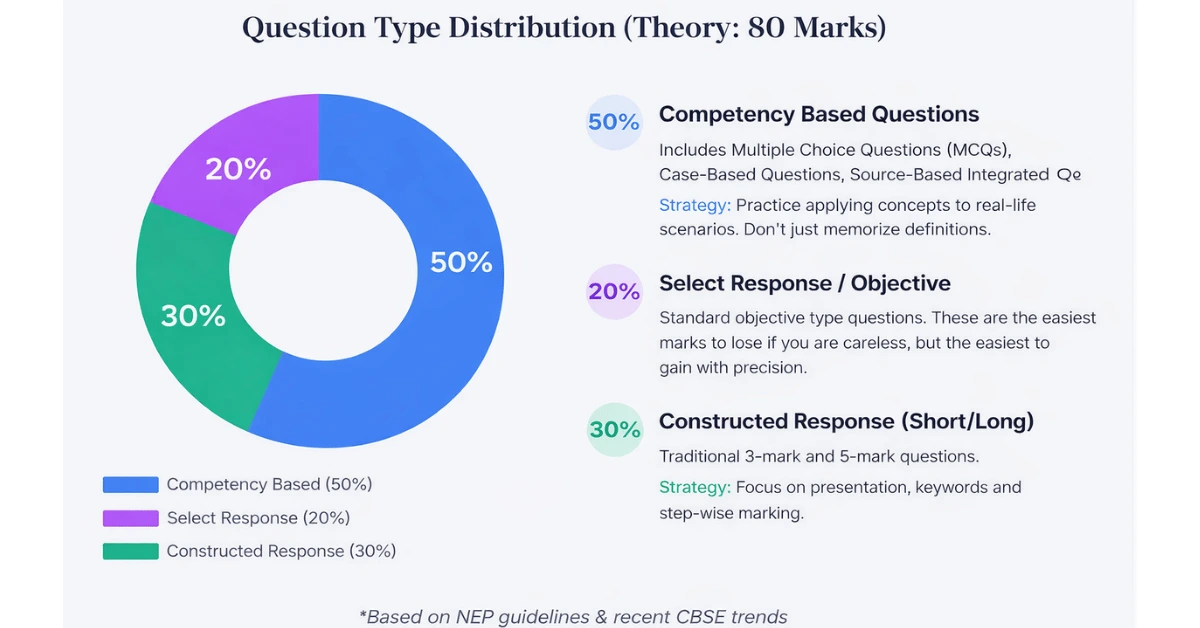
- 50% Competency-Based: Case studies, real-life scenarios, source-based questions
- 20% Objective Type: MCQs and Assertion-Reasoning (these need precision!)
- 30% Traditional: Short and long answer questions
If you understand why something happens, you’ll score. If you only memorise, marks will slip
Your 5-Week Sprint to 95%+ (Mid-January to February 17)
Okay, real talk. We’re in January now, and your exam starts February 17. That’s roughly 5 weeks. No time for long-term plans. Let’s focus on what matters RIGHT NOW.
Week 1-2 (Mid-January): Rapid Completion + Damage Control
If you haven’t finished your syllabus yet, don’t panic—but move FAST.
Priority 1 – Complete Pending Chapters: Focus on high-weightage units first. In Maths, that’s Algebra and Geometry. In Science, that’s Chemical Reactions, Life Processes, and Light. In SST, finish Nationalism in India and Geography map work.
Priority 2 – Start Your Mistake Copy NOW: Get a notebook and record every wrong answer from your practice. Write WHY you got it wrong. This is more important than solving new questions at this stage.
Daily Target: 3-4 chapters across subjects + 1 hour of previous year questions.
Week 3 (Late January): Practice Mode Activated
By now, your syllabus should be DONE. If it’s not, you need to make tough choices—focus on high-weightage topics only.
Paper Simulation Begins: Solve at least 2-3 full sample papers this week. Time yourself strictly between 9 AM to 12 PM (actual exam time). Get your body and brain used to this schedule.
Attack Competency Questions: Download CBSE’s official competency question banks. These case-study questions need practice—they won’t feel natural at first.
Quick Revision Formula: Use your notes + One-Shot videos for quick chapter revisions. Don’t reread entire NCERT chapters now—you don’t have time.
Week 4-5 (February 1-16): Perfection Mode
The final two weeks are about polish, not learning new things.
Alternate Day Pattern:
- Day 1: Full paper simulation (3 hours) + detailed analysis
- Day 2: Revise weak areas found in yesterday’s paper + formula/diagram practice
Last 3 Days Before Exam: Only revision. Your smart notes, formula sheets, diagrams, maps. NO new topics. Sleep well. Stay calm.
Also Read: Best AI Tools for CBSE Students to Solve Math Problems (2025): Free & Paid Options
Subject-Wise Strategies That Actually Work
Mathematics: Your Make-or-Break Subject
Focus on High-Weightage Units:

- Algebra (20 marks): Quadratic equations, AP formulas
- Geometry (15 marks): Similarity criteria, Circle theorems
- Trigonometry (12 marks): Identities, Heights & Distances
Quick Win Strategy:
- Memorize formulas: Make a one-page formula sheet. Quadratic formula, AP formulas, trigonometric identities, area/volume formulas. Revise daily.
- Step-wise marking saves you: Even wrong answers get marks for correct method. Always write: Formula → Given values → Substitution → Answer with units.
- Practice diagrams: In Geometry and Heights & Distances, your diagram is worth 1 mark. Draw it correctly in pencil, label everything.
- Previous Year Papers: Focus on last 5 years’ papers. Patterns repeat.
Science: Three Subjects in One
Chemistry (25 marks):
- Master Activity Boxes from NCERT (they ask these directly!)
- Focus: Chemical Reactions, Acids-Bases-Salts, Carbon Compounds, Metals & Non-Metals
- Reactivity Series is your best friend for displacement reactions
Biology (25 marks):
- Practice diagrams: Human Heart, Nephron, Alimentary Canal, Reflex Arc
- Life Processes = highest weightage. Understand photosynthesis and respiration experiments
- Heredity questions are logic puzzles—practice crosses until patterns click
Physics (25 marks):
- Light: Sign convention errors kill marks. Stick to one convention religiously
- Electricity: Practice circuit diagrams for resistance calculations
- Master direction rules: Right-Hand Thumb Rule, Fleming’s Left-Hand Rule
- Don’t skip “Our Environment” (5 easy marks)
Time-Saving Tip: For each chapter, memorize 2-3 key diagrams and 5-6 important points. That’s enough for most questions.
Social Science: Smart Work Over Hard Work
History: Create a timeline of events (1915-1947). Helps with sequencing and structuring answers.
Geography Map Work (5 FREE marks): Practice locating: Major dams, crops, minerals, power plants. This takes 30 minutes to master but guarantees 5 marks.
Political Science & Economics: Use specific terms like “Horizontal Distribution of Power” and “Coming-together Federation”. Add real-life examples in Economics answers.
Answer Writing: Never write paragraphs. Use 5 points for 5-mark questions. Highlight keywords. Makes examiner’s job easy = more marks for you.
Languages: Format = Marks
English:
- Writing: Stick to format (letter structure, paragraph format). Format itself carries 2-3 marks.
- Literature: Know your texts, don’t rely on summaries.
Also Read: AI Tools for CBSE English Students: Grammar, Writing, and Safe Use (A Teacher’s Guide)
Hindi:
- Watch spelling (matras, bindu). Biggest mark-killer.
- Use a doha/shloka in writing = instant bonus marks.
The Topper’s Secret Sauce: Presentation
I’ve analyzed dozens of topper answer sheets. Want to know the difference between a 92% and a 97% answer sheet? Presentation.
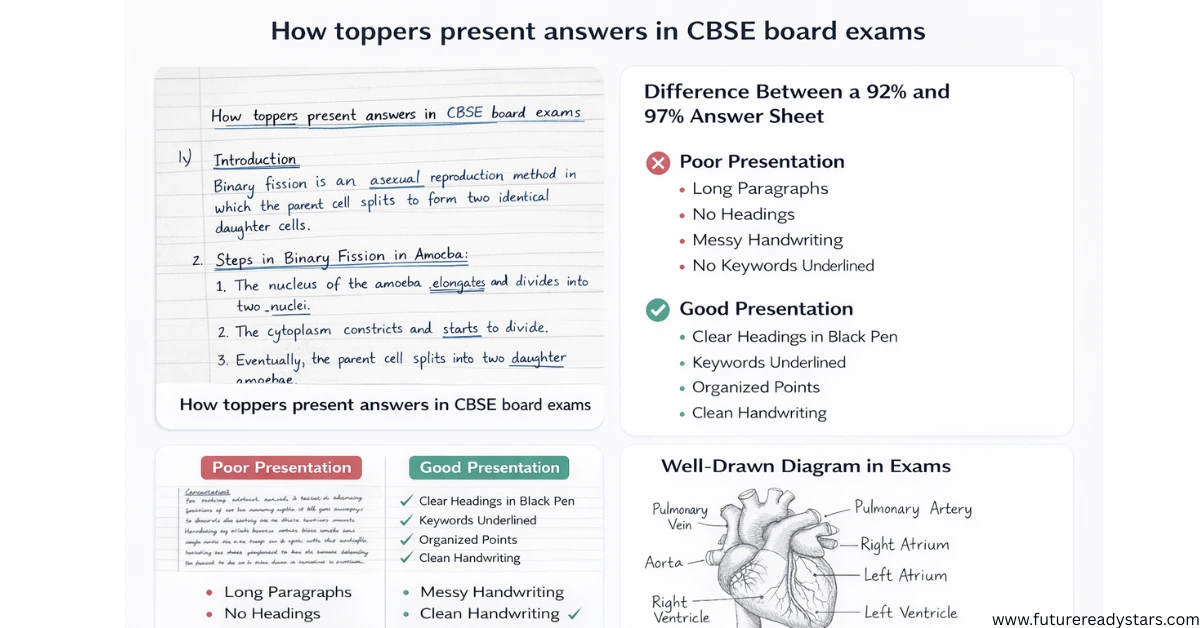
Visual Hierarchy:
- Use black pen for headings and keywords
- Blue pen for body text
- Underline important terms, dates, formulas
Structure Everything:
- Don’t write paragraphs of text
- Use clear Introduction-Points-Conclusion format
- For comparison questions (Aerobic vs Anaerobic), always use a table
Diagrams Are Your Friend:
- Even when not asked, relevant diagrams boost marks
- Always draw in pencil
- Label everything clearly
Time Management:
- Use the 15-minute reading time strategically
- Mark questions as Easy, Medium, Hard
- Start with 5-mark questions when your mind is fresh
- Don’t get stuck—move on and come back
Check Your Preparation Level
Not sure if you are on track for 95%?
Try our CBSE Class 10 Score Predictor Tool (Free) and get instant feedback
The Bottom Line
Look, scoring 95%+ in 2026 isn’t about studying 16 hours a day or joining five different coaching classes. It’s about understanding that CBSE has changed the rules. They want students who can think, not robots who can reproduce.
Build your foundation on NCERT. Practice competency questions until they feel natural. Maintain that mistake copy religiously. And when you sit for the exam, present your knowledge like a topper—structured, clear, and confident.
The roadmap is here. The path is clear. Now it’s your turn to walk it.
All the best! You’ve got this.
f you’re new to AI-based studying, you may want to start with our complete guide on how Indian students can use AI tools safely and effectively before diving into subject-specific tools.
Important Resources & Official Links
Bookmark these official CBSE links to stay updated and practice the right material.
- Official 2026 Date Sheet: Download CBSE Class 10 Date Sheet (Revised) Verify the Feb 17 start date and gaps between exams.
- Official Sample Papers (2025-26): CBSE Academic: Class X SQP & Marking Scheme Practice these to understand the exact pattern for February.
- Competency-Based Question Bank: CBSE Competency Focused Practice Questions Essential for the 50% “new style” questions.
- Official Syllabus: CBSE Secondary Curriculum 2025-26 Check this to ensure you aren’t studying deleted topics.
Hi there! Wishing you a great day ahead.
Let’s make your plan work. I’m offering grants for creative endeavors, business startups, and personal support. WhatsApp +447464379544