
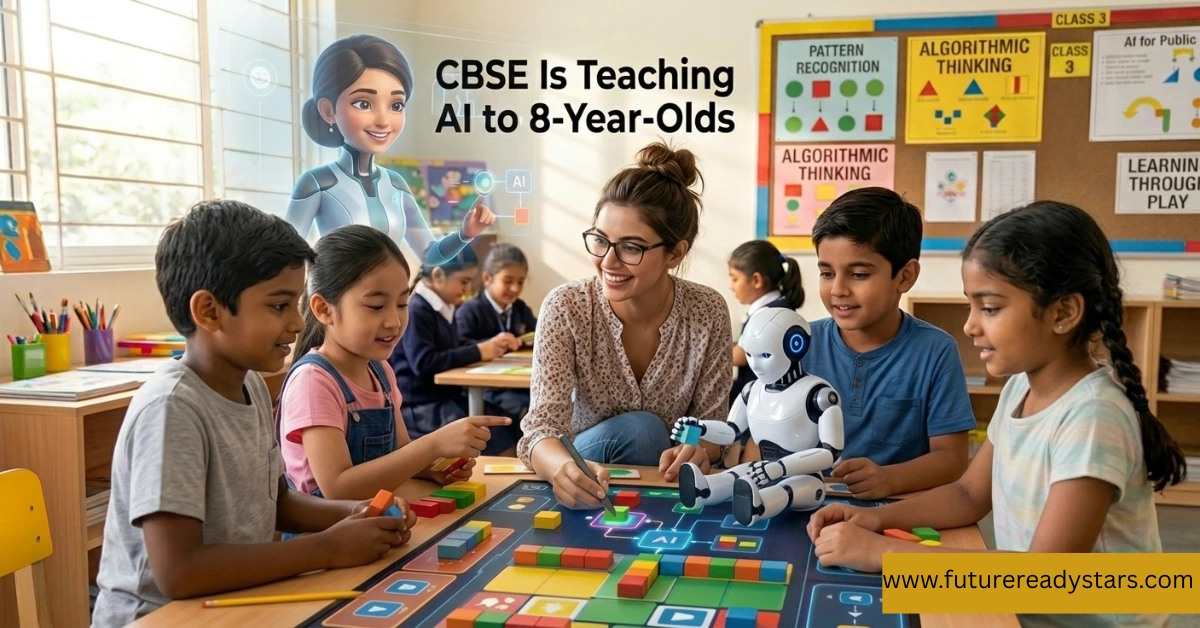
The CBSE AI curriculum 2026 is one of the biggest changes in India’s school education system, aiming to build real-world thinking skills from an early age It's not a pilot project. It's not a "tech elective" for gifted kids. From this academic year, every child in a CBSE school — starting Class 3 — will begin learning Artificial Intelligence. Here's what that actually looks like, classroom by classroom.
Think back to when you first encountered a computer in school. Maybe it was Class 5 or 6. Maybe you typed your name in MS Paint and thought that was revolutionary. Your kids won’t have that experience — because their generation is going to learn how the machine thinks, not just how to use it.
On October 30, 2025, the Ministry of Education made it official: AI and Computational Thinking will be embedded into every CBSE school, starting from Class 3, from the 2026–27 academic year. Not as a fancy optional subject. Not just in tech-heavy private schools. All schools. All students.
If you’re a parent trying to figure out what this means for your child — or a student wondering what’s coming — this is the breakdown you need.
Also Read: Help Your Child Read English: 5 Useful Educational Gadgets for Indian Students (Teacher’s Guide)
The Numbers That Put This in Perspective
31K+
CBSE schools that will implement this curriculum nationwide
10M
Teachers who need to be trained before this rolls out
Class 3
The earliest grade — roughly 8-year-olds — where AI learning begins
That teacher number — 10 million — is the one that tells you how ambitious (and honestly, how challenging) this really is. India is attempting one of the world’s largest integrations of AI education into school learning. No country has done this at this scale, at this age, this fast.
CBSE AI Curriculum 2026 Explained (Class 3 to 12)
Here’s the part most news articles skip — the actual classroom content. The curriculum is designed in four stages, each building on the last. Think of it like a staircase, not a jump.
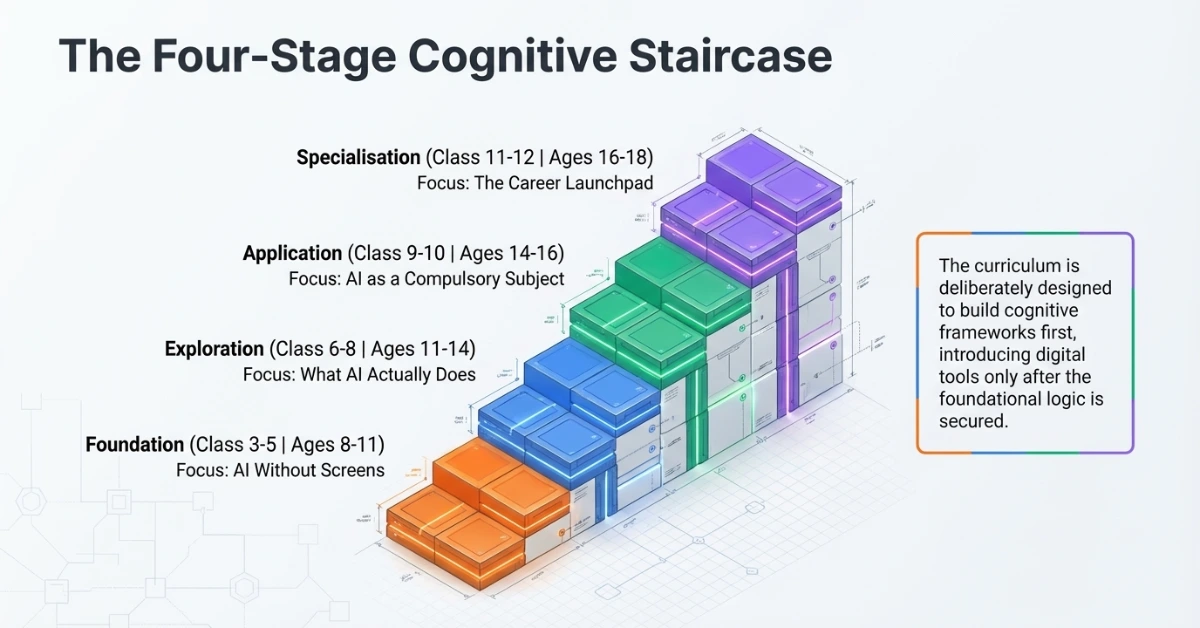
🟠 Class 3–5 · Ages 8–11
The Foundation Stage — “AI Without Screens”
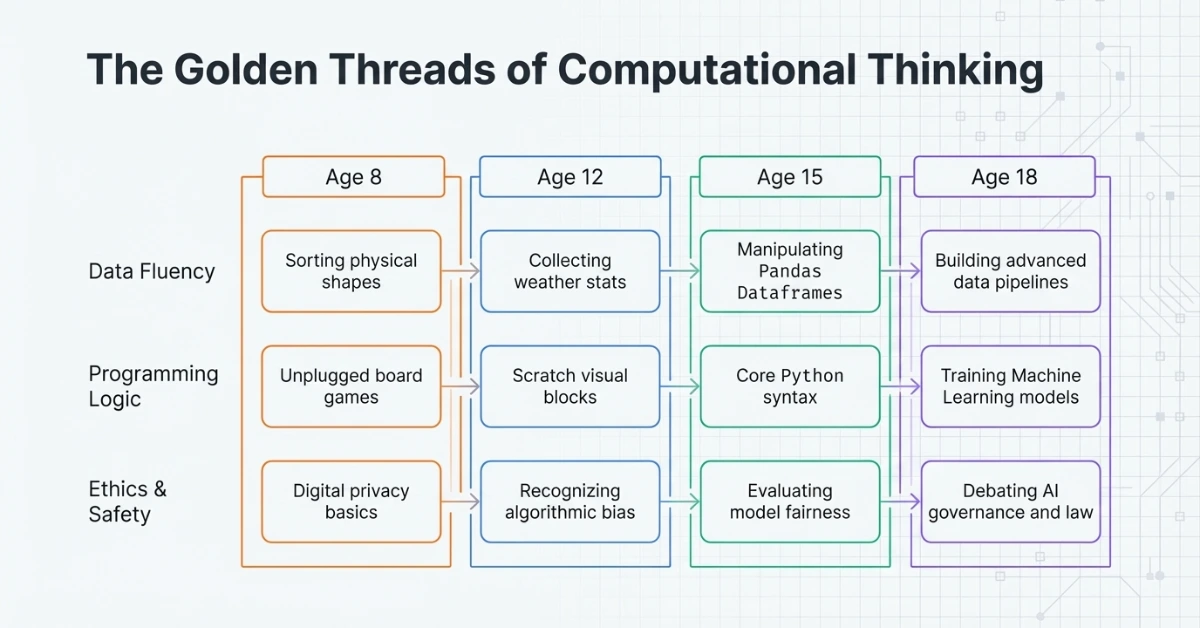
- Pattern Recognition — Children will be taught to spot sequences, repetitions, and rules in everyday things around them — tiles on a floor, beats in a song, leaves on a branch. This is the exact same skill AI uses when it recognises your face or filters spam from your inbox. Teachers will use physical sorting cards, bead sequences, and group activities — no laptop required.
- Classification & Grouping — Students will sort objects into categories using their own criteria: size, colour, shape, use. Then they’ll be asked — “what happens if the rule changes?” This trains flexible thinking, the kind that later becomes machine learning logic.
- Algorithmic / Step-by-Step Thinking — Kids will practice writing instructions for simple tasks: how to make a sandwich, how to water a plant, how to find a book in the library. The lesson: computers only do exactly what you tell them. If a step is missing, everything breaks. This is programming logic before there’s any programming.
- Cause and Effect Relationships — Activities like “if it rains, the ground gets wet — what else happens?” build the conditional thinking (if-then-else) that is the backbone of all computing.
- Responsible & Safe Technology Use — Age-appropriate conversations about screen time, sharing personal information online, and understanding that not everything on the internet is true. This isn’t just digital safety — it’s the beginning of AI literacy.
- Unplugged Games & Puzzles — The entire stage is designed to work without devices. Think board games that teach sequencing, physical card-sorting challenges, role-play exercises where one child “programs” another to navigate an obstacle course. A school in rural Rajasthan with no computers can deliver this just as well as a school in South Delhi.
Real talk for parents: Under the CBSE AI curriculum 2026, your 8-year-old will not be coding. They won’t touch Python; they won’t see a terminal screen. And that’s completely intentional. CBSE and the NCERT team have designed this stage around one idea — build the thinking first, tools come later. The child who can break a problem into steps, spot a pattern, and think about “what happens if I change this rule” is already thinking computationally.
🔵 Class 6–8 · Ages 11–14
The Exploration Stage — “What AI Actually Does”
- Introduction to AI — Demystifying the Buzzword — Not the sci-fi robot version. Students get real answers: How does Spotify know what song you want? Why does a spam filter work? Everyday examples make AI tangible instead of abstract.
- Human-Machine Interaction & Prompt Literacy — How do humans and machines actually communicate? Students learn why the way you phrase a question to AI matters — and practice rewriting prompts to get better results. Useful right now, not just someday.
- AI and the Sustainable Development Goals (SDGs) — Students explore AI solving real problems: predicting floods, monitoring air quality, diagnosing diseases where doctors are scarce. Then the real challenge: “Which problem in your community could AI help solve?”
- AI Ethics, Bias, and Access — Students learn that AI can be unfair — not because it’s evil, but because it reflects the biases of whoever built it. Facial recognition that works better on light skin. Hiring algorithms that penalise certain names. Who does AI serve, and who gets left out? This kind of thinking is rare even at university level.
- Block-Based Coding with Scratch or MIT App Inventor — Students snap logic together visually — no syntax errors, no cryptic terminals. They build simple games, stories, and animations. The lesson: software is just human decisions written in a language a machine can follow.
- Data Basics — Working with classroom surveys, weather data, sports stats — students collect, organise, spot patterns, and then ask: is this sample actually representative? The seed of data science thinking, planted early.
- Mini Projects — By Class 8: a simple FAQ chatbot, an image-labelling exercise, or a data story from self-collected information. Graded not on complexity — but on the quality of thinking behind the idea.
Real talk: This is where the curriculum becomes genuinely impressive. The ethics and bias module in particular is something most university computer science programmes still don’t teach properly. A Class 8 student who can articulate why an AI system might be unfair — and to whom — has a critical thinking edge that will matter in every career path, not just technology. If your child is in this age group right now, the best head start you can give them costs nothing: have dinner-table conversations about the apps they already use. “Why do you think Instagram showed you that reel?” is a perfect warm-up for what’s coming in their classroom.
Also Read: AI for Indian Students: Your Teacher’s Real Talk on Learning Smarter in 2025
🟢 Class 9–10 · Ages 14–16
The Application Stage — AI as a Compulsory Subject
The AI Project Cycle — The framework running through everything: Define the problem → Collect & clean data → Build the model → Test → Improve. Students apply this to real self-chosen problems — predicting electricity usage, detecting plant diseases in photos — not textbook exercises.
Python Programming — Students graduate from block-based coding to Python, the world’s most used AI language. Starting with variables, loops, and functions in Class 9 — by Class 10 they’re using NumPy and Pandas on actual datasets. With the Class 6–8 foundation, the jump is manageable.
Data Science Fundamentals — The full workflow: collecting data, cleaning it, analysing it, visualising it. Charts, heat maps, spotting outliers. A skill that’s useful in every career — medicine, journalism, economics, public policy — not just tech.
Neural Networks — How AI Actually “Learns” — First real look under the hood. What a neural network is, how it learns from examples instead of explicit rules, and what happens when you train one on a dataset and watch accuracy climb. One of those concepts that clicks and changes how you see everything.
Computer Vision — How AI identifies a face, reads a handwritten digit, or detects a tumour in an X-ray. Students label training data and discover why image quality and diversity matter. Directly connected to things they use daily — face unlock, Google Lens, Instagram filters.
Natural Language Processing (NLP) — How does ChatGPT understand a question? How does autocorrect know what you meant? Students do hands-on sentiment analysis, text classification, and basic language models — using tools they already interact with every day.
Machine Learning — Regression, Classification, Clustering — The three core types, each with real examples. Predicting tomorrow’s temperature. Filtering spam. Grouping customers by behaviour. All practiced in Python, not just defined in notes.
Mathematics for AI — Probability, statistics, basic linear algebra — taught with one purpose: showing students that the math from their other subjects is the actual engine inside every AI model they’ve ever used.
Real talk: This is a significant leap — and an exciting one. A Class 10 student who completes this curriculum will have built real AI projects, written actual Python code, and understood how models learn from data. That’s not exaggeration — that’s the syllabus. The AI Project Cycle assessment means marks aren’t just from memorising definitions; students are evaluated on the quality of the problem they chose, how they approached it, and what they learned from their results. For students considering engineering, data science, medicine, or economics — this is the best possible head start. For students who aren’t — the problem-solving and data literacy skills are just as valuable.
Also Read: When Your Kid Catches Deepfakes Faster Than You: A Survival Guide for Indian Parents (2025)
🟣 Class 11–12 · Ages 16–18
The Specialisation Stage — AI as a Career Launchpad
Advanced Python — Object-oriented programming, APIs, data pipelines, handling large datasets. By Class 12, students write code comparable to a first-year CS undergraduate — sometimes better.
Machine Learning — The Full Toolkit — Decision Trees, Random Forests, Support Vector Machines, Gradient Boosting. Students don’t just learn what these are — they implement, tune, and compare them on real datasets. University-level material, taught in Class 12.
Deep Learning & Neural Network Architectures — CNNs for image recognition, RNNs for text and speech, and a conceptual look at how large language models like GPT actually work. Students build and train small deep learning models using accessible tools.
Data Literacy — Storytelling With Numbers — Collecting data is one skill. Making people care about it is another. Right charts for the right questions, avoiding misleading visualisations, writing clear data narratives. In a world drowning in statistics, this is rare.
AI Ethics — The “Should We?” Questions — Should AI make medical decisions? Who’s liable when an autonomous vehicle crashes? How do we regulate AI-generated content? These are the governance challenges governments and courts face right now — students debate them with full technical awareness.
Capstone Project — The centrepiece of Class 12. A self-chosen real problem — agriculture, healthcare, climate, education — built end-to-end: problem definition, data collection, model, testing, presentation. Counts toward final grades. Also a portfolio piece for university and internship applications.
IBM SkillsBuild Certification — Globally recognised badges in AI Fundamentals, Data Science, and Machine Learning. Not just a CBSE certificate — a credential that means something on a CV, LinkedIn, and college applications. Most parents don’t know this exists. It might be the most practically valuable part of the whole programme.
Real talk: A student who completes a strong capstone here will graduate with what most engineering undergraduates don’t have until second year — real, project-backed AI skills. The IBM certification works internationally. The ethics modules mean they’re not just technically capable, they understand the responsibility. If your child is in Class 9 or 10 and has any interest in tech, business, medicine, or policy — this elective isn’t extra burden. It’s a competitive advantage.
The Real Challenges Nobody Is Talking About Enough
This curriculum is genuinely exciting. But let’s be honest — there are two massive elephants in the room that will decide whether this succeeds or becomes another well-intentioned policy that fizzles on the ground.
The Infrastructure Gap
Nearly 50% of Indian schools don’t have reliable electricity, internet, or computers. The “unplugged learning” approach for Classes 3–5 is a direct response to this — teaching AI concepts through physical games and activities requires no devices at all. It’s clever. But Classes 9–12 require Python, data tools, and computers. That gap is real and won’t close overnight.
The Teacher Training Problem
Ten million teachers need to be upskilled. The government’s plan is to use NISHTHA training modules and video-based resources — but training a math teacher to confidently explain neural networks is not a weekend workshop problem. An expert committee led by Prof. Karthik Raman from IIT Madras is developing the framework, but teacher readiness will be the true bottleneck.
These aren’t reasons to dismiss the initiative — they’re reasons to watch it carefully. The policy direction is exactly right. The execution is where history will be made or missed.
What Parents Can Do Right Now to Prepare
You don’t have to wait for your child’s school to figure it all out. Here’s how to get a head start this year:
Ask your child’s school one simple question: “What is your plan for the AI & CT curriculum rollout in 2026–27?“ How a school answers this tells you everything about how prepared they are.
Don’t buy anything expensive yet. Classes 3–5 won’t need devices or apps — the curriculum deliberately uses unplugged, activity-based learning. Save your money for Class 6 onwards when block-based coding tools come in.
Introduce “thinking games” at home. Puzzles, pattern games, sorting activities, logic riddles — these are the exact skills Class 3–5 AI lessons will build. You’re already doing AI prep without realising it.
Start conversations about AI, not just usage. Ask your child: “Why do you think YouTube keeps suggesting the same kind of video?” or “How does Google Maps know there’s traffic?” These questions build the intuition the curriculum will formalise.
For Class 8+ students — explore Scratch or Code.org now. Both are free, beginner-friendly, and directly relevant to the block-based coding modules coming in middle school. An hour a week makes a real difference.
Overall, the CBSE AI curriculum 2026 is not just about learning technology — it’s about preparing students for a future where AI will be part of every career