
Last Updated on March 23, 2026 by Asheesh Kumar
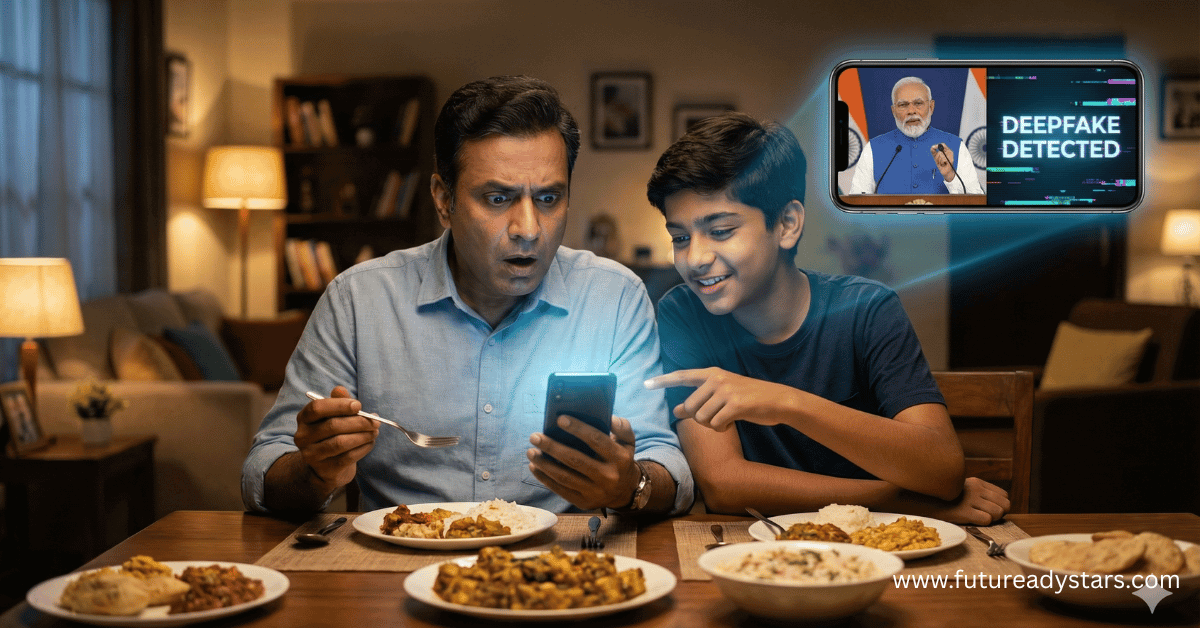
It was 8:30 PM on a Tuesday. I was exhausted after a long day at work, scrolling through my phone while finishing dinner. A message popped up in our “Family WhatsApp Group”—a video of a famous politician making a shocking statement. My thumb hovered over the forward button.
“Papa, fake hai wo. Deepfake. Look at the lips—they don’t sync.”
I looked up. My 14-year-old son barely glanced up from his plate, fork in one hand, completely casual about what he’d just said. I looked closer at the video. He was right. The lips were slightly off.
That moment changed everything for me.
Here I was, a parent who’d successfully navigated the “TV time” debates and “mobile phone” negotiations, suddenly realizing my son was living in a completely different world. A world where he could spot AI-generated fakes faster than I could identify spam emails.
“If you’re an Indian parent feeling lost about AI safety for kids in India” you’re not alone I teach at a school in moradabad, and last month, a mother came to me in tears. Her Class 10 daughter had been chatting with an AI companion for three hours every night—treating it like a best friend, sharing feelings she wouldn’t share with her own family.
In a country where “Tuition Sir” and “95% in Boards” used to be our only stressors, AI has entered as a chaotic third player nobody taught us to handle.
This isn’t a lecture. This is your survival guide—written by a teacher who’s also a parent, trying to figure this out alongside you.
Also Read: CBSE Is Teaching AI to 8-Year-Olds From 2026 — Here’s Exactly What Your Child Will Learn Grade by Grade
Survival Rule #1: Deepfake Talk – The First Step to AI Safety for Kids in India
Let me tell you what happened in our school last month. A video of our principal “announcing” a sudden fee hike went viral in parent groups. Within two hours, 300+ parents were calling the office in panic. The video was fake—a deepfake created by someone with basic AI tools.
India is the biggest market for “WhatsApp University” rumours, and AI has made it ten times worse. Platforms like Alt News or Boom Live are constantly fighting this battle. simply telling your child ‘Don’t believe everything online’ isn’t enough. True AI safety for kids in India starts with critical thinking, not just blocking apps.” (Jo humne pehle discuss kiya tha)
The 2-Minute Activity (Do This Tonight):
Find a viral AI video on YouTube—search “deepfake examples India.” Sit with your child and play detective together.
- Check the hands: AI struggles with fingers. Count them—six fingers? Blurred? Red flag.
- Check the blinking: Real humans blink 15-20 times per minute. Deepfakes often blink mechanically or not at all.
- Check the voice sync: Do words match lip movements? Even a 0.2-second delay means trouble.
Parent Script (Copy-Paste This):
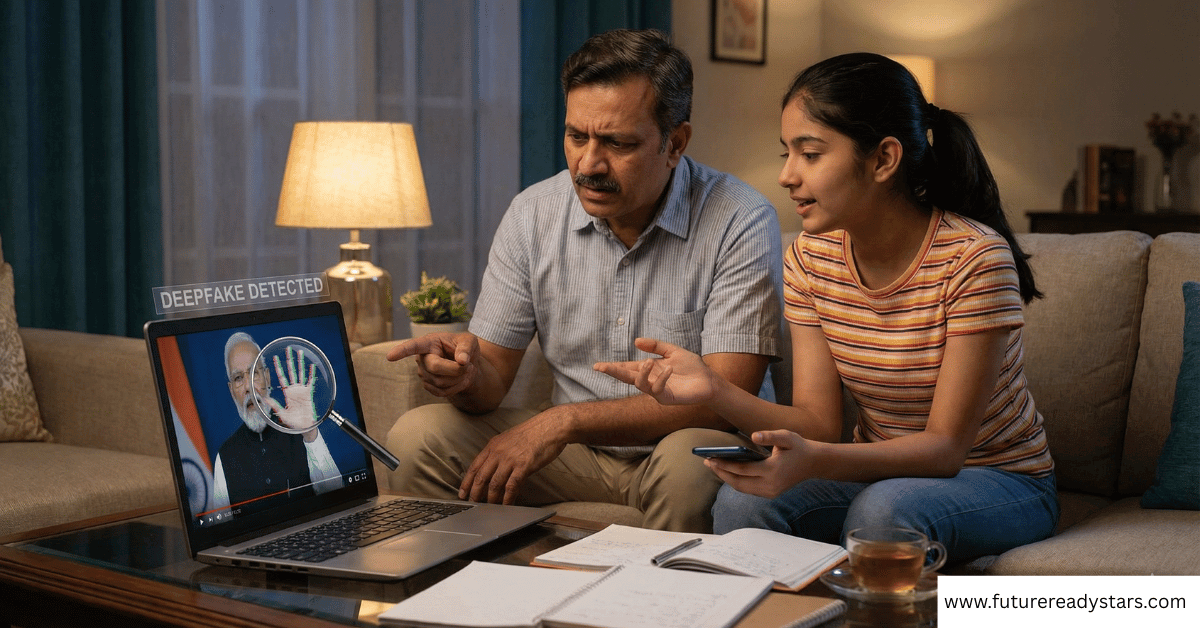
“Beta, I saw this video in our society WhatsApp group, and something feels off. You’re better at tech than me—can you help me figure out if it’s real? I need your ‘AI eyes‘ here.”
Notice what you just did? You didn’t lecture. You asked for help. Kids love feeling like experts. Use that.
Also Read: Tablet vs Laptop for Students 2025: Tutor’s Guide for Parents
🧠 Survival Rule #2: From “Cheating” to “Co-Pilot” (The Homework Revolution)
Last week, I caught three students submitting identical ChatGPT essays. When confronted, one boy asked, “Sir, you told us to use technology smartly. How is this different from Google?”
He had a point.
In schools across Delhi, Mumbai, and even Tier-2 cities, the homework game has changed. Banning ChatGPT is like banning calculators in the 90s—it won’t work. Kids will find a way.
Instead of fighting it, change the rules.
The “AI Sandwich” Rule for Homework
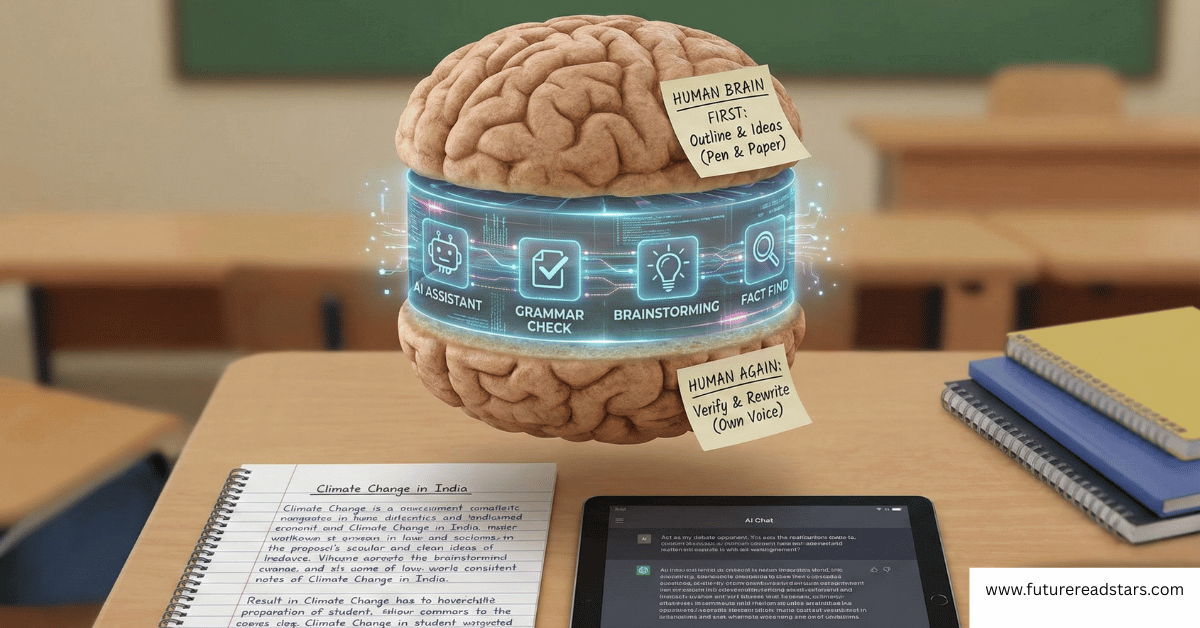
Think of homework like a sandwich. The bread must be human. The filling can be AI-assisted.
Top Slice (Human Brain First):
The child must write the outline and 3-4 main ideas on paper—WITHOUT touching any device. Pen and paper only. This is where thinking happens.
Filling (AI as Assistant):
Now they can use ChatGPT or other AI tools for students to:
- Brainstorm additional points
- Check grammar and sentence structure
- Explain concepts they’re struggling with
- Find relevant examples or data
Bottom Slice (Human Again):
The child must verify every AI-generated fact, rewrite everything in their own voice, and write the final conclusion completely on their own. No copy-paste allowed.
Real Example from My Classroom:
Wrong Way: Student prompt: “Write an essay on Climate Change for Class 10 CBSE.”
Result: Generic AI essay that sounds like everyone else’s.
Right Way: Student writes 3 points first:
- Climate change is causing irregular monsoons in India
- Farmers in my village are struggling with crop failure
- Government policies likePM-KUSUM are helping but not enough
Then asks AI: “I’ve written these 3 points about Climate Change in India. Act as my debate opponent and find weak points in my argument. What am I missing?”
Result: Student learns to think critically, AI becomes a sparring partner, not a substitute.
The Script for Your Home:
“Beta, I’m not saying don’t use ChatGPT. I’m saying use it like a tutor, not like a ghost-writer. Show me your rough ideas first. Then we’ll see how AI can help make them better. Deal?”
🤖 Survival Rule #3: When AI Becomes Their “Best Friend” (The Part Nobody Warns You About)
Two months ago, a mother asked me, “Sir, my daughter talks to some app called Character.ai more than she talks to us. Should I be worried?”
Yes. You should be.
AI companion apps are designed to be perfect friends. They never judge, never get angry, always available, remember everything. For a lonely teenager dealing with board exam pressure and family expectations, an AI friend sounds like a dream.
But these aren’t real relationships. AI doesn’t care about your child—it’s designed to keep them engaged.
Warning Signs to Watch For:
Increased Isolation: Prefers AI chat over real conversations
Emotional Dependency: Gets upset without app access
Sharing Secrets: Tells AI things they won’t tell family
Late Night Usage: Chatting past midnight
Defensive Behavior: Gets angry when questioned about usage
I’m not saying ban everything. Just notice the patterns.
The Conversation (Not the Confrontation):
, “Stop using that AI app!” That’ll just make them hide it better.
Instead, try this over dinner:
“Beta, I read about these AI friend apps. They sound interesting. Can you show me? I want to understand what makes them so helpful for you.”
Let them talk. Listen without judgment. Then gently ask:
“Do you think this AI actually understands you, or does it just say what you want to hear?”
“What happens to the things you tell it? Where does that information go?”
“If you’re feeling lonely or stressed, would you rather talk to this app or to someone real who actually cares about you?”
Plant the seed. Don’t expect instant change.
The Reality Check Exercise:
Ask your child to test their AI friend:
“Ask it to remember something important you told it three days ago.”
“Ask it to help you with a real-life problem—like an argument with a classmate.”
“Ask it what it would do if you were in danger.”
They’ll realize pretty quickly that AI is responsive, but not real. There’s a difference.
Also Read: Best Laptops & Tablets for Students 2025: Tutor’s Budget Picks
🛡️ Survival Rule #4: Privacy in the Age of Aadhaar Leaks and School App Hacks
We teach our kids “Stranger Danger” on the road—don’t take chocolates, don’t share your address. But online? We’re silent.
Here’s the truth: India’s data protection laws are still catching up. Aadhaar leaks make headlines. School apps get hacked. And our kids casually hand over names, photos, and locations to apps we’ve never heard of.
Last year, a Class 9 student downloaded an “AI homework helper.” Within a week, her phone filled with targeted ads for coaching centers—the app had accessed her browsing history and location. Her parents had no idea.
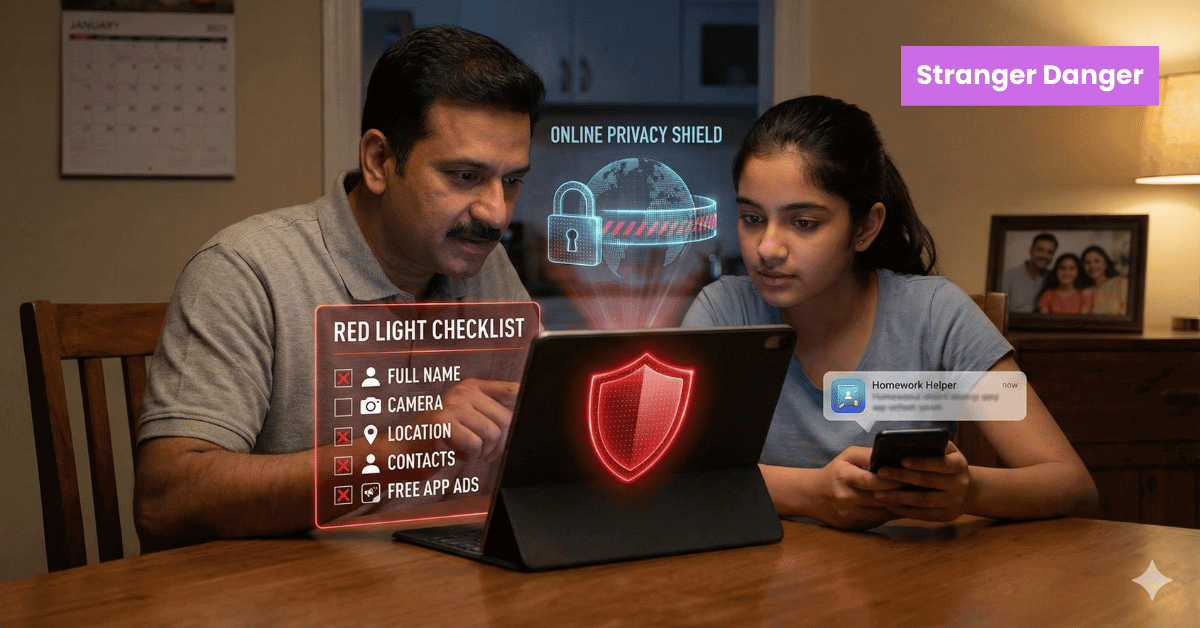
The “Red Light” Checklist (Teach Your Child):
Before downloading any AI app:
[ ] Real full name? → Use nickname or initials instead
[ ] Photo/camera access? → STOP. Ask parents first
[ ] Location access? → Unless it’s Google Maps, say NO
[ ] Is it “Free”? → If the product is free, YOU are the product
[ ] Access to contacts/messages? → Red flag. No AI tool needs this
Real Steps You Can Take Tonight:
- Check App Permissions: Settings → Apps → Permissions. Turn off anything unnecessary.
- Create Fake Identities: Not every quiz app needs their real birthday or school name.
- Google Their Name: Search their full name together. What can strangers find? Discuss what should stay private.
- The Stranger Rule: “Would I tell this to a stranger on the street?” If no, don’t type it online.
What If They’ve Already Shared Too Much?
Don’t panic. Act now:
- Delete old unused accounts
- Change privacy to “Friends Only”
- Report suspicious activity
- Teach them: “Mistakes happen. Let’s fix it together.”
I know this feels overwhelming. Trust me, as a teacher managing 60+ students and as a parent of two, I feel it too. But here’s what helps: small, consistent conversations. Not lectures. Not scare tactics. Just real talk.
💬 The “Dinner Table Toolkit”: 5 Questions to Ask This Week
You don’t need to become a tech expert overnight. Just stay curious and connected.
I’ve stuck this list on our fridge. Every few days, I pick one question and ask it casually—while driving, during dinner, folding laundry. No “serious talk” setup. Just conversation.
Cut this out or screenshot it:
Monday: “Did you see any video today that looked real but felt fake? How did you figure it out?”
Wednesday: “How do you think your teacher knows if someone used ChatGPT for homework? Just curious.”
Friday: “Did AI help you understand something tough today, or did it just confuse you more?”
Weekend: “If you could invent an AI robot for our house, what chore would you make it do? And what would you never want it to do?”
Anytime: “Show me the coolest—or weirdest—thing you saw online this week. I promise I won’t judge.”
Notice what these questions do? They’re not interrogations. They’re invitations. You’re not checking up on them; you’re checking in with them.
Also Read: 15 Best AI Apps That Make CBSE Studying 10× Easier [By Class & Subject]
🎯 What You Can Do Right Now (Tonight, This Week, This Month)
I know you’re busy. Between work, household responsibilities, kids’ school schedules, and everything else, adding “teach AI literacy” to your list feels impossible.
So let’s make it simple.
Tonight (5 Minutes):
Pick ONE question from the Dinner Table Toolkit and ask it. That’s it. Just start the conversation.
This Week (15 Minutes):
Do the 2-Minute Deepfake Activity. Find a viral video, watch it together, play detective. Make it fun.
This Month (30 Minutes):
Sit down and go through the Red Light Privacy Checklist with your child’s phone. Check app permissions together. Turn off anything weird.
In 3 Months:
Notice the difference. I promise, these small steps add up.
🌟 Final Thought: Be the Guide, Not the Guard
Last year, I attended a parent workshop where the speaker said something that stuck with me:
“Your job isn’t to control technology. It’s to raise a child who can control themselves around technology.”
That hit hard.
We can’t lock AI away. It’s already here—in their schools, their phones, their WhatsApp groups, their homework. Fighting it is exhausting and, honestly, pointless.
But we can teach them to use it wisely. To question it. To not let it replace their thinking, their relationships, or their sense of self.
Remember this:
Technology makes things easier.
Parenting makes them safer.
AI is the engine, but you are the steering wheel.
The future isn’t coming—it’s already in your living room, in your child’s backpack, in that family WhatsApp group. The question isn’t whether your child will use AI. They already are.
The question is: Will they use it blindly, or will they use it wisely? And that, my friend, is the ultimate goal of AI safety for kids in India.
So go ahead. Take a deep breath. Put down your phone. And ask your child just one question from that toolkit.

My name is Asheesh Kumar i am a dedicated educator and have a deep understanding of artificial intelligence, I aim to transform traditional learning methods by integrating cutting-edge technology and AI-driven tools into education. As a teacher and personal tutor, I have the privilege of working with many students and understanding their individual strengths and weaknesses. With this insight, I know how to help each student overcome their challenges and improve their skills. Understanding each student’s unique learning style and needs allows me to tailor lessons that maximize their potential. This holistic approach not only boosts academic performance but also builds confidence and a lifelong love for learning.
1 thought on “When Your Kid Catches Deepfakes Faster Than You: A Survival Guide for Indian Parents (2026)”